Start at the top for an easy introduction. Go further down for more detail and scholarship.
- Easy
- Intermediate
- Advanced
For young readers
In the summer of 1971, workers in the Korean city of Gongju were digging a ditch to stop rainwater leaking into an old royal tomb. Their shovels hit bricks. Behind the bricks was a doorway that no one had opened for more than 1,400 years.
Inside lay the tomb of King Muryeong of Baekje and his queen. Robbers had never found it, so everything was still there: golden crown decorations shaped like flames, gold earrings, gilt shoes, bronze mirrors, a sword decorated with a dragon, and thousands of beads.
At the entrance stood a small stone animal with a horn, like a guard dog, to protect the king. In front of it lay two flat stones with writing on them. They said that King Sama of Baekje died in 523 at the age of sixty-two and was buried two years later, and that the queen was buried with him in 529. This is the only tomb of an ancient Korean king where we know for certain who was buried inside.
The tomb itself is special too. It is built of thousands of bricks decorated with lotus flowers, in the style of tombs in southern China. The king’s and queen’s coffins were made of a kind of pine tree that grows only in Japan. So one tomb tells us that Baekje had friends in China and Japan at the same time.
Today the real tomb is closed to protect it, but visitors can see a life-size model next to it, and the treasures are shown in the Gongju National Museum.
At a glance
- Built
- For King Muryeong (d. 523, buried 525) and his queen (d. 526, buried 529)
- Place
- Songsan-ri, Gongju, South Chungcheong Province, South Korea (Baekje capital Ungjin)
- Type
- Brick-built chamber tomb with a barrel-vaulted roof, in the style of southern Chinese (Liang) tombs
- Chamber
- About 4.2 m long, 2.7 m wide and 2.9 m high, with an entrance passage
- Discovered
- 5 July 1971, by chance during drainage work; never looted
- Finds
- About 4,600 objects of 108 types in the original count (the Gongju National Museum’s revised reports catalogue 5,232); 12 groups designated National Treasures (1974)
- Key inscription
- Two epitaph stones naming “King Sama of Baekje, Great General Who Pacifies the East”, with a land-purchase contract
- Status
- Historic Site of Korea; part of the UNESCO World Heritage Site “Baekje Historic Areas” (2015)
Easy
What is the Tomb of King Muryeong?
The Tomb of King Muryeong is a royal grave on a low hillside at Songsan-ri in Gongju, a city in the west-central part of South Korea. In the early sixth century Gongju was called Ungjin and was the capital of Baekje, one of the three kingdoms of ancient Korea. The tomb belongs to a group of royal tombs now officially called the Tomb of King Muryeong and the Royal Tombs of Gongju.
King Muryeong ruled Baekje from 501 to 523. He restored the kingdom after a period of disaster, when Goguryeo had captured Baekje’s old capital near Seoul in 475 and several kings had been murdered. His son, King Seong, buried him here in 525, and the queen was laid beside him in 529.
The tomb is famous for three reasons. It was never robbed, so it gives a complete picture of a sixth-century royal burial. It contains inscribed stones that identify the king by name, which is extremely rare among ancient Korean tombs. And its bricks, coffins and grave goods show that Baekje was connected with southern China, Japan and even South-east Asia.
Easy
A walk inside the tomb
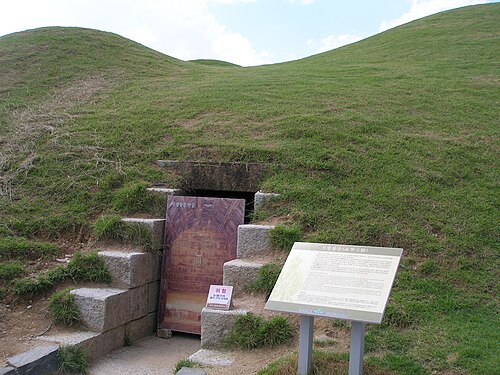
From outside, the tomb looks like a round earth mound. Beneath it, a sloping passage leads to a narrow entrance corridor and then to a rectangular burial chamber running north to south. Walls and roof are built of bricks, the roof curving over like a tunnel. Many bricks are stamped with lotus flowers, a Buddhist symbol of purity, arranged in repeating patterns.
In the walls are small niches shaped like arched windows, where lamps once burned. At the far end, raised brick platforms held the two wooden coffins, the king on the east side and the queen on the west. Under and around the coffins lay the objects the royal couple wore or took with them.
In the entrance passage stood a stone guardian beast, a sturdy four-legged creature with a single iron horn, facing outwards to keep evil away. In front of it were the two epitaph stones, and on top of them lay a string of Chinese bronze coins, as if paying for the land.
Easy
Treasures of a king and queen
The most famous objects are pairs of gold crown ornaments, cut from thin sheets of gold into shapes that look like rising flames or plants, and hung with tiny gold discs that shimmered when the wearer moved. Museum analysis shows they were made of almost pure gold. They were probably attached to a cloth or silk cap.
The king wore gold earrings, a belt of gold and silver plaques and gilt-bronze shoes almost 40 centimetres long, too big and delicate for walking: they were made for the funeral. Beside him lay a sword whose ring-shaped pommel holds a dragon, a symbol of royal power. The queen had a silver bracelet engraved with the name of its maker, a craftsman called Dari, and a wooden headrest and footrest painted red and decorated with gold.
There were also bronze mirrors decorated with the animals of the four directions and Daoist immortals, Chinese celadon jars, lamps and many glass beads. The finds have been counted in different ways: the original count was about 4,600 objects, and the Gongju National Museum’s revised reports catalogue 5,232. They are now displayed in the Gongju National Museum.
Intermediate
The epitaph stones and the land contract
The two stones, each about 35 by 41 centimetres, are written in Chinese characters in an elegant hand that shows southern Chinese calligraphic influence. The king’s stone begins with his Chinese title, “Great General Who Pacifies the East” (寧東大將軍), followed by “Sama, King of Baekje”. It records that he died at the age of sixty-two in the gyemyo year (523), in the fifth month, and was laid in the great tomb in the eulsa year (525), in the eighth month.
Another inscription is a land-purchase contract (maejigwon). It states that, with ten thousand coins, the king bought the grave plot from the gods of the earth and the officials of the underworld. This was a Chinese funerary custom in which the dead were given a legal title to their grave, protecting them from spirits and later claimants. It is the only such contract known from a Three Kingdoms tomb. The queen’s epitaph, added when she was buried, records that she died in 526, that mourning was held for her in a western location, and that she was placed in the tomb in 529.
These texts do several things at once. They identify the tomb with certainty. They confirm and refine the dates in the Samguk sagi, which says Muryeong died in the fifth month of 523. They show that his personal name was Sama (斯麻), a name the Japanese chronicle Nihon shoki also gives as Shima. And they show that his Chinese title, granted by the Liang emperor in 521, was used even in the tomb, as part of how the king presented himself in death.
The gap between death and burial, about twenty-seven months for both king and queen, matches a Confucian three-year mourning period as counted in China. In 1996 archaeologists excavated a building complex at Jeongjisan in Gongju, west of the old palace area, that many scholars identify as the place where the royal bodies lay in state during this period.
Intermediate
How it was built: a Chinese tomb in Baekje
Before the Ungjin period, Baekje’s royal tombs were stepped stone mounds or stone-chamber tombs. Muryeong’s tomb uses a completely different technique. Its builders made thousands of fired bricks in several shapes, some wedge-shaped for the vault, many with moulded lotus patterns, and laid them in alternating courses of flat and upright bricks. The barrel vault, the lamp niches and the arrangement of the platforms all have close parallels in brick tombs of the Six Dynasties, especially the Liang dynasty around Nanjing.
This did not happen by accident. Baekje sent envoys to Liang in 512 and 521, and the Liang history records that Muryeong informed the Liang court that Baekje had “again become a strong country”. It is likely that Baekje obtained brick-making knowledge, and perhaps craftsmen, through these contacts. Nearby Songsan-ri Tomb No. 6, another brick tomb of the same period, has wall paintings of the Four Guardian animals, a southern Chinese theme; a brick reported from it bears an inscription usually read as saying that it was made on the model of Liang official tiles.
Yet the tomb is not a simple copy. Its proportions, the colour patterns of the bricks and the way the lamps were placed show local choices, and the grave goods mix Chinese imports with objects made in Baekje style. Archaeologists therefore describe it as a Baekje adaptation of a southern Chinese model, created at a time when the court wanted to display its international connections.
Only a few brick tombs are known in Korea, all around Gongju, and after the move to Sabi in 538 the Baekje royal family returned to stone-chamber tombs, as seen at Neungsan-ri in Buyeo. The brick tombs of Gongju thus mark a short, intense moment of southern Chinese influence.
Intermediate
Objects from three seas: China, Japan and beyond
The grave goods map Baekje’s connections. From southern China came celadon vessels, probably from kilns in the Yue or Hongzhou regions, as well as bronze coins of the Liang wuzhu type laid on the epitaph stones, and perhaps some of the bronze mirrors. The epitaphs and land contract themselves follow Chinese funerary forms.
The coffins were made of Japanese umbrella pine (koyamaki, Sciadopitys verticillata), a tree that grows naturally only in Japan. The wood must have been shipped across the Korea Strait, presumably as a prestige gift or through exchange between the Baekje and Wa elites. Umbrella pine coffins have also been identified in other Baekje royal tombs, and archaeologists compare the tomb’s bronze vessels and burial customs with those of contemporary Japanese tombs such as Takaidayama in Osaka.
Scientific studies of glass beads from the tomb suggest that some glass came from South-east or South Asian sources, which may indicate indirect exchange with the maritime world around Funan and the Bay of Bengal. Such results are still being refined, but they show that a sixth-century Korean court sat at the edge of a trading world that reached the Indian Ocean.
The Nihon shoki adds a personal link: it says Muryeong was born on an island called Kakara in Tsukushi (northern Kyushu) while his family was travelling to Wa, and was therefore named Shima (“island”). Historians treat this story cautiously, but the tomb’s Japanese coffin wood gives material form to the close relations between Baekje and Wa in his time.
Intermediate
Meanwhile in the world
The years in which the tomb was built and closed, 525 to 529, were busy ones across Eurasia. In Constantinople Justinian I became emperor in 527 and in 529 issued the first version of his Code, the start of the great compilation of Roman law later known as the Corpus Juris Civilis. In the same period, Benedict of Nursia is traditionally said to have founded the monastery of Monte Cassino in Italy (around 529), and the Sasanian empire under Kavad I was troubled by the Mazdakite movement before Khosrow I took the throne in 531.
In China, the Liang emperor Wu, whose court had given Muryeong his title, offered himself to the Tongtai temple for the first time in 527. In the kingdom of Silla, Muryeong’s eastern neighbour, the courtier Ichadon was martyred in 527 or 528, clearing the way for King Beopheung to accept Buddhism. In Japan, the Iwai rebellion broke out in northern Kyushu in 527, close to the island where the Nihon shoki says Muryeong was born.
The tomb’s Chinese-style brickwork and its coffins of Japanese umbrella pine are direct evidence of the Baekje court’s place in an East Asian network of envoys, craftsmen and trade. A century later in eastern England, the ship burial at Sutton Hoo shows another royal family using imported treasures to display status in death; the two burials had no connection, but comparing them shows how rulers far apart turned foreign goods and styles into signs of power.
Intermediate
Discovery and a hurried excavation
The discovery was an accident. In July 1971 workers were digging a drainage channel behind the mound of Tomb No. 6 to stop water seeping into it. On 5 July they struck the brick wall of a previously unknown tomb. The entrance was opened on 7 July, and news spread quickly.
Under pressure from crowds, journalists and officials, the excavation team decided to clear the chamber at once. Working through the night, they removed the contents in a very short time, far faster than modern standards would allow. Many small objects were collected in bulk, and the positions of many finds were not recorded precisely. The team leader, the archaeologist Kim Won-yong, later described the excavation as a serious mistake and a lesson for Korean archaeology.
Despite this, the finds transformed the study of Baekje. The excavation report appeared in 1973, and specialists have since restudied the objects, the textiles, the wood and the glass. Recent studies have tried to reconstruct the funeral step by step from the surviving records, photographs and objects.
The tomb was open to visitors for many years, but humidity, algae and visitors’ breath threatened the bricks, and in 1997 it was closed permanently. A full-scale replica in a nearby exhibition hall now allows visitors to see the interior.
Advanced
Different perspectives
Whose son was Muryeong? The Samguk sagi calls him the second son of King Dongseong. The Nihon shoki, citing a lost Baekje chronicle, makes him the son of King Gaero or of Gaero’s brother Gonji, which would make him Dongseong’s half-brother. The epitaph gives his age at death as sixty-two, which places his birth in 462 and fits the Nihon shoki’s chronology better than the Samguk sagi’s. Korean and Japanese historians continue to debate the genealogy, and the question matters because it affects how the troubled succession of the Ungjin period is understood.
Muryeong and Japan. The Nihon shoki story of his birth on Kakara island has been embraced in both countries, and a monument and festival mark the site in Saga Prefecture. In 2001 Emperor Akihito remarked that the mother of Emperor Kanmu (r. 781–806) was descended from King Muryeong, according to the Shoku Nihongi, and that he felt a kinship with Korea. Many Koreans welcomed this as recognition of Baekje’s role in Japanese history. Some Japanese commentators downplayed it, while historians in both countries stress that the statement refers to a documented genealogy of an eighth-century consort, not to the origins of the imperial line as a whole.
Imitation or creativity? Early scholarship often described the tomb as a straightforward copy of a Liang tomb, sometimes with the implication that Baekje culture was derivative. Korean scholars have emphasised instead the selective, local reworking of southern Chinese models, and archaeologists in Korea, China and Japan now tend to present the tomb as evidence of a shared East Asian elite culture in which each court combined imported and local forms. Similarly, the Japanese umbrella pine coffins have been read variously as tribute from Wa, as a gift within a Baekje-dominated exchange, or as trade between equals; the wood alone cannot decide between these views.
The ethics of 1971. The rushed excavation is now widely cited in Korean heritage education as an example of what not to do. It raises broader questions that are debated worldwide: how quickly archaeologists should excavate intact royal tombs, whether some should be left unopened, and how public and political pressure should be handled. Korea has since generally avoided opening other intact royal tombs such as the largest mounds in Gyeongju.
Advanced
What the tomb tells historians
Because the tomb is dated precisely, it has become a chronological anchor for East Asian archaeology. Objects found in it, such as its crown ornaments, earrings, swords and ceramics, allow similar objects in undated tombs in Korea and Japan to be placed in time. Japanese archaeologists, for example, use comparisons with the Muryeong finds when dating Kofun-period tombs in the early sixth century.
The epitaphs are among the earliest dated Baekje texts and a source for Baekje’s use of Chinese titles, calendrical terms and funerary ideas. The directional chart on the back of the king’s stone, combining the heavenly stems, earthly branches and trigrams, shows knowledge of Chinese cosmology, and the phrase recording mourning in the “western” direction has been used to locate the temporary mortuary at Jeongjisan.
At the same time, the tomb cannot tell us everything. The haste of 1971 means that the original placement of many items is uncertain; debates about which objects belonged to the king and which to the queen, or what was placed in 525 and what in 529, depend partly on photographs and memories. The bodies themselves did not survive, so there are no human remains to study. Historians must combine the tomb with the written record of the Samguk sagi, the Liang history and the Nihon shoki, while remembering that each of those texts had its own purposes.
Key ideas
- An identified royal tomb
- The epitaph stones make this the only ancient Korean royal tomb whose occupants are named with certainty.
- Brick tomb from southern China
- Its barrel-vaulted brick chamber follows Liang models, reworked by Baekje builders.
- Land-purchase contract
- A Chinese funerary custom by which the dead bought their grave from the gods of the earth.
- International grave goods
- Chinese ceramics and coins, Japanese coffin wood and foreign glass show Baekje’s wide networks.
- Temporary burial and mourning
- About 27 months passed between death and burial, matching Chinese-style mourning; Jeongjisan may be where the bodies lay in state.
- Chronological anchor
- Its precise dates allow similar objects in Korea and Japan to be dated.
Records
- 462 CE — Birth of Sama, the future King Muryeong, as calculated from his epitaph.
- 475 CE — Goguryeo captures Hanseong; Baekje moves its capital to Ungjin (Gongju).
- 501 CE — Muryeong becomes king of Baekje.
- 521 CE — Liang grants Muryeong the title “Great General Who Pacifies the East”.
- 523 CE — Muryeong dies at 62 in the fifth month.
- 525 CE — The king is buried in the brick tomb; the land contract is dated to this year.
- 526 CE — The queen dies.
- 529 CE — The queen is buried beside the king.
- 538 CE — Baekje moves its capital to Sabi (Buyeo).
- 1971 — The tomb is discovered on 5 July during drainage work and excavated within days.
- 1974 — Twelve groups of finds are designated National Treasures.
- 1997 — The tomb is permanently closed to the public for conservation.
- 2015 — Inscribed on the UNESCO World Heritage List as part of the Baekje Historic Areas.
Glossary
- Baekje
- A kingdom in south-western Korea (traditionally 18 BCE–660 CE).
- Ungjin
- Baekje’s capital from 475 to 538, modern Gongju.
- Epitaph stone (jiseok)
- A stone placed in a tomb recording the name and dates of the dead.
- Land-purchase contract (maejigwon)
- A text buying the grave site from the gods of the earth.
- Barrel vault
- A curved, tunnel-shaped roof built of bricks or stones.
- Stone guardian beast (jinmyosu)
- A sculpted animal placed in a tomb to ward off evil.
- Celadon
- Stoneware with a grey-green glaze, made in China from early times.
- Liang
- A southern Chinese dynasty (502–557) with its capital at Jiankang (Nanjing).
- Umbrella pine (koyamaki)
- A conifer native only to Japan, whose wood was used for the royal coffins.
Questions and answers
How do we know it is King Muryeong’s tomb?
Two stones inside the tomb name him as “Sama, King of Baekje” and give the dates of his death and burial.
Why was it never robbed?
It lay hidden behind and below the neighbouring tomb’s mound, so robbers did not notice it. It was found only by chance in 1971.
Can I go inside?
No. It was closed in 1997 to protect it, but there is a full-size replica next to it and the treasures are in the Gongju National Museum.
Why were the coffins made of Japanese wood?
The umbrella pine grows naturally only in Japan, so the wood was brought across the sea, showing close ties between Baekje and Wa. Whether it was a gift, tribute or trade is debated.
Why did the burial take place two years after the king died?
The body lay in a temporary mortuary for about 27 months, following Chinese-style mourning customs.
What mistakes were made in the 1971 excavation?
The chamber was emptied within a very short time under public pressure, so the exact positions of many objects were not recorded. The team leader later called it a lesson for Korean archaeology.
What does the tomb tell us about Baekje and southern China?
Its brick architecture, coins, celadon and epitaph customs show close ties with the Liang dynasty, which had granted Muryeong a Chinese title in 521.
Sources and further reading
- 무령왕릉 (Tomb of King Muryeong). Encyclopedia of Korean Culture, Academy of Korean Studies
- 무령왕릉 지석 (Epitaph stones from the Tomb of King Muryeong). Encyclopedia of Korean Culture, Academy of Korean Studies
- 공주 정지산 유적 (Jeongjisan site, Gongju). Encyclopedia of Korean Culture, Academy of Korean Studies
- Ungjin Baekje Hall (Permanent Exhibition). Gongju National Museum
- Kwon Ohyoung, Cultural Exchange and International Interaction in East Asia as Seen through the Tomb of King Muryeong. Journal of Korean Art and Archaeology, vol. 16, 2022
- Kang Wonpyo, Research on the Excavation and Investigation of the Tomb of King Muryeong. Journal of Korean Art and Archaeology, vol. 16, 2022
- Tomb of King Muryeong. Wikipedia
- Muryeong of Baekje. Wikipedia
- Emperor Wu of Liang. Wikipedia
Related
- King Seong of BaekjeThe 26th king of Baekje (r. 523–554), who moved the capital to Sabi, made Baekje a bridge between Liang China and Japan, and died in battle against Silla.
- IchadonA young official of King Beopheung of Silla whose martyrdom, according to tradition, led the kingdom to accept Buddhism in 527.
- Sutton HooAn early 7th-century royal cemetery in eastern England whose Mound 1 held a 27-metre ship burial filled with gold, garnet jewellery and Byzantine silver.
- Corpus Juris CivilisThe body of Roman law compiled in 529–534 on the orders of Emperor Justinian I, later the foundation of the civil-law tradition in Europe and far beyond.
- Gyeongju Historic AreasFive zones of palace grounds, royal tombs, temple sites, carved Buddhas and fortresses preserving the capital of the Silla kingdom, inscribed as a World Heritage property in 2000.
Written with AI assistance from the published sources listed above, and revised as new research appears.