Start at the top for an easy introduction. Go further down for more detail and scholarship.
- Easy
- Intermediate
- Advanced
For young readers
More than 400 years ago, from 1592 to 1598, Japan fought a long war in Korea, which was then the kingdom of Joseon. China, then called Ming, sent armies and ships to help Korea. In 1598 the Japanese ruler Toyotomi Hideyoshi died, and the Japanese leaders decided to bring their soldiers home.
But one Japanese general, Konishi Yukinaga, was stuck in a fort at Suncheon on the south coast. Korean and Chinese warships, led by the Korean admiral Yi Sun-sin and the Chinese admiral Chen Lin, were blocking the sea in front of his fort, so his army could not sail away.
Other Japanese generals, led by Shimazu Yoshihiro, gathered hundreds of ships and sailed west to rescue him. Their way led through Noryang, a narrow channel between Namhae Island and the mainland. Yi Sun-sin and Chen Lin sailed through the night to meet them there.
The battle began in the dark and went on after sunrise. Cannons boomed, burning arrows flew, and ships crashed into each other. Many Japanese ships were burned or captured, and the rest turned back. While Yi was chasing them, he was hit by a bullet. Old records say he told the people next to him: “The battle is at its height. Do not tell anyone that I am dead.”
Yi Sun-sin died, and so did an old Chinese general, Deng Zilong. While everyone was busy fighting, Konishi’s army escaped by another route. A few days later the last Japanese soldiers sailed home from Busan, and the long war was over. Koreans still remember Yi Sun-sin as their greatest hero.
At a glance
- Date
- Night of the 18th to the 19th day of the 11th lunar month of 1598 (Joseon calendar) = 15–16 December 1598 (Gregorian, converted with the Korea Astronomy and Space Science Institute table); the fighting began before dawn on 16 December and went on into the morning. Japanese accounts give the 18th day of the 11th month in the Japanese calendar, which corresponds to the same Gregorian day as the Joseon calendar’s 19th
- Place
- The Noryang Strait between Namhae Island and the mainland (today’s Namhae and Hadong counties, South Gyeongsang Province), with the last fighting near Gwaneumpo bay on Namhae Island
- War
- Second Japanese invasion (Jeongyu War, 1597–1598) of the Imjin War, during the Japanese withdrawal after the death of Toyotomi Hideyoshi
- Commanders
- Joseon: Yi Sun-sin, naval commander of the three southern provinces (killed) / Ming: Chen Lin, with Deng Zilong (killed) and other officers / Japan: Shimazu Yoshihiro, with Tachibana Muneshige, Sō Yoshitoshi, Terazawa Masanari and others
- Forces
- Joseon: 82 panokseon warships and about 8,000 men according to English Wikipedia, which follows Samuel Hawley / Ming: 63 ships besides two panokseon lent by Yi, with 5,000 men of the Guangdong squadron and 2,600 marines aboard Korean ships (same source); the allied fleet is put at about 150 ships (English Wikipedia) or over 200 (Encyclopedia of Korean Culture) / Japan: over 300 ships according to Yi Deok-hyeong’s report to the court, about 500 according to the Encyclopedia of Korean Culture and English Wikipedia
- Losses
- Japan: over 200 ships destroyed and several thousand killed or wounded according to Yi Deok-hyeong’s report; Chen Lin’s messenger reported 200 ships burned, 100 captured, 500 heads taken and over 180 prisoners; Japanese accounts give differing claims rather than a reliable total / Joseon: about ten commanders, including Yi Sun-sin, reported killed by gunfire / Ming: Deng Zilong and others killed
- Result
- Joseon–Ming victory at sea: the Japanese relief fleet suffered heavy losses and fell back east. But Konishi Yukinaga’s army left Suncheon by another route during the battle, and the Japanese completed their withdrawal from Busan in late December 1598
- Main sources
- Veritable Records of King Seonjo (reports of the 21st–29th days of the 11th month, including Yi Deok-hyeong’s report and a historian’s comment), Revised Annals of King Seonjo, Yu Seong-ryong’s Jingbirok, the Ming History; Japanese clan records as summarised in modern works
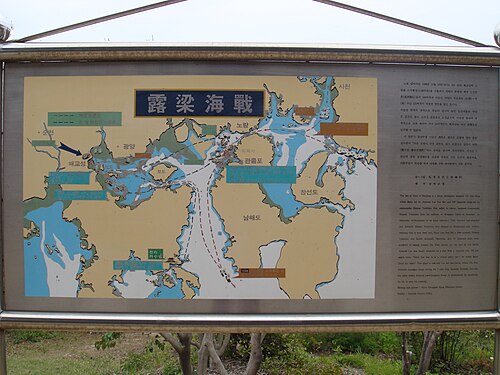
On the map
Meanwhile elsewhere in the world
Other subjects in this library from around the same years, in distant parts of the world.
- Benin Bronzesc. 1300–1897 · Benin City (Kingdom of Benin)
- William Shakespeare1589–1613 · London (England)
- Akbar1556–1605 · Fatehpur Sikri (Mughal Empire)
- Selimiye Mosque1568–1575 · Edirne (Ottoman Empire)
- Florentine Codexc. 1545–1577 · Tlatelolco, Mexico City (New Spain)
- Nzinga of Ndongo and Matamba1624–1663 · Ndongo and Matamba (Mbundu kingdoms, present-day Angola)
Easy
What happened at Noryang?
The Battle of Noryang was the last major battle of the Imjin War, the Japanese invasions of Korea that began in 1592 and resumed in 1597. It was fought at sea in the night of the 18th to the 19th day of the 11th lunar month of 1598. Converted with the table of the Korea Astronomy and Space Science Institute (KASI), the fighting began before dawn on 16 December 1598. The Encyclopedia of Korean Culture dates the battle to the 18th and 19th days of the 11th month.
The background was the Japanese withdrawal. Toyotomi Hideyoshi, who had launched the invasions, died in September 1598, and the Japanese leadership decided to bring its armies home. The westernmost Japanese army, under Konishi Yukinaga at Suncheon, could not leave because a combined Joseon and Ming fleet was blockading the sea in front of its fort. Other Japanese commanders, led by Shimazu Yoshihiro, gathered a fleet on the coast to the east and sailed west to relieve Konishi. Their route ran through the Noryang Strait, a narrow channel between Namhae Island and the mainland.
The Joseon admiral Yi Sun-sin and the Ming admiral Chen Lin moved east through the night to meet them. The battle began in the dark and continued past dawn: the allies used cannon and fire arrows, crews threw burning material onto enemy decks, and in places the ships fought at close quarters. By morning the Japanese fleet had lost many ships and was retreating east. During the pursuit Yi Sun-sin was hit by a bullet and died; according to Yu Seong-ryong’s Jingbirok and the Revised Annals of King Seonjo, he told those near him not to announce his death while the battle was still being fought. The Ming commander Deng Zilong was also killed.
The victory was not complete. While the fleets fought at Noryang, Konishi’s army left Suncheon by another route, and in late December 1598 the last Japanese forces sailed home from Busan. Noryang was therefore the last major battle of the war, but not a formal end to it: there was no peace treaty, and relations between Korea and Japan were restored only in 1607–1609. The later sections of this page look at how the battle came about, what the sources say, and where they disagree.
Easy
Rebuilding a navy: Gogeumdo and the alliance with Chen Lin
A year before Noryang the Joseon navy had almost ceased to exist. In August 1597 the fleet under Won Gyun was destroyed at Chilcheollyang, and Yi Sun-sin, who had been dismissed and imprisoned earlier that year, was reappointed with only a handful of ships. In October 1597 he defeated a much larger Japanese fleet in the narrow Myeongnyang Strait. According to the Encyclopedia of Korean Culture, he then based himself on Bohwado (Gohado, near Mokpo), and in the 2nd lunar month of 1598 (March) moved his headquarters to the island of Gogeumdo, in today’s Wando County.
Gogeumdo became the base where the navy was rebuilt. Jingbirok says that Yi had over 8,000 men there, and that to feed them he issued sea passes: refugee boats sailing along the coast had to obtain a pass by paying rice, three seok for a large boat, two for a medium one and one for a small one. In ten days he collected over 10,000 seok of grain. He also had people bring copper and iron to cast cannon and cut timber to build ships, and refugees settled around the base. The Encyclopedia of Korean Culture adds that at Gogeumdo he had military farmland cultivated and sold fish and salt, and a historian’s comment in the Veritable Records credits him with the same measures after his reappointment.
In 1598 a Ming fleet joined him. Its commander, Chen Lin, came from Guangdong and had made his career fighting rebels and pirates in southern China. The Ming History describes him as a capable commander who was also greedy wherever he went and was repeatedly impeached. He was sent to Korea with 5,000 troops from Guangdong, and in 1598 he was put in charge of the Ming naval forces; that year his fleet came south and joined Yi at Gogeumdo.
Jingbirok tells the story of the alliance in two parts. When King Seonjo saw Chen Lin off from Seoul, Yu Seong-ryong watched Chen’s men beat a local official and feared that Chen would interfere with Yi’s command. But Yi welcomed Chen with a great feast, and when Korean ships took forty heads in a skirmish, he gave them all to Chen as his credit. Chen, Jingbirok says, came to consult Yi on everything and wrote to the king that Yi had “the talent to order heaven and earth and the merit of mending the sky and bathing the sun”. Not every account is so harmonious: Korean Wikipedia’s article on Chen Lin describes disputes between the two men over credit and operations before Noryang. Both accounts agree that, by the end of 1598, the two fleets were operating together.
Easy
Hideyoshi’s death and the four-route offensive
In 1598 the Japanese armies held a chain of forts (wajō) along Korea’s south coast, from Ulsan in the east to Suncheon in the west. Katō Kiyomasa held Ulsan, Shimazu Yoshihiro held Sacheon in the centre and Konishi Yukinaga held Suncheon. The forts were built on the sea so that they could be supplied by ship from Japan. A first allied siege of Ulsan in January and February 1598 had failed.
Toyotomi Hideyoshi died at Fushimi Castle on 18 September 1598 (the 18th day of the 8th month of Keichō 3). His heir, Hideyori, was five years old. According to English Wikipedia, the Council of Five Elders who now governed in Hideyori’s name kept the death secret to preserve morale and ordered the armies in Korea to return home. News of the death reached the Joseon court late and in conflicting forms. In a report recorded in the 11th lunar month (December), a Korean commander relayed returning captives’ claim, which was wrong, that Hideyoshi had died in the 7th month; they also said that Tokugawa Ieyasu was directing affairs. The notice Katō Kiyomasa left when he abandoned Ulsan stated correctly that Hideyoshi had died in the 8th month.
Meanwhile the Ming and Joseon allies launched their largest offensive of the second invasion. Jingbirok and the Encyclopedia of Korean Culture describe a “four-route” plan (saro byeongjin): the Ming supreme commander Xing Jie sent Ma Gui against Ulsan in the east, Dong Yiyuan against Sacheon in the centre and Liu Ting against Suncheon in the west, while Chen Lin attacked by sea. Korean troops fought alongside each army. Jingbirok sums up the result in a few words: all the attacks failed, and Dong Yiyuan’s army was defeated with the heaviest losses. At Sacheon, in October, the attack collapsed after a fire broke out in the Ming camp and Shimazu’s garrison sallied out.
At Suncheon, Liu Ting’s army attacked by land from about 19 October, while Yi Sun-sin and Chen Lin attacked from the sea. Japanese Wikipedia, summarising Japanese and Korean records, says that Liu first tried to lure Konishi to a peace meeting in order to capture him, but the ambush was sprung too early; that a full assault by land and sea failed with heavy Ming losses; and that a night attack by the Ming fleet ended with many Ming ships stranded on the falling tide and burned. In November Liu Ting pulled back his army, and the allied fleet withdrew to Gogeumdo for a time before returning to blockade Suncheon from the sea.
Easy
Konishi trapped: deals, gifts and a boat
Konishi’s fort at Suncheon, which Korean records call Waegyo, held about 13,700 men from the forces of five lords, according to Japanese Wikipedia: Konishi himself, Matsura Shigenobu, Arima Harunobu, Gotō Harumasa and Ōmura Yoshiaki. As the order to withdraw spread, other garrisons began to leave. Yi Chung-won, the Korean officer attached to the Ming general Dong Yiyuan, reported that the Japanese at Dongyangchang on Dong’s front had begun to withdraw on the 17th day of the 11th month and that some seventy ships had crossed the sea the next day; Katō Kiyomasa abandoned Ulsan. But Konishi could not sail out while the allied fleet held the sea in front of his fort.
Konishi tried to talk his way out. Korean officials accused Liu Ting of making a private bargain with him: royal secretaries told the king that Liu had sent hostages to the Japanese and deliberately let them go, and that he had stopped Chen Lin from cutting the sea route. When Katō left Ulsan, he posted a notice addressed to the Ming generals, which the Korean governor of Gyeongsang copied to the court. In it Katō claimed that Konishi had agreed with the Ming generals to make peace among the three countries and that hostages were to be sent to him, and accused the Ming of breaking that agreement by besieging Konishi.
At sea Konishi turned to Chen Lin. According to the Encyclopedia of Korean Culture, Konishi sent Chen bribes and asked him to open a way of retreat, and Chen let one Japanese messenger boat pass, telling Yi afterwards. The encyclopedia says that Konishi used the boat to contact Shimazu Yoshihiro at Sacheon, intending to have the relief fleet attack the allied fleet from behind. The historian’s comment in the Veritable Records tells a related story: one evening four Japanese left by boat, and Yi told Chen that they must have gone to ask for help and that a large force would soon arrive. Chen at first refused to go out to meet it, but agreed when Yi pleaded with him in tears.
The relief force was large. Left State Councillor Yi Deok-hyeong reported from the south that more than 300 Japanese ships from Sacheon, Namhae and Goseong reached Noryang on the 19th day of the 11th month. Jingbirok and the Revised Annals say that Konishi asked for help from the commander at Sacheon, whom Korean records call Sim Andon-o (沈安頓吾), that is, Shimazu. Japanese Wikipedia lists the commanders who sailed to rescue Konishi as Shimazu Yoshihiro, Tachibana Muneshige, Sō Yoshitoshi, Takahashi Munemasu, Kobayakawa Hidekane, Chikushi Hirokado and Terazawa Masanari.
Easy
The night battle in the strait: 15–16 December 1598
The Noryang Strait is the narrow channel that separates Namhae Island from the mainland near Hadong. A fleet sailing west from Sacheon or Goseong towards Suncheon had to pass through it or go round the south of Namhae. According to the historian’s comment in the Veritable Records, the allied fleets rowed through the night and reached Noryang before dawn, where they found the Japanese fleet arriving. The Encyclopedia of Korean Culture quotes the prayer Yi is said to have made that night, as recorded in later accounts: “If only this enemy can be destroyed, I will have no regret even in death.”
The fighting began in the small hours; English Wikipedia puts the start at about 2 a.m. The allies used cannon and fire arrows, and the ships came so close that Joseon crews could throw burning wood onto the decks of Japanese ships. The Japanese answered with heavy arquebus fire and tried to board. The fleets became mixed up in the narrow water, and at one point Chen Lin’s flagship was surrounded; in Jingbirok and the Revised Annals it was rescued by Yi’s ship, which was by then led by Yi’s nephew Yi Wan.
The Ming History describes the death of Deng Zilong, a Ming veteran it says was over seventy years old. Chen Lin had sent him with Yi Sun-sin to lead the vanguard with 1,000 men in three large ships. Eager to win the first honours, Deng jumped with 200 men onto a Korean ship and charged the enemy, but another allied ship mistakenly threw fire weapons into his ship, which caught fire, and the Japanese closed in and killed him.
The Japanese also suffered heavily. Japanese Wikipedia, summarising Japanese clan records, says that Shimazu Yoshihiro’s own ship fell behind and was nearly boarded, and was saved only by the musket fire of his retainers and other ships coming to help; a detachment under Kabayama Hisataka was cut off, ran aground in Gwaneumpo bay and had to cross Namhae Island on foot. By morning the Japanese fleet was retreating east along the south side of Namhae. Yi Deok-hyeong reported that bodies, broken planks, weapons and clothing covered the sea so thickly that the water could not flow and that the sea was red.
Intermediate
The deaths of Yi Sun-sin and Deng Zilong
Yi Sun-sin was killed in the morning, during the pursuit. The Revised Annals say that he chased the enemy to the edge of Namhae, fought in person exposed to arrows and stones, and was struck in the chest by a flying bullet. Those around him helped him into the curtained shelter (帳中), and he said: “The battle is at its height. Take care not to say that I am dead” (戰方急,愼勿言我死). With these words he died. Jingbirok gives the same words and adds that the bullet passed through his chest and out of his back. He was 53.
In the same two accounts, his nephew Yi Wan hid the death and kept urging the fleet on in Yi’s name, so that the men did not know. When Chen Lin’s ship was surrounded, Yi Wan led the rescue. Chen sent a man to thank Yi and only then learned that he was dead; according to Jingbirok, he threw himself from his chair to the floor, crying, “I thought the old master was alive and coming to save me. Why has he died?”, and beat his chest and wept. The Korean and Ming soldiers wept in camp after camp.
The historian’s comment attached to Yi Deok-hyeong’s report in the Veritable Records tells the scene differently. It does not record any last words. It says that Yi was shot while shooting arrows at the enemy, that his son was about to wail and the soldiers were alarmed, and that a man named Yi Mun-uk, who was beside him, stopped the crying, covered the body with clothing and beat the drum to advance. The soldiers fought on thinking Yi was alive, and people said that “the dead Sun-sin defeated the living enemy”. Korean Wikipedia identifies Yi Mun-uk with Son Mun-uk, a former captive who had served on the Japanese side. Some popular modern versions add more words, about beating the drums or wearing his armour; these are not in the court records or Jingbirok used here.
Yi was not the only Korean commander to die. Yi Deok-hyeong reported that Yi Sun-sin, the Garipo commander Yi Yeong-nam, the Nagan magistrate Bang Deok-ryong, the Heungyang magistrate Go Deuk-jang and others, about ten in all, were killed by bullets. On the Ming side, the Ming History compresses the story: it says that Deng Zilong died fighting and that Yi Sun-sin, going to his rescue, died as well.
Intermediate
Konishi’s escape and the last ships from Busan
The battle did not stop Konishi. Yi Deok-hyeong reported that when Konishi saw the Japanese fleet defeated he fled to the open sea, and that Japanese troops who had stayed in their camps abandoned them, leaving behind the grain they had piled on the shore of Namhae. Jingbirok says that while the allied fleet was pursuing the enemy past his camp, Konishi slipped away behind it. English Wikipedia describes his route as passing the southern end of Namhae Island, bypassing the Noryang Strait and the battle. Japanese Wikipedia adds that Konishi and other commanders then helped rescue about 500 of Shimazu’s men stranded on Namhae.
The Japanese commanders gathered at Busan. According to English Wikipedia, Konishi, Shimazu, Katō and the other generals sailed for Japan on 21 December, and the last ships left on 24 December. News travelled more slowly: on the 28th day of the 11th month a Korean commander reported that only fifty or sixty Japanese remained at Busan, and on the 29th (26 December) the Border Defence Council told the king that the Japanese at Busan had gone and proposed announcing the news at the royal ancestral shrine.
The court’s reaction was mixed. Senior ministers came to congratulate the king that the Japanese on all three routes had fled at once, while admitting that in seven years Joseon had not destroyed a single enemy camp and had let the enemy chiefs cross the sea; King Seonjo thanked the Ming commander Xing Jie for the victory. The court historian went further: the ministers deserved blame, he wrote, for congratulating the king when not one enemy commander had been killed as the invaders left. Xing Jie, the Ming supreme commander, ordered Liu Ting, Dong Yiyuan and Chen Lin to Busan and asked the Korean court to name a successor to Yi Sun-sin at once.
Noryang was the last major battle of the war, but the war did not end with a treaty. Ming troops remained in Korea for some time, and the Japanese, now led by Tokugawa Ieyasu, sought peace through the lords of Tsushima. Joseon sent an official delegation to Japan in 1607, and the Giyu Agreement of 1609 set the terms of trade through Tsushima.
Intermediate
Meanwhile in the world, 1598
In Europe, 1598 was a year of settlements and successions. In France, King Henry IV issued the Edict of Nantes in April 1598, granting rights to the Protestant Huguenots, and on 2 May the Peace of Vervins ended his war with Spain. Philip II of Spain died at El Escorial on 13 September 1598, five days before Hideyoshi.
In Russia, Tsar Feodor I died childless on 17 January 1598 (7 January in the Julian calendar then used in Russia), and the regent Boris Godunov became tsar later that year. In Ireland, during the Nine Years’ War, an Irish army under Hugh O’Neill routed an English army at the Battle of the Yellow Ford on 14 August 1598 by the Julian calendar used by the English (24 August in the Gregorian calendar).
None of these events was connected with the fighting at Noryang. Setting them side by side shows only that the year the Imjin War ended was also a year of endings elsewhere: the French Wars of Religion drew to a close, and Spain and Russia passed to new rulers.
Intermediate
Remembering Noryang
Mourning began at once. The Revised Annals and Jingbirok say that wherever Yi’s coffin passed, people set up offerings and held on to the carriage weeping, so that it could hardly move. The court made him a posthumous Right State Councillor, and people on the coast built a shrine to him on their own initiative (called Chungmin in the Revised Annals and Minchung in Jingbirok). He was buried at Asan. According to the Encyclopedia of Korean Culture, he was named a first-class Seonmu merit subject in 1604 and raised posthumously to Chief State Councillor in 1793; his posthumous title Chungmu (“loyal and martial”), by which he is best known, was granted in 1643, according to English Wikipedia.
Two sites on Namhae Island mark the battle. At Chungnyeolsa in Seolcheon, near the strait, Yi’s body is said to have rested before it was taken to Asan; local scholars built a small shrine there in 1632, and it received a royal name plaque in 1663. At Gwaneumpo, where he is said to have fallen, an altar and a stele were set up by royal order in 1832, with an inscription by Hong Seok-ju; the shrine there is called Irak-sa, “the shrine where Yi fell”. Both sites became Historic Sites in 1973, and on 16 December 1998, the 400th anniversary, a stone engraved with his last words was unveiled at Gwaneumpo.
The allies were remembered too. The Ming History records that Deng Zilong was given a posthumous rank and that sacrifices were offered to him in Korea. Chen Lin’s grandson, according to Korean and English Wikipedia, settled in Korea after the fall of the Ming, and his descendants form the Gwangdong Jin clan. In Japan, Shimazu Yoshihiro is remembered above all for his victory at Sacheon, which Japanese Wikipedia says gave him and his house a legendary military reputation, and for his breakout at Sekigahara in 1600; Japanese accounts say that the Koreans and Ming called him “Demon Shimazu” (鬼石曼子).
In modern South Korea, Noryang belongs to the story of Yi Sun-sin as national hero. The 2023 film Noryang: Deadly Sea, by Kim Han-min, completed a trilogy that began with Myeongnyang (2014) and Hansan (2022). In Korean usage the battle is usually called Noryang haejeon (“naval battle”) rather than daecheop (“great victory”), and Japanese Wikipedia suggests that this is because the hero who saved the country died in it.
Advanced
Counting ships and dead: what the sources say
The size of the allied fleet is uncertain. English Wikipedia, following Samuel Hawley, gives 82 Joseon panokseon with 8,000 sailors and marines, and a Ming fleet of six large war junks, 57 lighter warships and two panokseon lent by Yi, with 5,000 men of the Guangdong squadron and 2,600 Ming marines fighting aboard Korean ships, about 150 ships and 16,000 men in all. The Encyclopedia of Korean Culture speaks of over 200 allied ships. The Ming History gives Chen Lin over 13,000 men and several hundred warships, but this describes his whole naval command, not the fleet at Noryang. Jingbirok’s figure of over 8,000 men refers to Yi’s base at Gogeumdo some months earlier.
The Japanese figures vary even more. Yi Deok-hyeong reported over 300 ships from Sacheon, Namhae and Goseong; the Encyclopedia of Korean Culture and English Wikipedia give about 500, and English Wikipedia about 20,000 men. Japanese Wikipedia points out that neither 300 nor 500 comes from Japanese records, and that the mobilisation quotas of the five houses involved add up to about 17,000 men. Korean Wikipedia’s figure of 60,000 men is questioned in the same article.
The absolute loss figures quoted here come from allied reports. Yi Deok-hyeong reported over 200 Japanese ships destroyed and several thousand killed or wounded, with about 100 ships escaping towards Namhae. Chen Lin’s messenger told the court of 100 ships captured, 200 burned, 500 heads taken and over 180 prisoners, adding that the drowned could not yet be counted. The Revised Annals and Jingbirok speak of over 200 ships burned. In its account of the final operations as a whole, the Ming History claims that those burned or drowned were counted in tens of thousands, a figure not clearly limited to Noryang. Japanese Wikipedia notes that the Shimazu house history Seikanroku gives no number of ships lost and names twenty-six dead, adding only that many others died. Seikanroku thus gives no overall total. Japanese Wikipedia also cites other Japanese accounts claiming that half the Japanese soldiers died or that sixty warships returned; none of these claims establishes a reliable overall figure.
Allied losses are known mainly by name. On the Joseon side, about ten commanders, including Yi Sun-sin, were reported killed by gunfire; on the Ming side, Deng Zilong and others. Japanese Wikipedia cites figures of four Joseon and two Ming ships sunk, but the sources used here do not record the number of ordinary soldiers and sailors killed on either side.
Advanced
Sources and their problems
News reached Seoul in stages, and the first reports were wrong. On the 21st day of the 11th month a dispatch rider from the Ming western army reported that the allies had attacked the fort at Waegyo on the 19th, burned more than fifty Japanese ships as the enemy tried to escape, and killed “Sim Ando”, that is, Shimazu, who had come to help. On the 24th Chen Lin’s messenger brought his figures and confirmed that Yi was dead. On the 27th came Yi Deok-hyeong’s report, the fullest early Korean account, to which the court historian attached a long comment on Yi’s character and death. Shimazu in fact survived the battle and died in Japan in 1619.
The best-known version of Yi’s last words comes from two texts written or compiled after the war: Yu Seong-ryong’s Jingbirok and the Revised Annals of King Seonjo, which were completed in 1657 and whose account of Noryang follows Jingbirok closely, almost word for word. The court historian’s comment in the original Veritable Records gives no last words and credits Yi Mun-uk, not Yi Wan, with hiding the death. The Encyclopedia of Korean Culture presents elements of both: it quotes the same last words as Jingbirok and then describes Yi Mun-uk covering the body. The traditions agree that Yi was shot during the fighting and that his death was concealed; they differ on what he said and who acted.
Ming sources are shaped by the Ming reporting system. Chen Lin’s biography in the Ming History credits him with intercepting and killing Shi Manzi (石曼子), the Chinese name for Shimazu, which is not true. Japanese Wikipedia describes how Japanese prisoners were presented in Beijing in 1599 with exaggerated claims about their rank, and suggests that Ming commanders inflated their success because no major Japanese commander had been captured.
Japanese sources are thinner on the battle itself. Japanese Wikipedia lists clan diaries and memoirs of Shimazu retainers and the later Shimazu history Seikanroku (1671), which record the deeds and deaths of individual retainers but give few totals. Japanese records date the battle and Konishi’s departure to the 18th day of the 11th month in the Japanese calendar, where Korean records have the 19th; the two calendars were a day apart, and converted to the Western calendar both refer to the night of 15–16 December.
Advanced
Debates: who won, why fight, and how Yi died
Who won? Korean accounts and the English and Japanese Wikipedia summaries cited here describe Noryang as an allied victory at sea: the Japanese relief fleet lost a large part of its ships and turned back, and Japanese Wikipedia calls this the generally accepted view. A second point is also stressed: the aim of the Japanese operation was to get Konishi out of Suncheon, and that aim was achieved. Japanese Wikipedia’s article on Shimazu Yoshihiro says so directly, and English Wikipedia’s article on the war also says that strategically the Japanese attained their objective. Both views rest on the same facts: the allies won the fight at sea, but the Japanese army escaped.
Why fight an enemy that was already leaving? For Yi Sun-sin and many at the Joseon court, letting the Japanese go unpunished after seven years of war was unacceptable. The historian’s comment of the 24th day of the 11th month shows this anger, and so do the accusations against Liu Ting. Chen Lin, according to the Encyclopedia of Korean Culture and the Veritable Records, was at first reluctant to fight, and Liu Ting, in the eyes of Korean officials, preferred to negotiate. The battle came about because Yi refused to lift the blockade and because the Japanese tried to break it by force.
Did Yi Sun-sin seek his own death? This theory has a long life in popular history. It points to his arrest and torture in 1597 and to the court politics he would face after the war; in the very weeks of Noryang, his patron Yu Seong-ryong was being impeached and dismissed. Korean Wikipedia lists a 1992 biography by Choe Seok-nam that argues the theory, and English Wikipedia describes Kim Hoon’s 2001 novel Song of the Sword as portraying Yi deliberately exposing himself. The Encyclopedia of Korean Culture notes that Yi’s death has raised many questions among later generations but that these remain speculation without firm evidence. The early records describe him being shot while fighting in the pursuit.
Was Noryang the end of the war? It was the last major battle, and Korean accounts often say that with Noryang the war came to an end. But the Japanese were already withdrawing, and the last ships left Busan a week later; there was no peace treaty, and normal relations were restored only in 1607–1609. Noryang is best seen as the violent last act of a withdrawal that had already been decided, one that cost the allies their most famous commander.
Key ideas
- Withdrawal under fire
- Japan had already decided to leave Korea after Hideyoshi’s death. The last battle was fought not to conquer but to get a trapped army out, and to stop it from leaving.
- Blockade
- By holding the sea in front of Suncheon, the allied fleet kept Konishi’s army from sailing away. Breaking the blockade was the reason the Japanese relief fleet came to Noryang.
- Narrow water
- The Noryang Strait forced the fleets close together, so cannon, fire weapons and boarding all came into play, and the fight was confused and costly for both sides.
- An uneasy alliance
- Joseon and Ming commanders did not always want the same thing: Chen Lin and Liu Ting were willing to negotiate, while Yi Sun-sin insisted on fighting.
- Victory and escape
- The allies won the battle at sea, but Konishi’s army escaped. Whether Noryang counts as a victory depends on which goal is measured.
- Last words and records
- Yi’s famous last words come from Jingbirok and the Revised Annals; the original court record tells the scene differently. Comparing them shows how a story is shaped.
- Last battle, not a peace
- Noryang ended the fighting, but peace came only through later negotiations, with an embassy in 1607 and a trade agreement in 1609.
Records
- 1597 — August: the Joseon fleet is destroyed at Chilcheollyang; Yi Sun-sin is reappointed naval commander.
- 1597 — 26 October: Yi defeats a much larger Japanese fleet at Myeongnyang.
- 1598 — January–February: the first allied siege of Ulsan fails.
- 1598 — 2nd lunar month (March): Yi moves his headquarters to Gogeumdo.
- 1598 — The Ming fleet under Chen Lin joins Yi at Gogeumdo.
- 1598 — 18 September: Toyotomi Hideyoshi dies at Fushimi; the Japanese leadership decides to withdraw from Korea.
- 1598 — October–November: the allied four-route offensive fails at Ulsan, Sacheon and Suncheon.
- 1598 — 15–16 December (18th–19th day of the 11th lunar month): Battle of Noryang; Yi Sun-sin and Deng Zilong are killed; Konishi leaves Suncheon.
- 1598 — 21–24 December: the last Japanese forces sail home from Busan.
- 1604 — Yi Sun-sin is named a first-class Seonmu merit subject.
- 1607 — Joseon sends an official delegation to Japan, the hoedap-gyeom-swaehwansa (“envoys in reply and for bringing back captives”).
- 1832 — An altar and stele are set up by royal order at Gwaneumpo, where Yi fell.
- 1973 — Gwaneumpo and the Namhae Chungnyeolsa shrine are designated Historic Sites.
- 2023 — The film Noryang: Deadly Sea is released.
Glossary
- Noryang (露梁)
- The narrow strait between Namhae Island and the mainland near Hadong, on the south coast of Korea.
- Panokseon
- The main Joseon warship: a large oared ship with a raised upper deck that protected the rowers and carried cannon.
- Wajō (waeseong)
- Japanese-style forts built on Korea’s south coast during the war, such as those at Ulsan, Sacheon and Suncheon.
- Waegyo
- The name Korean records give to Konishi Yukinaga’s fort at Suncheon (also written Yegyo).
- Four-route offensive (saro byeongjin)
- The allied plan of autumn 1598 to attack Ulsan, Sacheon and Suncheon at once by land, with a fourth force at sea.
- Samdo sugun tongjesa
- Naval commander of the three southern provinces, the post Yi Sun-sin held at Noryang.
- Sea pass (haero tonghaengcheop)
- A permit Yi issued at Gogeumdo: boats paid rice for the right to sail, which fed his army.
- Arquebus
- An early matchlock musket; the Japanese used it in large numbers, and Yi was killed by an arquebus ball.
- Council of Five Elders
- The five great lords whom Hideyoshi appointed to govern for his young son; they ordered the withdrawal from Korea.
- Lunisolar calendar
- The calendar used in Joseon and Japan, with months following the moon. Its dates must be converted to the Western (Gregorian) calendar, and the Korean and Japanese versions could differ by a day.
Questions and answers
What were Yi Sun-sin’s last words?
According to Jingbirok and the Revised Annals of King Seonjo: “The battle is at its height. Take care not to say that I am dead.” The original Veritable Records do not record any last words, and some popular versions add more.
Why did they fight if Japan was already leaving?
Konishi’s army was trapped at Suncheon by the allied blockade, and other Japanese commanders came to break it. Yi Sun-sin refused to let the invaders leave unpunished, while his allies were more willing to negotiate.
Did Chen Lin take a bribe from Konishi?
Korean accounts, including the Encyclopedia of Korean Culture, say Konishi sent Chen bribes and that Chen let one Japanese boat pass. Chen nevertheless fought at Noryang, where his own ship was surrounded and rescued.
Did Yi Sun-sin die on purpose?
Some later writers have suggested so, pointing to the court politics he faced. The Encyclopedia of Korean Culture calls this speculation without firm evidence; the early records describe him being shot while fighting.
Who won the battle?
The allies won the fight at sea and inflicted heavy losses. But the Japanese achieved their main aim: Konishi’s army escaped and sailed home.
Was Noryang the end of the war?
It was the last major battle. The last Japanese left Busan about a week later, but there was no peace treaty; relations with Japan were restored only in 1607–1609.
Is the date 19 November or 16 December?
Both refer to the same day. The 19th day of the 11th lunar month in the Joseon calendar is 16 December 1598 in the Western calendar. “19 November” mixes the lunar month with the Western calendar.
Sources and further reading
- 조성도, 노량해전 (露梁海戰). Encyclopedia of Korean Culture (Academy of Korean Studies)
- 이순신 (李舜臣). Encyclopedia of Korean Culture (Academy of Korean Studies)
- 정유재란 (丁酉再亂). Encyclopedia of Korean Culture (Academy of Korean Studies)
- Revised Annals of King Seonjo (선조수정실록), vol. 32, 1st day of the 11th month of the 31st year of Seonjo (1598), entry 2: naval commander Yi Sun-sin defeats the enemy relief force at sea and is killed. Annals of the Joseon Dynasty database, National Institute of Korean History
- Veritable Records of King Seonjo (선조실록), vol. 106, 21st day of the 11th month of 1598, entry 2: Gyeongsang Left Army Commander Seong Yun-mun reports captives’ accounts of Hideyoshi’s death. Annals of the Joseon Dynasty database, National Institute of Korean History
- Veritable Records of King Seonjo (선조실록), vol. 106, 21st day of the 11th month of 1598, entry 3: first report of the attack on Waegyo and the naval battle of the 19th. Annals of the Joseon Dynasty database, National Institute of Korean History
- Veritable Records of King Seonjo (선조실록), vol. 106, 23rd day of the 11th month of 1598, entry 2: the censorates demand that Yu Seong-ryong be stripped of office; the king replies that he has already been dismissed. Annals of the Joseon Dynasty database, National Institute of Korean History
- Veritable Records of King Seonjo (선조실록), vol. 106, 23rd day of the 11th month of 1598, entry 6: the Royal Secretariat accuses Liu Ting of letting the enemy go. Annals of the Joseon Dynasty database, National Institute of Korean History
- Veritable Records of King Seonjo (선조실록), vol. 106, 24th day of the 11th month of 1598, entry 1: senior ministers congratulate the king on the enemy’s flight, with the historian’s comment. Annals of the Joseon Dynasty database, National Institute of Korean History
- Veritable Records of King Seonjo (선조실록), vol. 106, 24th day of the 11th month of 1598, entry 2: Yun Du-su and others on Liu Ting’s release of the enemy. Annals of the Joseon Dynasty database, National Institute of Korean History
- Veritable Records of King Seonjo (선조실록), vol. 106, 24th day of the 11th month of 1598, entry 4: Chen Lin’s messenger reports the results of the naval battle and Yi Sun-sin’s death. Annals of the Joseon Dynasty database, National Institute of Korean History
- Veritable Records of King Seonjo (선조실록), vol. 106, 24th day of the 11th month of 1598, entry 5: Xing Jie orders the Ming generals to Busan and asks for Yi Sun-sin’s successor. Annals of the Joseon Dynasty database, National Institute of Korean History
- Veritable Records of King Seonjo (선조실록), vol. 106, 26th day of the 11th month of 1598, entry 3: King Seonjo visits Xing Jie and thanks the Ming for the victory. Annals of the Joseon Dynasty database, National Institute of Korean History
- Veritable Records of King Seonjo (선조실록), vol. 106, 26th day of the 11th month of 1598, entry 5: report from Dong Yiyuan’s liaison officer that the Japanese at Dongyangchang have withdrawn. Annals of the Joseon Dynasty database, National Institute of Korean History
- Veritable Records of King Seonjo (선조실록), vol. 106, 27th day of the 11th month of 1598, entry 5: Left State Councillor Yi Deok-hyeong reports the battle at Noryang, with the historian’s comment on Yi Sun-sin. Annals of the Joseon Dynasty database, National Institute of Korean History
- Veritable Records of King Seonjo (선조실록), vol. 106, 28th day of the 11th month of 1598, entry 2: Gyeongsang governor Jeong Gyeong-se sends the notice Katō Kiyomasa left at Ulsan. Annals of the Joseon Dynasty database, National Institute of Korean History
- Veritable Records of King Seonjo (선조실록), vol. 106, 28th day of the 11th month of 1598, entry 3: report that only fifty or sixty Japanese remain at Busan. Annals of the Joseon Dynasty database, National Institute of Korean History
- Veritable Records of King Seonjo (선조실록), vol. 106, 29th day of the 11th month of 1598, entry 6: the Border Defence Council reports that the Japanese have left Busan. Annals of the Joseon Dynasty database, National Institute of Korean History
- Yu Seong-ryong (柳成龍), 懲毖錄 (Jingbirok), vol. 2 (classical Chinese text). Wikisource
- 明史 (Ming History), vol. 247: biographies of Chen Lin and Deng Zilong (classical Chinese text). Wikisource
- 음양력 변환 계산 (Lunar–solar calendar conversion). Korea Astronomy and Space Science Institute
- Battle of Noryang. Wikipedia
- 노량 해전. Wikipedia (Korean)
- 露梁海戦. Wikipedia (Japanese)
- 順天城の戦い. Wikipedia (Japanese)
- Imjin War. Wikipedia
- Toyotomi Hideyoshi. Wikipedia
- Yi Sun-sin. Wikipedia
- 이순신. Wikipedia (Korean)
- 이문욱. Wikipedia (Korean)
- Chen Lin (Ming dynasty). Wikipedia
- 진린. Wikipedia (Korean)
- Shimazu Yoshihiro. Wikipedia
- 島津義弘. Wikipedia (Japanese)
- 선조실록. Wikipedia (Korean)
- 남해 관음포 이충무공 유적. Wikipedia (Korean)
- 남해 충렬사. Wikipedia (Korean)
- Noryang: Deadly Sea. Wikipedia
- Edict of Nantes. Wikipedia
- Peace of Vervins. Wikipedia
- Philip II of Spain. Wikipedia
- Boris Godunov. Wikipedia
- Battle of the Yellow Ford. Wikipedia
Related
- Yi Sun-sinJoseon naval commander who defeated Japanese fleets during the invasions of 1592–1598 and kept the war diary Nanjung ilgi.
- Shimazu YoshihiroSatsuma general who held the Japanese castle at Sacheon in 1597–1598, beat back a Ming–Joseon assault there and led the relief fleet that the allied navy fought at Noryang; in 1600 he made a famous breakout at Sekigahara.
- Chen LinMing general from Guangdong who commanded the Ming fleet in Korea in 1598, joined Yi Sun-sin at Gogeumdo and fought beside him at the Battle of Noryang.
- Konishi YukinagaChristian daimyō from a Sakai merchant family who led the First Division in the 1592 invasion of Korea and conducted Japan’s peace talks with the Ming envoy Shen Weijing.
Written with AI assistance from the published sources listed above, and revised as new research appears.