Start at the top for an easy introduction. Go further down for more detail and scholarship.
- Easy
- Intermediate
- Advanced
For young readers
More than 400 years ago, after the great lord Toyotomi Hideyoshi died, another lord, Tokugawa Ieyasu, won a big battle at Sekigahara in 1600 and later became shogun, the military ruler of Japan. But Hideyoshi’s young son Hideyori still lived in a huge castle in Osaka, with a great deal of gold and silver.
For years the two families lived side by side, but uneasily. Ieyasu wanted Hideyori to accept that the Tokugawa were now in charge. In 1614 a quarrel about words written on a temple bell turned into a war.
In winter Ieyasu’s enormous army surrounded the castle. A warrior named Sanada Nobushige built a small earth fort in front of it and drove the attackers back. Then the two sides made peace, and the castle’s moats, the deep ditches that protected it, were filled in.
In the summer of 1615 the fighting began again. Without its moats the castle could not hold out, so Hideyori’s soldiers came out to fight. Sanada charged all the way to Ieyasu’s camp, but he was killed, and the castle burned.
Hideyori and his mother died, and Hideyoshi’s family came to an end. After this there were no more wars between Japan’s great lords for about 250 years.
At a glance
- Date
- Winter Campaign: Keichō 19, 11th–12th months = 19 December 1614 (first fighting at Kizugawaguchi) to 21 January 1615 (exchange of peace oaths). Summer Campaign: Keichō 20, 4th–5th months = late May to 4 June 1615; the main battles on 2 and 3 June, the deaths of Hideyori and Yodo-dono on 4 June (Gregorian dates converted with the NAOJ calendar database)
- Place
- Osaka Castle and its surroundings in Settsu Province; in 1615 also Kashii (Izumi), Dōmyōji, Yao and Wakae (Kawachi) and the Tennōji–Okayama area just south of the castle. Today all in Osaka Prefecture
- Sides
- Tokugawa shogunate: the retired shogun Tokugawa Ieyasu, Shogun Tokugawa Hidetada and almost all the daimyo / Toyotomi: Toyotomi Hideyori and his mother Yodo-dono, the Ōno brothers and Kimura Shigenari, with rōnin commanders including Sanada Nobushige, Gotō Matabei, Chōsokabe Morichika, Mōri Katsunaga and Akashi Kamon
- Forces
- Estimates only. Winter: Tokugawa about 200,000 (one encyclopedia says about 300,000), Toyotomi about 100,000. Summer: Tokugawa about 155,000, Toyotomi about 78,000
- Trigger
- The Hōkō-ji bell inscription affair (Ieyasu stopped the dedication on 31 August 1614) and the departure of the Toyotomi elder Katagiri Katsumoto from Osaka (2 November 1614), the day Ieyasu decided on war
- Result
- Tokugawa victory. Osaka Castle fell and burned on 3 June 1615; Hideyori and Yodo-dono killed themselves on 4 June; Hideyori’s son Kunimatsu was executed on 19 June. The main line of the Toyotomi house ended
- Aftermath
- Order requiring daimyo to pull down their castles other than their residence (“one castle per province”) (7 August 1615), the Laws for the Military Houses (Buke shohatto, 30 August), the change of era name to Genna (5 September); later called “Genna enbu”, the laying down of arms in Genna
- Main sources
- Contemporary records of Ieyasu’s court (Sunpu-ki) and of his adviser Sūden, the chronicle Tōdaiki, court diaries and daimyo letters; Jesuit annual reports and records of the English and Dutch trading posts at Hirado; Edo-period war tales (later and less reliable); for news reaching Korea, the Joseon Gwanghaegun ilgi
On the map
Meanwhile elsewhere in the world
Other subjects in this library from around the same years, in distant parts of the world.
- Benin Bronzesc. 1300–1897 · Benin City (Kingdom of Benin)
- Don Quixote1605–1615 · Madrid
- Journey to the Westc. 1592 · Nanjing (Ming China)
- Taj Mahal1632–1653 · Agra, Mughal Empire
- Nzinga of Ndongo and Matamba1624–1663 · Ndongo and Matamba (Mbundu kingdoms, present-day Angola)
- Selimiye Mosque1568–1575 · Edirne (Ottoman Empire)
Easy
What was the Siege of Osaka?
The Siege of Osaka (Ōsaka no jin) is the name for two campaigns in which the Tokugawa shogunate attacked Toyotomi Hideyori, son of Toyotomi Hideyoshi, in Osaka Castle: the Winter Campaign of Keichō 19 and the Summer Campaign of Keichō 20. Dates in this article are Gregorian, converted from the Japanese lunisolar calendar with the database of the National Astronomical Observatory of Japan; on that reckoning the “winter” campaign ran from December 1614 into January 1615, and the summer campaign was fought in May and June 1615. Where a date is quoted from a Japanese or Korean record in its original lunisolar form, this is said explicitly.
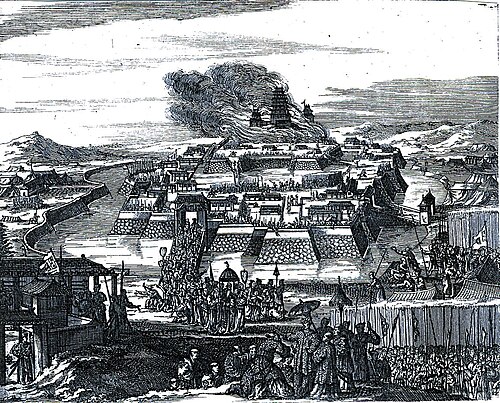
In the winter the castle held. Sanada Nobushige’s earthwork, the Sanada Maru, beat off a major assault on 3 January 1615, and after a bombardment the two sides made peace, on terms that cost the castle its outer defences and moats. When fighting resumed, the Toyotomi army had to fight in the open. It was beaten at Dōmyōji and at Yao and Wakae on 2 June 1615; on 3 June, at Tennōji and Okayama south of the castle, Sanada’s charge reached Tokugawa Ieyasu’s headquarters before he was killed. The castle burned that day, and on 4 June Hideyori and his mother Yodo-dono killed themselves.
The campaigns ended the Toyotomi house fifteen years after Ieyasu’s victory at Sekigahara and are usually taken as the end of the wars that had begun with the Ōnin War in 1467. The sections below follow the story from 1600, look at the disputed points and at what Joseon Korea heard of the war, and then ask why the Toyotomi, who had survived Sekigahara, fell fifteen years later.
Easy
Why the Toyotomi survived Sekigahara
The Battle of Sekigahara, fought on 21 October 1600, was not a war between the Tokugawa and the Toyotomi. Both armies claimed to be fighting for Hideyori, and after the battle Hideyori thanked Ieyasu as a loyal servant. The defeated were Ishida Mitsunari and his allies. The Toyotomi house itself was not treated as an enemy, and Hideyori stayed in the great castle his father had built at Osaka.
The settlement nevertheless left the Toyotomi much weaker. Ieyasu took most of their directly held lands, about 2.2 million koku scattered across Japan, to reward the victors. What remained was about 650,000 koku in the three provinces round Osaka (reference works give between about 600,000 and 700,000), and the great silver mines and the ports of Nagasaki and Sakai passed under Tokugawa control.
Yet Hideyori was not simply one daimyo among many. He kept Osaka Castle and the gold and silver Hideyoshi had left. Court nobles came to Osaka every New Year to greet him, he continued to rise in court rank, becoming Minister of the Right in 1605, and his retainers were recorded in documents on the same footing as the shogun’s own direct vassals. The historian Kasaya Kazuhiko has described these years as a “dual public authority” (nijū kōgi), with two centres of legitimate power. Many historians reject or question that view, but the Toyotomi clearly kept a special position that did not fit easily into the new Tokugawa order.
Easy
A shogun in Edo and a lord in Osaka, 1603–1614
On 24 March 1603 Ieyasu was appointed shogun. In the same year his granddaughter Senhime, Hidetada’s daughter, married Hideyori, as Hideyoshi had arranged; her mother was Yodo-dono’s younger sister, so the couple were cousins. On 2 June 1605 the office of shogun passed to Hidetada, a plain sign that rule would be inherited in the Tokugawa house and not handed back to the Toyotomi. When Ieyasu asked that Hideyori come to Kyoto to congratulate the new shogun, Yodo-dono refused.
The two men finally met at Nijō Castle in Kyoto on 10 May 1611 (28th day of the 3rd month of Keichō 16). Hideyori was 17, and it was the first time he had left Osaka Castle since 1599. Lords who owed their rise to Hideyoshi, among them Katō Kiyomasa and Asano Yoshinaga, helped to arrange the meeting and attended it. According to the accounts summarised in Japanese Wikipedia, Ieyasu invited Hideyori to go up first, as an equal, and Hideyori declined and let Ieyasu go first. Whether the meeting marked Hideyori’s submission or preserved his standing is still debated.
Soon afterwards Ieyasu had 22 lords in Kyoto, and in 1612 65 more, swear to obey the shogunate; Hideyori was not asked to swear. In the same years several older lords close to the Toyotomi died: Katō Kiyomasa fell ill on the ship home and died on 2 August 1611, and Ikeda Terumasa, Asano Yoshinaga and Maeda Toshinaga followed in 1613–14. Stories that Ieyasu had them poisoned come from later plays and novels; the contemporary chronicle Tōdaiki ascribes the deaths of Kiyomasa and Asano to illness.
Easy
Eight characters on a bell, 1614
Hideyori spent heavily on temples, above all on rebuilding the Great Buddha of Kyoto at the temple later called Hōkō-ji, founded by Hideyoshi. A common view, found in the Nipponica encyclopedia, is that Ieyasu encouraged such projects to drain the Toyotomi treasury; other historians, citing a record of 1610, describe the rebuilding as a joint undertaking ordered by Ieyasu, paid for by Hideyori and built under the Tokugawa master carpenter Nakai Masakiyo.
On 31 August 1614 (26th day of the 7th month of Keichō 19), shortly before the dedication, Ieyasu ordered it postponed, saying that he was displeased with the inscription on the temple’s great bell. Scholars consulted by the shogunate then fastened on two phrases: kokka ankō (国家安康, “may the state be peaceful and secure”), which splits the two characters of Ieyasu’s name (家康) with the character an (安); and kunshin hōraku (君臣豊楽, “lord and subjects in prosperity and joy”), which was read as “enjoying the Toyotomi (豊臣) as lords”. Together they were taken as a curse on Ieyasu and a wish for Toyotomi rule.
The author of the inscription, the Nanzen-ji monk Bun’ei Seikan, had gone to Korea in 1592 as Katō Kiyomasa’s secretary. He explained that he had worked Ieyasu’s name into the text deliberately, as a mark of congratulation. The affair has long been told as a pretext invented by Ieyasu, and many reference works still call it an unreasonable accusation. But some historians point out that using a superior’s personal name without permission could be seen at the time as a real breach of etiquette; the Zen monks whom the shogunate consulted mostly agreed that the name had been used improperly, though not that it was a curse. A letter of Ieyasu’s adviser Ishin Sūden passes on Ieyasu’s private wish that the inscription simply be ground off. How far the incident was a manufactured excuse and how far a real offence that escalated remains disputed.
Easy
Katagiri leaves and the rōnin arrive
The Toyotomi sent their senior retainer Katagiri Katsumoto to Ieyasu at Sunpu to explain. On his way back he proposed three ways to satisfy Ieyasu: that Hideyori live in Edo, that Yodo-dono go to Edo as a hostage, or that Hideyori give up Osaka for another province. In the castle he was suspected of working for Ieyasu, and a plot to kill him was reported. On 2 November 1614 Katagiri left Osaka with his men. The same day Ieyasu, told of the plot by his Kyoto deputy Itakura Katsushige, decided on war; a letter of his aide Honda Masazumi says that at the news Ieyasu seemed to grow young again.
The Toyotomi called on the lords who owed them favour, and not one daimyo came. Fukushima Masanori merely let them seize rice stored in his Osaka warehouse, and the Shimazu replied that their service to the Toyotomi was done. Instead the Toyotomi used Hideyoshi’s gold and silver to hire rōnin, masterless samurai, many of whom had lost their lords after Sekigahara. Their army is estimated at around 100,000. Wary of Hideyoshi’s old generals, the Tokugawa kept Fukushima, Kuroda Nagamasa and a few others at Edo during the winter campaign.
Among the rōnin leaders were the so-called “five men”: Sanada Nobushige, Gotō Matabei, Chōsokabe Morichika, Mōri Katsunaga and Akashi Kamon. Several had fought in Korea. Gotō is said in Japanese records to have used an armoured “tortoise-shell cart” against the walls at the second siege of Jinju in 1593 and to have competed to be first inside; Mōri Katsunaga is credited with distinguished service in the relief of Ulsan early in 1598; and Chōsokabe served in Korea with his father Motochika. Sanada Nobushige did not go to Korea; since Sekigahara, when his father had held up Hidetada’s army at Ueda Castle, he had lived in exile at Kudoyama.
Easy
The Winter Campaign and the Sanada Maru
Ieyasu left Sunpu on 12 November 1614 and Hidetada left Edo on 24 November. The Tokugawa forces are usually estimated at about 200,000 men (the Nipponica encyclopedia says about 300,000). Fighting began on 19 December at the Toyotomi fort at the mouth of the Kizu River, west of the castle, and by 30 December the defenders had abandoned their outer forts and withdrawn into the castle.
Osaka Castle stood at the northern end of the Uemachi plateau, a long ridge running from north to south. Rivers, among them the Yodo to the north, and low ground protected it on three sides; only on the south did solid ground lead up to the castle, guarded by dry moats. The defences were in several rings: the main citadel (honmaru), the inner enceintes around it and, on the outside, the sōgamae, a line of walls and moats that enclosed much of the castle town.
In front of the southern line Sanada Nobushige built an earthwork outwork, the Sanada Maru. It is usually drawn as a half-moon bastion against the outer moat, but recent studies of old plans propose other shapes, and a reconstruction of the terrain found a valley about 200 metres wide behind it, suggesting a more independent fort. Its site is thought to lie near today’s Meisei Gakuen school.
On 3 January 1615 (4th day of the 12th month) the troops of Maeda Toshitsune (then called Toshimitsu), drawn on by the defenders, rushed the Sanada Maru without proper cover. The defenders waited until the attackers were close under the walls and fired volleys. An accidental gunpowder explosion inside the castle was mistaken for a signal from traitors within, and more troops pressed forward and suffered heavy losses before Ieyasu ordered them back. The battle first made Nobushige’s name famous. When Hidetada proposed a general assault, Ieyasu refused, telling him to think of winning without fighting.
Intermediate
Cannon, peace and the filling of the moats
Ieyasu turned to artillery and pressure. From 15 January the whole army opened fire; from Bizenjima, north of the castle, about a hundred large guns fired at the residential quarters of the main citadel. According to Japanese Wikipedia the guns probably included cannon bought from the English and Dutch that year. Katagiri Katsumoto, who had left Osaka two months earlier, now led Tokugawa gunners firing from Bizenjima towards Yodo-dono’s quarters. The Tokugawa jikki, an official history compiled in the nineteenth century, says a shot brought down part of her apartments and killed seven or eight maids, and that she then leaned towards peace.
Talks began on 17 January with Honda Masazumi and Ieyasu’s consort Acha no Tsubone for the Tokugawa and Yodo-dono’s sister Jōkō-in for the Toyotomi. Terms were agreed on 18 January and oaths exchanged on 21 January 1615. According to the summary in Japanese Wikipedia, the Toyotomi were to keep only the main citadel, pull down the second and third enceintes, fill the moats of the outer line and give hostages instead of sending Yodo-dono to Edo; Ieyasu guaranteed Hideyori’s safety and domain and promised not to punish the men in the castle.
Who was to fill what is itself part of the dispute. The division reported in Japanese Wikipedia gave the second enceinte (ni-no-maru) to the Toyotomi and the third enceinte and the outer moats to the Tokugawa. Tokugawa commissioners used the besieging army and local people to fill the outer moats in a rush and then, from the first month of the Japanese calendar (from late January 1615), filled the second enceinte as well, pulling down houses to do it. The work was finished on 20 February 1615 (23rd day of the 1st month of Keichō 20), and gates and towers were demolished; the Sanada Maru was levelled too. Ieyasu’s adviser Sūden wrote that with its moats filled the castle had been reduced to its main citadel and become a sorry sight.
The famous story is that the agreement covered only the outer moats, and that the Tokugawa tricked the Toyotomi by reading sō (惣, “outer”) as “all” and filling the inner moats too. Many Japanese dictionaries still tell it this way, and English Wikipedia’s narrative includes a Toyotomi protest. But the protest appears only in later works such as the Mikawa monogatari and the Butoku taiseiki of 1686. The historian Goza Yūichi points out that letters by lords on the Tokugawa side, among them Hosokawa Tadatoshi and Mōri Terumoto, name the demolition of the second and third enceintes as a peace term, and that contemporary records show no Toyotomi complaint during a month of work. Japanese Wikipedia also notes a source suggesting that the second enceinte need not have been demolished. The likeliest reading is that the dismantling was largely within what had been agreed, while its speed and thoroughness were the Tokugawa’s doing; the exact obligations of each side remain uncertain.
Intermediate
The Summer Campaign: Dōmyōji, Yao and Wakae
The peace did not last. Many rōnin stayed in Osaka, and in April 1615 Itakura Katsushige reported disorder, the restoration of moats and walls and rumours of plans to burn Kyoto. The shogunate demanded that the Toyotomi either dismiss all newly hired rōnin or move to Yamato or Ise. A letter of the Dutch merchant Wouterssen from the spring of 1615, studied by Frederik Cryns, likewise says that Ieyasu was coming back because Hideyori would not dismiss the men he had taken in. Ōno Harunaga, who conducted the negotiations, was attacked inside the castle, and the Toyotomi handed out gold and silver to the rōnin and dug out parts of the filled moats.
Ieyasu and Hidetada were in Kyoto by 18 May. The Tokugawa army, about 155,000 men, marched on Osaka by two roads, through the Kawachi plain and through Yamato over the hills. Desertions had reduced the Toyotomi to about 78,000. Since the castle without its moats could not be held, they decided to fight in the field and look for a chance to strike at the enemy commander. On 26 May at Kashii in Izumi Province, Ban Naoyuki and others were defeated and killed.
The decisive fighting began on 2 June (6th day of the 5th month). To catch the Tokugawa column on the Yamato road as it came out of the hills, Gotō Matabei marched through the night with about 2,800 men and reached Dōmyōji, some 15 kilometres south-east of the castle, before dawn. The other units had not arrived, delayed, it is said, by fog, and the enemy was already deployed. Gotō held the hill of Komatsuyama through the morning against more than 20,000 men under Date Masamune and others, until he was shot; accounts of his end differ. Sanada and Mōri Katsunaga arrived late; Sanada pushed back the Date vanguard, but on news of defeat elsewhere the Toyotomi withdrew, with Sanada covering the retreat.
The same day, about 8 kilometres south-east of the castle, Kimura Shigenari and Chōsokabe Morichika tried to stop the main Tokugawa army on the Kawachi road at Yao and Wakae. At Yao, Chōsokabe made all his men, mounted samurai included, dismount and lie flat on a river embankment, then rise and charge with spears when the troops of Tōdō Takatora came close. Tōdō, one of the commanders who had destroyed the Joseon fleet at Chilcheollyang in 1597, lost more than 600 killed and wounded. At Wakae, Kimura was killed fighting the troops of Ii Naotaka; it is said that, expecting to die, he had perfumed his helmet with incense. With Kimura dead, Chōsokabe withdrew, and his force effectively broke up.
Intermediate
Tennōji and Okayama: Sanada’s charge
On 3 June 1615 (7th day of the 5th month) the Toyotomi formed their last line south of the castle. Sanada Nobushige held Chausuyama, the hill that had been Ieyasu’s headquarters in the winter; Mōri Katsunaga stood in front of the Shitennō-ji temple; and Ōno Harufusa covered the Okayama road to the east. Ieyasu advanced on the Tennōji side and Hidetada on the Okayama side. A surviving order issued that day to Ōno Harufusa forbade anyone to start fighting early and called the battle the one that would decide the realm.
Around midday (records give times between about 10 a.m. and 1 p.m.) soldiers of Mōri’s force opened fire on the Tokugawa vanguard under Honda Tadatomo, and the battle began against the plan. Mōri’s troops killed Honda Tadatomo, and the first, second and third Tokugawa lines broke one after another, leaving the front of Ieyasu’s headquarters exposed. Nobushige drove through the large army of Matsudaira Tadanao and charged Ieyasu’s headquarters. Accounts speak of two, three or more charges; the exact number is not known.
The best-known witnesses are letters and reports. A Shimazu-side document says that those of Ieyasu’s guards who ran away about three ri (perhaps 12 kilometres) all survived, that Sanada was killed in the third attack, and that he was “the finest warrior in Japan”, unequalled even in the old tales. A Jesuit annual report passed on word that Ieyasu, in despair, had wanted to cut his belly. Later the shogunate punished several officers of Ieyasu’s own headquarters, among them a standard commissioner, for their conduct that day.
But the Toyotomi were too few. On the Okayama side Ōno Harufusa’s troops threw Hidetada’s headquarters into confusion, yet the larger Tokugawa army recovered, and by about 3 p.m. the Toyotomi lines had collapsed. Nobushige was killed that afternoon, aged 49 by East Asian reckoning. Tradition places his death at the Yasui Shrine, but a record of the Echizen Matsudaira house says that Nishio Munetsugu killed him on high ground between Ikutama and Shōman without knowing who he was. A Kyoto court diary of that day notes simply: “Osaka castle fell. At Tennōji Sanada fought bravely again and again, and was then killed.”
Intermediate
The fall of Osaka Castle
Echizen troops under Matsudaira Tadanao were the first into the castle, and other Tokugawa forces poured in after them. Fire broke out, and the second enceinte and the main citadel burned. Itakura Katsushige reported from Kyoto that the castle fell at noon on 3 June, that the fire could be seen from Kyoto until the next morning, and that ten to twenty thousand fugitives were streaming towards the capital.
Late that afternoon Ōno Harunaga sent Senhime out of the castle and asked that Hideyori and Yodo-dono be spared, offering his own death instead. An account recorded in 1712 from the memory of one of her maids says her attendants wrapped her in bedding to shield her from arrows and brought her to the Tokugawa camp. Ieyasu left the decision to Hidetada. According to a letter by Mōri Hidemoto, Hidetada replied that it could not happen a second time and that they should cut their bellies at once.
Hideyori and his mother had taken refuge in a storehouse in the Yamazato enclosure within the castle. Around noon on 4 June (8th day of the 5th month), troops of Ii Naotaka surrounded it and fired their guns as a signal; Hideyori, Yodo-dono and about thirty others with them, among them Ōno Harunaga, Mōri Katsunaga and Sanada’s son Daisuke, killed themselves, and the storehouse burned. Hideyori was 21 (23 by East Asian reckoning). Rumours that he had escaped to Satsuma soon spread, but they remained legends.
The Tokugawa hunted down the survivors. Chōsokabe Morichika was beheaded in Kyoto on 11 June. Hideyori’s son Kunimatsu, eight by East Asian reckoning, was beheaded at the Rokujō riverbed on 19 June; a Jesuit annual report says he died rebuking Ieyasu for breaking his sacred oath to his father. Hideyori’s daughter was spared on condition that she become a nun. Katagiri Katsumoto died on 24 June, twenty days after his old lord. The great screen of the Summer Campaign made for Kuroda Nagamasa shows soldiers of the Tokugawa side robbing, killing and abducting the people of Osaka.
Intermediate
After Osaka: one castle per province and the Laws for the Military Houses
The shogunate moved quickly. On 7 August 1615 (13th day of the intercalary 6th month) Hidetada, on a plan by Ieyasu, ordered the daimyo to keep their principal residential castle and pull down the other castles throughout their domains, with exceptions in practice; about 400 castles are said to have been pulled down within days. On 30 August (7th day of the 7th month) the daimyo were assembled at Fushimi Castle to hear the thirteen articles of the Laws for the Military Houses (Buke shohatto), which required lords to report castle repairs and forbade marriages between houses without permission.
On 5 September 1615 the era name was changed from Keichō to Genna. Later writers called this moment Genna enbu, “the laying down of arms in Genna”; when the term was first used is not known, and it seems to have been spread by later Confucian scholars praising the Tokugawa peace. It marked the end of nearly 150 years of intermittent large-scale warfare since the Ōnin War. The shrine where Hideyoshi was worshipped as a god was abolished, Osaka was given to Ieyasu’s grandson Matsudaira Tadaakira and became land under the shogun’s direct rule in 1619, and Ieyasu died at Sunpu on 1 June 1616.
Intermediate
What Joseon saw and heard
For Korean readers the campaigns bring back many names from the Imjin War. Katō Kiyomasa and Asano Yoshinaga, who had held Ulsan in the winter of 1597–98, helped arrange the Nijō meeting; the author of the bell inscription had been Kiyomasa’s secretary in Korea; Gotō, Mōri Katsunaga and Chōsokabe fought for Hideyori and Tōdō Takatora against him. The castle itself had been seen by a Korean: on the 8th day of the 4th month of 1607 in the Korean lunar calendar, Gyeong Seom, deputy envoy of the first Joseon embassy to the Tokugawa, described its walls ring within ring and its storeyed towers, the blue tiles and white battlements glimpsed between clouds and trees. Eight years later it burned.
The Joseon court learned of the war through Tsushima. In a report recorded on the 12th day of the intercalary 8th lunar month of 1615 (early October in the Western calendar), the governor of Gyeongsang Province passed on what a Tsushima man recorded as 橘知滿 had told the magistrate of Dongnae: the death of the lord of Tsushima, Sō Yoshitoshi, early that year had not been announced because of a great war in Japan. His account of the war was garbled. Katagiri, a favourite of Hideyoshi and then of Hideyori, had been bribed by Ieyasu and tried to poison Hideyori at a banquet; Hideyori found out and banished him; and in the 5th month Ieyasu sent Hidetada with a great army to storm Hideyori’s castle and kill him, so that “on Hideyori’s side not one man is left”.
A stranger version came with a returned captive, Sin Gyeong-ran of Yangsan, carried off to Japan in 1597. His testimony, quoted in a Joseon memorial to the Ming recorded under the 30th day of the 5th lunar month of 1617 (early July), claimed that Ieyasu had lost the first round and persuaded Hideyori to pull down part of the castle so that he could save face, then accused him of rebuilding it and attacked again, while a spy inside set fire to the powder store. The same memorial reports that Japanese envoys called the war a punishment of Hideyori’s rebellion, and that the Tokugawa, having swallowed Osaka, claimed to have destroyed Korea’s enemy. In 1616 a Ming officer surnamed Qiu had warned Joseon that, although trouble in an enemy country was its good fortune, Ieyasu was skilled at mastering the strong by stratagem.
The war also opened the way to the next embassy. Tsushima envoys said that Ieyasu had put down the internal troubles and that Hidetada wanted Korean envoys to come. In 1617 Joseon sent a second “reply and repatriation” embassy under Oh Yun-gyeom. It was presented as congratulating Japan on the pacification of Osaka, but its larger purpose was to bring home Koreans captured in the Imjin War. Oh Yun-gyeom met Hidetada at Fushimi Castle, and the embassy brought back about 230 people.
Intermediate
Yukimura, Yodo-dono and the bell: how Osaka is remembered
Sanada Nobushige became the hero of the campaign. Edo-period war tales such as the Sanada sandaiki and the storytelling books of the Meiji and Taishō eras turned him into “Sanada Yukimura”, leader of ten legendary braves; the name Yukimura is not found in reliable sources of his lifetime. Yodo-dono’s image has also been shaped by later writing: the name Yodogimi became established through a Meiji-period play, and historians have argued that the picture of a proud woman who ruined her son’s house is largely a product of the Tokugawa period.
The bell still hangs at Hōkō-ji in Kyoto; the story that the Tokugawa punished it by setting it on the ground is wrong: its belfry was pulled down in 1871, during the Meiji government’s seizure of temple land, and the bell lay on the ground until a new belfry was built in 1884. In 1980 an excavation at the castle site found the skull of a high-ranking man in his early twenties, tentatively identified as Hideyori’s and reburied at Seiryō-ji in Kyoto in 1983. The site of the Sanada Maru was marked with a monument in 2016, the year the NHK drama Sanada Maru was broadcast.
Advanced
Why did the Toyotomi fall fifteen years after Sekigahara?
The first part of the answer is that Sekigahara never settled the Toyotomi position. Because the war of 1600 was fought in Hideyori’s name, Ieyasu could take most of the Toyotomi lands but could not treat the house as a defeated enemy. Hideyori kept Osaka, Hideyoshi’s treasure and high court rank, and many historians think he kept a special status above ordinary lords. That left two claims that could not both last: by passing the office of shogun to Hidetada in 1605, the Tokugawa declared that power was hereditary in their house, while the Toyotomi had not given up the possibility that Hideyori might one day rule.
Time worked against the Toyotomi. By 1614 Ieyasu was over seventy, and historians who see the war as planned argue that he wanted the question settled before he died. Meanwhile the lords who might have spoken for Hideyori or mediated on his behalf, Katō Kiyomasa, Asano Yoshinaga, Ikeda Terumasa and Maeda Toshinaga, died between 1611 and 1614, and the others had sworn written oaths to the shogunate. When war came, not one daimyo joined Hideyori.
Whether Ieyasu meant from the start to destroy the Toyotomi is debated. Okamoto Ryōichi’s entry in the Nipponica encyclopedia describes a deliberate plan: draining the Toyotomi treasury with temple projects and then seizing on the bell inscription. Takagi Shōsaku, in the Heibonsha encyclopedia, writes rather that Ieyasu used the bell affair to press Hideyori to submit as a vassal, and recent work by Goza Yūichi on the peace terms and by Frederik Cryns on Dutch letters stresses that Ieyasu’s demands concerned Hideyori’s status and residence and the dismissal of the rōnin. On any of these views the crisis turned on Hideyori’s place under the shogunate, and the options changed over time. In 1614 Katagiri’s three proposals (Hideyori living in Edo, Yodo-dono as a hostage, or a move from Osaka) were rejected in the castle, and Katagiri was driven out. In the winter talks the Toyotomi offered Yodo-dono as a hostage in return for rewards for the rōnin, which Ieyasu refused; the peace that followed traded the castle’s moats for Hideyori’s safety. In 1615 the final break came when the Toyotomi would neither dismiss the rōnin nor move to Yamato or Ise.
Finally, the military balance decided the outcome. A rōnin army in a great castle could beat off assaults, as the Sanada Maru showed, but it had no allies to relieve it, while the Tokugawa could bombard it and wait. The winter peace traded the castle’s defences for Hideyori’s safety; when the Toyotomi would not dismiss the rōnin, the shogunate came back to a castle that could no longer be held, and the Toyotomi had to fight in the open against an army twice their size. In short, the Toyotomi survived 1600 because they were not formally on the losing side; they fell in 1615 because the Tokugawa had in the meantime made their rule hereditary and isolated Osaka, and because the Toyotomi, unwilling to become an ordinary vassal house, had to fight without allies a war they were very unlikely to win.
Advanced
Sources and their problems
Much of the familiar story of Osaka was shaped by Edo-period war tales and later compilations, written long after the events and often to entertain or to praise particular families. Some famous details began earlier, in contemporary reports that passed on what people said: a Shimazu letter already speaks of Sanada’s third attack, and a Jesuit report of rumours that Ieyasu thought of suicide; later tales then elaborated them. Others, such as the trick over the moats, appear only in later works. Even names are affected: “Yukimura” is not found in reliable contemporary sources, and Gotō signed his own documents not “Mototsugu” but “Masachika”.
Contemporary evidence includes the Sunpu-ki, a record of Ieyasu’s court; the diary of his adviser Sūden; the chronicle Tōdaiki; court diaries; letters of lords on both sides; and outside observers such as the Jesuits and the English and Dutch trading posts at Hirado. These are closer to events but often pass on rumours. The phrase “the finest warrior in Japan”, long known mainly from a later Satsuma compilation, appears in a Shimazu family document dated the 11th day of the 6th month of Keichō 20 (6 July 1615), attributed to Shimazu Iehisa and shown by the Osaka Museum of History in 2016.
Numbers need special caution. The usual figures, about 200,000 against 100,000 in the winter and 155,000 against 78,000 in the summer, are estimates, many derived from the Meiji army general staff’s history of the campaign. A Dutch letter of 1615 passed on a rumour that the Toyotomi army had grown to 150,000. Even the date of the fall varies: most accounts say 3 June, when the main citadel burned, some give 4 June, the day Hideyori died. Korean records of the war are second-hand and confused, but they show how the war was told at the time.
Key ideas
- Survived, but not secure
- The Toyotomi came through 1600 because the war had been fought in Hideyori’s name, not against him. But they lost most of their lands, and their special position became harder to fit into the Tokugawa order.
- A hereditary shogunate
- When Ieyasu passed the office of shogun to his son Hidetada in 1605, it showed that power would stay in the Tokugawa house. Hideyori could keep his rank only by accepting this.
- The bell inscription
- Ieyasu objected to phrases on a temple bell that split his name. Whether this was a manufactured pretext or a real breach of etiquette is still debated, but it opened the crisis of 1614.
- An army of rōnin
- No daimyo joined the Toyotomi, so they hired masterless samurai with Hideyoshi’s gold. They fought bravely but were hard to coordinate, as Dōmyōji showed.
- Moats and the peace
- The winter peace led to the filling of Osaka Castle’s moats. The story that the Tokugawa filled the inner moats by trickery comes from later works; contemporary letters suggest it was largely agreed.
- Genna enbu
- After Osaka the era name became Genna, and the shogunate cut down the number of castles and issued laws for the daimyo. Later writers called this the laying down of arms: no more wars between great lords followed for about 250 years.
Records
- 1600 — 21 October: Battle of Sekigahara. The Toyotomi keep Osaka Castle but their lands are cut to about 650,000 koku.
- 1603 — 24 March: Tokugawa Ieyasu becomes shogun. Senhime marries Toyotomi Hideyori.
- 1605 — 2 June: Hidetada becomes shogun. Yodo-dono refuses to let Hideyori go to Kyoto to congratulate him.
- 1607 — Gyeong Seom of the Joseon embassy describes Osaka Castle from the river.
- 1611 — 10 May: Ieyasu and Hideyori meet at Nijō Castle. 2 August: Katō Kiyomasa dies.
- 1614 — 31 August: Ieyasu stops the dedication of the Great Buddha over the bell inscription. 2 November: Katagiri Katsumoto leaves Osaka; Ieyasu decides on war.
- 1614 — 19 December: the Winter Campaign begins at Kizugawaguchi; on 30 December the defenders withdraw into the castle.
- 1615 — 3 January: Battle of the Sanada Maru. 15 January: general bombardment. 18–21 January: peace agreed and sworn. 20 February: the moats are filled.
- 1615 — 26 May: Battle of Kashii. 2 June: battles of Dōmyōji and of Yao and Wakae; Gotō Matabei and Kimura Shigenari are killed.
- 1615 — 3 June: Battle of Tennōji–Okayama; Sanada Nobushige is killed and the castle burns. 4 June: Hideyori and Yodo-dono kill themselves.
- 1615 — 11 June: Chōsokabe Morichika is executed. 19 June: Hideyori’s son Kunimatsu is executed.
- 1615 — 7 August: the “one castle per province” order. 30 August: Laws for the Military Houses. 5 September: the era name becomes Genna.
- 1615 — Early October: the Joseon court records a Tsushima report of the war in Japan.
- 1616 — 1 June: Tokugawa Ieyasu dies at Sunpu.
- 1617 — A Joseon embassy under Oh Yun-gyeom meets Hidetada at Fushimi and brings home about 230 captives.
- 1623 — Rōnin who fought for the Toyotomi are finally pardoned.
- 1980 — A skull tentatively identified as Hideyori’s is excavated at the castle site.
- 2016 — A monument marks the site of the Sanada Maru, and an excavation finds possible traces of it.
Glossary
- Rōnin
- A samurai without a lord, often one whose master had been defeated or dispossessed. Most of the Toyotomi army at Osaka were rōnin.
- Honmaru, ni-no-maru, san-no-maru
- The main citadel of a Japanese castle and the second and third enclosures (enceintes) around it.
- Sōgamae
- The outermost ring of walls and moats of a castle, enclosing the castle town. Osaka’s sōgamae was filled after the winter peace.
- Demaru
- An outwork built in front of a castle’s main defences, such as the Sanada Maru.
- Ōgosho
- A retired shogun who kept real power; Ieyasu’s position at Sunpu after 1605.
- Gonin-shū
- “The five men”: Sanada Nobushige, Gotō Matabei, Chōsokabe Morichika, Mōri Katsunaga and Akashi Kamon, the leading rōnin commanders at Osaka.
- Koku
- A measure of rice (about 180 litres) used to rate the yield of land and so the size of a domain.
- Ikkoku ichijō rei
- The order of 1615, traditionally called “one castle per province”, requiring daimyo to keep their principal residential castle and pull down the other castles in their domains, with exceptions in practice.
- Buke shohatto
- The Laws for the Military Houses, first issued in 1615 to regulate the daimyo.
- Genna enbu
- “The laying down of arms in Genna”: a later name for the end of the civil wars after the fall of Osaka in 1615.
Questions and answers
Why did the Toyotomi survive Sekigahara?
Because the war of 1600 was fought by both sides in Hideyori’s name. Ieyasu took most of the Toyotomi lands but left Hideyori in Osaka Castle with his rank and treasure.
Was the bell inscription just an excuse?
It is often told that way. But some historians note that using a superior’s personal name could be seen as a real offence at the time, and that the monks consulted agreed it was improper, though not a curse. How far Ieyasu manufactured the crisis is debated.
Did Ieyasu trick the Toyotomi into filling the inner moats?
The famous story comes from later works. Contemporary letters from daimyo say that demolishing the inner enclosures was part of the peace terms, and no Toyotomi protest is recorded at the time. The exact division of the work is still discussed.
Was he called Sanada Yukimura?
His real name was Sanada Nobushige. “Yukimura” comes from later war tales and is not found in reliable sources of his lifetime.
Did Sanada nearly kill Ieyasu?
His charge broke into Ieyasu’s headquarters, and letters and a Jesuit report describe panic and flight there. How many times he charged and how close he came are not known.
Did Hideyori escape to Satsuma?
Rumours said so, and an English merchant recorded them, but there is no good evidence. He is generally accepted to have died in the castle on 4 June 1615.
Did the castle fall on 3 or 4 June?
It was captured and burned on 3 June (7th day of the 5th month); Hideyori and Yodo-dono died the next day. Some works date the fall to the second day.
Did Korea know about the war?
Yes, through Tsushima and returned captives, though the accounts were garbled. The 1617 Joseon embassy was presented as congratulating Japan on pacifying Osaka, but its main aim was to bring captives home.
Sources and further reading
- 大坂の陣 (Siege of Osaka). Wikipedia (Japanese)
- Siege of Osaka. Wikipedia
- Okamoto Ryōichi (岡本良一) (Nipponica); Takagi Shōsaku (高木昭作) (Sekai daihyakka jiten), 大坂の陣 (Siege of Osaka), in Nihon daihyakka zensho (Nipponica), Kaitei shinban Sekai daihyakka jiten and other reference works. Shogakukan, Heibonsha and others, via Kotobank
- 方広寺鐘銘事件 (Hōkō-ji bell inscription incident). Wikipedia (Japanese)
- Takagi Shōsaku (高木昭作) (Sekai daihyakka jiten), 鐘銘事件 (Bell inscription incident), in Kaitei shinban Sekai daihyakka jiten and other reference works. Heibonsha and others, via Kotobank
- 豊臣秀頼 (Toyotomi Hideyori). Wikipedia (Japanese)
- 豊臣秀頼 (Toyotomi Hideyori), in several Japanese reference works. Kotobank
- 淀殿 (Yodo-dono). Wikipedia (Japanese)
- 二条城会見 (Nijō Castle meeting). Wikipedia (Japanese)
- 加藤清正 (Katō Kiyomasa). Wikipedia (Japanese)
- 文英清韓 (Bun’ei Seikan). Wikipedia (Japanese)
- 文英清韓 (Bun’ei Seikan), in Digital daijisen and Nihon jinmei daijiten. Shogakukan and Kodansha, via Kotobank
- 片桐且元 (Katagiri Katsumoto). Wikipedia (Japanese)
- 片桐且元 (Katagiri Katsumoto), in several Japanese reference works. Kotobank
- 後藤基次 (Gotō Mototsugu / Matabei). Wikipedia (Japanese)
- 毛利勝永 (Mōri Katsunaga). Wikipedia (Japanese)
- 長宗我部盛親 (Chōsokabe Morichika). Wikipedia (Japanese)
- 真田信繁 (Sanada Nobushige). Wikipedia (Japanese)
- Kobayashi Keiichirō (小林計一郎) (Nipponica); Sasamoto Shōji (笹本正治) (Sekai daihyakka jiten), 真田幸村 (Sanada Yukimura), in Nipponica, Sekai daihyakka jiten and other reference works. Shogakukan, Heibonsha and others, via Kotobank
- 真田丸 (Sanada Maru). Wikipedia (Japanese)
- 真田丸の戦い (Battle of the Sanada Maru). Wikipedia (Japanese)
- 道明寺の戦い (Battle of Dōmyōji). Wikipedia (Japanese)
- 八尾・若江の戦い (Battles of Yao and Wakae). Wikipedia (Japanese)
- 藤堂高虎 (Tōdō Takatora). Wikipedia (Japanese)
- 木村重成 (Kimura Shigenari), in Nipponica, Sekai daihyakka jiten and other reference works. Kotobank
- 天王寺・岡山の戦い (Battle of Tennōji–Okayama). Wikipedia (Japanese)
- 豊臣国松 (Toyotomi Kunimatsu). Wikipedia (Japanese)
- 一国一城令 (One castle per province order). Wikipedia (Japanese)
- 武家諸法度 (Buke shohatto), in Sekai daihyakka jiten and other reference works. Heibonsha and others, via Kotobank
- 元和偃武 (Genna enbu). Wikipedia (Japanese)
- 元和偃武 (Genna enbu), in Nipponica and other reference works. Kotobank
- Goza Yūichi (呉座勇一), 大河ドラマ『どうする家康』解説⑨:大坂城内堀の埋め立ては謀略か? (Was the filling of Osaka Castle’s inner moats a trick?). Agora, 2023
- Frederik Cryns (フレデリック・クレインス), International Research Center for Japanese Studies, 大坂の陣の講和は、家康の陰謀だったのか? (Was the Osaka peace Ieyasu’s plot?). Gendai Business (Kodansha), 2018
- 特別展「真田丸」主な展示資料 (Special exhibition Sanada Maru: main exhibits), incl. 某条書案 (Shimazu family documents). Osaka Museum of History, 2016
- Yamashita Hisatake (山下久猛), 信繁最期の地 (Where Nobushige died), 安居神社 (Yasui Shrine). Bunshun Online, 2016
- Gyeong Seom (慶暹); Korean translation by Jeong Bong-hwa, 海槎錄 (Haesarok), entry for the 8th day of the 4th month of 1607. Institute for the Translation of Korean Classics (Korean Classics DB)
- 光海君日記 (Gwanghaegun ilgi, draft version), 12th day of the intercalary 8th month of the 7th year of Gwanghaegun (1615), entry 4: the Gyeongsang governor reports news from Tsushima. Annals of the Joseon Dynasty database, National Institute of Korean History
- 光海君日記 (Gwanghaegun ilgi, draft version), 20th day of the 5th month of the 8th year of Gwanghaegun (1616), entry 11: memorandum from the Ming officer Qiu. Annals of the Joseon Dynasty database, National Institute of Korean History
- 光海君日記 (Gwanghaegun ilgi, draft version), 30th day of the 5th month of the 9th year of Gwanghaegun (1617), entry 6: the embassy to Japan and the memorial to the Ming. Annals of the Joseon Dynasty database, National Institute of Korean History
- 김성환 (Kim Seong-hwan), 동사상일록 (東槎上日錄). Encyclopedia of Korean Culture (Academy of Korean Studies)
- 呉允謙 (Oh Yun-gyeom), in Nihon jinmei daijiten. Kodansha, via Kotobank
- 日本の暦日データベース (Japanese calendar database). National Astronomical Observatory of Japan
- 음양력 변환 계산 (Lunar–solar calendar conversion). Korea Astronomy and Space Science Institute
- Fujimoto Atsushi (藤本篤), 大坂藩 (Osaka domain), in Nihon daihyakka zensho (Nipponica). Shogakukan, via Kotobank
- 発掘調査で見つかった恭明宮 (The Kyōmeikyū found by excavation), 277th Kyoto City Archaeological Museum lecture, with a chronology of the Hōkō-ji site. Kyoto City Archaeological Research Institute, 2016
- Goza Yūichi (呉座勇一), 天下統一目前の徳川家康が「切腹を考えた」瞬間… (The moment Ieyasu ‘thought of seppuku’). Shūeisha Online, 2023
Related
- Wars of Japan’s UnificationThe wars of 1560–1615 in which Oda Nobunaga, Toyotomi Hideyoshi and Tokugawa Ieyasu ended Japan’s century of civil war and founded the Tokugawa shogunate.
- Tokugawa IeyasuJapanese warlord who won the Battle of Sekigahara in 1600 and founded the Tokugawa shogunate, ruling from Edo.
- Katō KiyomasaJapanese commander from Owari who served Toyotomi Hideyoshi from boyhood, led the Second Division into Hamgyeong Province in 1592 and later built Kumamoto Castle.
- Kuroda NagamasaSon of Kuroda Kanbei who led the Third Division in the 1592 invasion of Korea and met the Ming at Jiksan in 1597; after siding with Tokugawa Ieyasu at Sekigahara he became the first lord of Fukuoka.
- Joseon missions to Japan (Tongsinsa)Twelve embassies of several hundred people each that the kings of Joseon sent to the Tokugawa shoguns between 1607 and 1811; born of the peace after Hideyoshi’s invasions, they became the main channel of diplomacy and cultural exchange between Korea and Japan.
Written with AI assistance from the published sources listed above, and revised as new research appears.