Start at the top for an easy introduction. Go further down for more detail and scholarship.
- Easy
- Intermediate
- Advanced
For young readers
More than 400 years ago, Japan invaded Korea, which was then the kingdom of Joseon. In 1597 the Japanese came back for a second time. That summer almost the whole Korean navy was destroyed in a surprise attack at a place called Chilcheollyang.
The king gave the command of the navy back to Admiral Yi Sun-sin, who had been arrested and punished a few months before. When he took over, there were only about twelve warships left. Some officials thought the navy should give up and fight on land, but Yi is said to have answered: “I still have twelve ships.”
A big Japanese fleet sailed west along the coast. Yi waited for it near a very narrow channel between Jindo Island and the mainland. The sea there rushes through so fast and so loudly that people call it Uldolmok, “the roaring channel”.
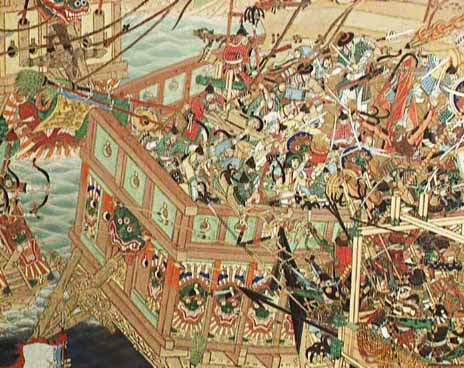
On the day of the battle, more than 130 Japanese ships came into the channel against 13 Korean ships. At first Yi’s own ship fought almost alone, while the others hung back. Then the other captains came forward, a Japanese commander was killed, and about thirty Japanese ships were smashed. The Japanese turned back.
The battle did not end the war. Yi had too few ships to stay, so he sailed north to gather more men and boats. But the navy that had almost disappeared was saved, and Koreans remember Myeongnyang as one of the most famous sea battles in their history. A popular story says Yi stretched iron chains across the channel, but his diary’s account of the battle says nothing about chains across the strait.
At a glance
- Date
- 16th day of the 9th lunar month of 1597 (Joseon and Japanese calendars) = 26 October 1597 (Gregorian). The fighting lasted from morning until late afternoon
- Place
- The Myeongnyang Strait (Uldolmok) between Jindo Island and the Hwawon Peninsula of the mainland, and the waters off the Jeolla Right Navy headquarters (Usuyeong) at its north-western end, in today’s Haenam and Jindo counties
- War
- Second Japanese invasion (Jeongyu War, 1597–1598) of the Imjin War (1592–1598)
- Commanders
- Joseon: Yi Sun-sin (naval commander of the three provinces), with Kim Eok-chu (Jeolla Right naval commander), An Wi, Kim Eung-ham, Song Yeo-jong and others / Japan: Tōdō Takatora, Katō Yoshiaki, Wakisaka Yasuharu and Kurushima Michifusa (killed), with Mōri Takamasa as inspector
- Forces
- Joseon: 13 warships, plus 32 scouting boats that probably stayed out of the fighting (Yi’s report) / Japan: 133 ships in the attack according to Yi’s diary (“130-odd” in his report to the court); total estimates of the fleet nearby range up to about 330
- Losses
- Japan: 31 ships smashed according to Yi’s diary (his report gives more than twenty, then eleven more; about 30 in most modern works), Kurushima Michifusa killed, Tōdō Takatora wounded / Joseon: no ships lost; 2 killed and 3 wounded on Yi’s flagship, and seven or eight rowers from An Wi’s ship jumped into the sea (Yi’s diary)
- Result
- Joseon victory: the Japanese fleet withdrew. Yi pulled back north the same night; the Japanese navy later raided the west coast of Jeolla before withdrawing to the south coast for the winter. The war ended only after Hideyoshi’s death, when the Japanese left Busan in December 1598
- Main sources
- Yi Sun-sin’s war diary (Nanjung ilgi) and his report as quoted in the Veritable Records of King Seonjo; Yu Seong-ryong’s Jingbirok; the biography (haengnok) by Yi’s nephew Yi Bun; Japanese family records of the Tōdō and Mōri; the 1688 victory stele
On the map
Meanwhile elsewhere in the world
Other subjects in this library from around the same years, in distant parts of the world.
- Benin Bronzesc. 1300–1897 · Benin City (Kingdom of Benin)
- William Shakespeare1589–1613 · London (England)
- Akbar1556–1605 · Fatehpur Sikri (Mughal Empire)
- Selimiye Mosque1568–1575 · Edirne (Ottoman Empire)
- Florentine Codexc. 1545–1577 · Tlatelolco, Mexico City (New Spain)
- Nzinga of Ndongo and Matamba1624–1663 · Ndongo and Matamba (Mbundu kingdoms, present-day Angola)
Easy
What happened at Myeongnyang?
The Battle of Myeongnyang was a sea battle of the Imjin War, fought during Japan’s second invasion of Korea. It took place on the 16th day of the 9th lunar month of 1597, which is 26 October 1597 in the Western calendar. Japanese records give the same lunar date. The battlefield was the Myeongnyang Strait, a narrow channel between Jindo Island and the south-western tip of the Korean mainland, which Koreans also call Uldolmok, “the roaring channel”, after the noise of its tidal currents.
Two months earlier the Joseon navy had been almost wiped out at Chilcheollyang. Yi Sun-sin, reappointed to command what was left of it, had gathered only 13 warships by the day of the battle. A Japanese fleet moving west along the coast of Jeolla Province came into the strait to attack him; Yi’s diary counts 133 Japanese ships in the attack.
For a long time Yi’s flagship fought almost alone, while his other captains held back. When they finally came forward, the fighting turned. Yi recorded that 31 Japanese ships were smashed, and the Japanese withdrew. Japanese records also report heavy losses: the commander Kurushima Michifusa was killed and Tōdō Takatora was wounded.
Myeongnyang saved the Joseon navy, but it did not end the war. Yi had too few ships to hold the strait and sailed north the same night, the Japanese land army had already begun to turn back south, and the fighting went on for another year, until the Japanese left Busan in December 1598. The later sections look at what the sources actually say, and at how the story of the battle grew.
Easy
From Chilcheollyang to “twelve ships”
Japan invaded again in 1597 after peace talks with Ming China broke down. Early that year, a Japanese agent named Yoshira passed word that the commander Katō Kiyomasa would cross the sea on a particular day; the information is reported to have been a ploy. Yi Sun-sin did not attack as the court wished, and he was arrested, interrogated and sent to serve without rank under the commander-in-chief Gwon Yul. Won Gyun took over the navy. On the 15th and 16th days of the 7th lunar month (27–28 August 1597), Won Gyun’s fleet was surprised and destroyed at Chilcheollyang, off Geoje Island; Won Gyun himself is reported to have been killed.
The officer Kim Sik, who escaped from the disaster, told the king that the fleet had burned and that the Gyeongsang Right naval commander Bae Seol and a few other commanders had barely got away. He had landed with Won Gyun and seen Japanese soldiers rush at him, but could not say whether he had survived. Bae Seol had brought out about a dozen warships. When the court discussed punishing the commanders in the 8th lunar month, it left Bae alone for the time being, because he was still at sea with the ships.
On the 22nd day of the 7th lunar month (3 September), the day it heard of the defeat, the court appointed Yi again as naval commander of Jeolla Left Province and of the three southern provinces. Yi received the order early in the 8th lunar month near Jinju. Travelling west through Jeolla, he gathered scattered soldiers, weapons and grain, and on the coast of Jangheung he took over the ships that Bae Seol had saved. Accounts differ on how many ships he took over at first; with further ships gathered later, he had 13 warships by the time of the battle.
So few ships seemed useless to some at court, and Yi was ordered to join the land forces. According to the biography (haengnok) written by his nephew Yi Bun, Yi replied that for five or six years the Japanese had not dared to push into Jeolla and Chungcheong because the navy blocked their way: “Now your servant still has twelve warships. If I fight with all my strength, there is still something to be done… Though the warships are few, as long as I am alive the enemy will not dare to look down on us.” The sources used here do not include the memorial itself; the famous words are known from Yi Bun’s biography.
Easy
Byeokpajin: waiting at the mouth of the strait
On land, the Japanese armies were sweeping through Jeolla. They stormed Namwon in late September and took Jeonju without a fight. At sea, the Japanese fleet followed the coast westward to support them. Yi, with too few ships to meet it in open water, fell back towards the Myeongnyang Strait, the passage from the south coast into the western sea.
On the 29th day of the 8th lunar month Yi moved his ships to Byeokpajin, at the north-eastern tip of Jindo Island, just south-east of the strait. A few days earlier, according to his diary, eight Japanese ships that approached his anchorage off Eoranpo had been driven away. On the 2nd day of the 9th month (12 October) Bae Seol deserted. The court later demanded that he be punished under military law, and he was eventually caught and executed. On the night of the 7th (17 October) a Japanese squadron attacked the Korean ships at Byeokpajin and was beaten off.
On the 14th, scouts reported that more than 200 Japanese ships were on the way, and that dozens had already entered Eoranpo. Yi judged that his small fleet could not fight with the strait behind it. On the 15th (25 October) he moved through the strait to Usuyeong, the Jeolla Right Navy headquarters on the mainland at its north-western end.
That evening, according to his diary, he called his officers together and quoted the art of war: “Those who seek death shall live; those who seek life shall die,” and “If one man holds a narrow pass, he can frighten a thousand.” He warned them that anyone who disobeyed orders, even in the slightest, would be punished under military law.
Easy
The 16th day of the 9th month: battle in the strait
Early on the morning of the 16th, scouts reported that countless Japanese ships were coming through the strait towards the Korean anchorage. Yi led his ships out to meet them. In his report to the court he wrote that 130-odd warships came on from the waters off Ijinpo; his diary counts 133. The Tōdō family’s memoir says that, because it was hard for large ships to go down the rapid channel, medium-sized sekibune were gathered for the attack instead of the great atakebune.
The Japanese surrounded the Korean ships, and at first Yi’s flagship fought them almost alone with cannon and arrows. The other ships hung back; the diary says that the ship of the Jeolla Right naval commander Kim Eok-chu was far away. Yi raised signal flags to call his captains forward. When An Wi, magistrate of Geoje, came near, Yi shouted at him, in the words recorded in the diary: “An Wi, do you want to die under military law? Do you think you will live if you run away?” An Wi charged into the enemy and his ship was swarmed by Japanese soldiers; Yi brought his flagship up and helped to beat them off.
Two Korean records describe a Japanese commander called Madasi, in different ways. Yi’s report says that a large Japanese ship with red flags and a blue curtain directed the attack, and that a Japanese who had surrendered to the Koreans pointed to it as the ship of “Madasi, the enemy commander of Angolpo”. The Encyclopedia of Korean Culture, following the diary, says that Junsa, a surrendered Japanese serving on Yi’s ship, recognised a man in patterned clothes floating in the water as Madasi; he was hooked out, beheaded and his head hung up, and Japanese morale fell. Yi’s report says that the Koreans first smashed more than twenty Japanese ships with cannon fire, and that when Song Yeo-jong and Jeong Eung-du joined the fight, they broke eleven more; his diary gives 31 in all. The Japanese drew off. Yi wrote in his diary: “This was truly heaven’s luck.”
According to Yi’s own account, no Korean ship was lost, and two men were killed and three wounded on his flagship; the diary also says that seven or eight rowers on An Wi’s ship jumped into the sea and swam, without saying whether they survived. Yi wanted to stay at the battle site, but the current was dangerous, the wind was against him and he had few ships, so that night he moved away to Dangsado, an island to the north. A Japanese account says the fighting lasted from the hour of the dragon (about 7–9 a.m.) to the hour of the rooster (about 5–7 p.m.).
Intermediate
Uldolmok: the strait and its tides
The Myeongnyang Strait is one of the narrowest and fastest channels on the Korean coast. According to the Encyclopedia of Korean Culture, it is 293 metres wide at its narrowest point and about 19 metres deep, and at spring tides the current reaches 11.5 knots (more than 20 km an hour). Its Korean name, Uldolmok, comes from the roar of the water, which sounds as if the channel were crying. The tide floods towards the north-west and ebbs towards the south-east, and the current slackens and turns about four times a day.
Early accounts already link the battle to the strength of the water, though in different ways. Yu Seong-ryong’s Jingbirok, written after the war, says that Yi, with twelve ships carrying cannon, “rode the tide” and attacked with the current. The victory stele erected in 1688 says the tide was strong and that the Japanese came down on the Korean ships riding it. Yi’s report to the court, as quoted in the Veritable Records, credits cannon fire and hard fighting and does not mention the tide; summaries of his diary mention the dangerous current mainly when explaining why he could not stay at the battle site.
The detailed picture of the tide on the day comes from modern reconstructions. In 2010 the Korea Hydrographic and Oceanographic Agency used six months of current measurements in Uldolmok to recalculate the tide for the 16th day of the 9th lunar month; the press report does not say which Western date it used. As reported, it was a spring tide: the north-westward flood began about 6:30 a.m. and was strongest, at 4.0 metres a second, around 10:10; the current turned to the south-east at 12:21 and the ebb was strongest, at 2.7 metres a second, around 2:40 p.m. A study published in 2011 by Byun Do-seong, Lee Min-woong and Lee Ho-jung used such hindcasts to reinterpret the course of the battle, taking 25 October, the conversion then commonly used, as the battle day; its figures therefore cannot be applied unchanged to 26 October, the date used on this page. On this view, the Japanese, coming from the south-east, entered the strait with the flood, and the turn of the current around midday ran against them.
These reconstructions should be read with care. Reference works do not agree on the details: the Encyclopedia of Korean Culture says the current was close to slack when the Japanese entered and that they tried to surround Yi’s ships when it turned south-east. Hindcasts rely on modern measurements in a channel whose shores have changed, and they depend on the date: tides come about fifty minutes later each day, so the one-day disagreement between Korean records over the calendar (see “Sources and their problems”) matters. The tide helps to explain why the strait favoured a small fleet holding its northern end, but the hour-by-hour story of the battle remains a reconstruction.
Intermediate
The Japanese side
In the 1597 campaign the Japanese armies first attacked the southern provinces, above all Jeolla, which had escaped the worst of the first invasion. After Chilcheollyang the Japanese navy, under commanders including Tōdō Takatora, Katō Yoshiaki, Wakisaka Yasuharu and Kurushima Michifusa, moved west along the coast of Jeolla to support the army. Some of these commanders had also fought on land: Kurushima, according to Japanese Wikipedia, led 600 men in the attack on Namwon.
Japanese records of the battle are mainly family records of the commanders, as summarised in Japanese and English Wikipedia. The memoir of the Tōdō family (Tōdō-ke oboegaki) says that because large ships could hardly go down the rapid channel, sekibune were gathered for the attack; Japanese Wikipedia speaks of several dozen. According to these summaries, the Tōdō memoir and the Kōzankō jitsuroku, a record of Tōdō Takatora, record that Kurushima Michifusa was killed; that more than half of the Tōdō house’s senior retainers were wounded or killed; that Tōdō himself was wounded; and that Mōri Takamasa, the inspector sent with the fleet, fell into the sea while grappling with a Korean ship and was pulled out by two Tōdō retainers. A Mōri family document says that hundreds of small boats were gathered behind the Korean line.
Kurushima Michifusa (1561–1597) came from the Kurushima branch of the Murakami, the sea lords of the Seto Inland Sea. He went over to Toyotomi Hideyoshi in 1582, became a daimyo with an estate of 14,000 koku in Iyo Province (Shikoku) in 1585, and fought on land and at sea in the first invasion. At Myeongnyang he led the vanguard into the strait and was killed, aged 37 by the East Asian count. His second son, Nagachika, succeeded him.
It is often said that the commander Yi’s men pulled from the water, “Madasi”, was Kurushima himself. Yi’s report calls him “Madasi, the enemy commander of Angolpo”, and Korean Wikipedia, for example, takes him to be Kurushima. But the identification links a name in Korean records with a death recorded in Japanese ones, and rests on what a Japanese who had already surrendered to the Koreans recognised in the middle of the battle; and the name Madasi also appears in Korean records of earlier in 1597 for a Japanese at Busan; the sources used here do not allow it to be settled.
Intermediate
After the battle: what changed and what did not
Yi did not stay in the strait. After the night at Dangsado he sailed north along the coast and by the 21st of the 9th month had reached the Gogunsan islands, off today’s Gunsan, gathering survivors of Chilcheollyang on the way. He came back south in the 10th month, finding the Usuyeong headquarters burned by the Japanese, and over the winter rebuilt his strength. Yu Seong-ryong’s Jingbirok describes how, by the time he based himself on Gogeumdo Island early in 1598, Yi had more than 8,000 men: he issued sea passes to the many refugee boats in exchange for rice, gathering more than 10,000 seok of grain in ten days, cast cannon and built ships.
The Japanese navy, for its part, passed the strait after Yi left and raided the west coast of Jeolla before the winter. On the 23rd of the 9th month the scholar Kang Hang was captured at sea by Tōdō’s fleet and taken to Japan. A Korean soldier who escaped from Japanese captivity told officials early in 1598 that his commander’s fleet had fought the Korean naval commander off Usuyeong, where half of the Japanese were killed or wounded; it then anchored off Muan, burned the area for several days and went back to Suncheon. Before winter set in, the Japanese fleet withdrew to the south coast.
On land the Japanese had already turned back. After taking Namwon and Jeonju, Japanese armies advanced into Chungcheong Province, and some units reached the southern edge of Gyeonggi Province. In mid-October Ming troops met Kuroda Nagamasa’s vanguard at Jiksan. Then the Japanese turned south. A Veritable Records entry dated the 15th day of the 9th month, before Myeongnyang, records King Seonjo and his ministers puzzling late at night over reports that the Japanese had suddenly pulled back. The land army’s withdrawal had therefore begun before the battle, and Myeongnyang alone cannot explain it. Over the winter the Japanese held and built forts along the south coast from Ulsan to Suncheon.
Myeongnyang also had a personal cost. In the 10th month Yi learned that his youngest son, Yi Myeon, had been killed by Japanese troops raiding the family home at Asan. In 1598 a Ming fleet under Chen Lin joined Yi at Gogeumdo. Toyotomi Hideyoshi died in September 1598, and the Japanese prepared to leave. At the Battle of Noryang on 16 December 1598, Yi was killed while attacking a Japanese fleet; in late December the last Japanese forces left Busan, and the war ended.
Intermediate
Meanwhile in the world, 1597
In Japan, the year of the second invasion began with an act of persecution at home. On 5 February 1597, twenty-six Catholics, Franciscan missionaries from Europe and Mexico and Japanese believers among them, were crucified on a hill above Nagasaki on the orders of Toyotomi Hideyoshi, the same ruler who had sent his armies back to Korea.
In Europe, Spain sent a third armada against England in October 1597. The fleet left A Coruña and, in late October, was scattered by storms before it could land, so that its commanders ordered the surviving ships to disperse. In London the same year saw the first printing of Shakespeare’s Romeo and Juliet.
None of these events was connected with the fighting in Korea. Setting them side by side shows only that 1597 was also a year in which weather and the sea decided another naval campaign, on the other side of the world, and in which Hideyoshi’s Japan continued its hostility to the Christian mission at home.
Intermediate
Iron chains, decoy boats and other stories
The best-known legend about Myeongnyang is that Yi stretched iron chains across the strait and pulled them tight to catch and overturn the Japanese ships. Yi’s diary entries on the battle do not mention any chains across the strait, and neither does his report as quoted in the Veritable Records. Korean Wikipedia traces the story to a later family record of Kim Eok-chu, the Hyeonmugong silgi. The Encyclopedia of Korean Culture mentions it only among stories that have been “handed down”, and the National Institute of Korean History’s online history (Urinara yeoksanet) says that research does not support it. It is best treated as a later legend.
The story of the refugee boats is better supported. Jingbirok says that people who had fled to sea in their own boats gathered when they heard Yi had come, and that he placed them behind his fleet “to help its appearance”. The victory stele of 1688 says more than a hundred refugee boats were spread out at sea as decoys, so that from a distance they looked like warships, and a Japanese document of the Mōri family speaks of hundreds of small boats behind the Korean line. The numbers and the purpose vary, but the presence of civilian boats behind the fleet appears in several early accounts.
Some popular retellings add things that the sources do not support. No turtle ship fought at Myeongnyang. The famous “twelve ships” and the “thirteen ships” of the battle are both correct: the first is the number Yi wrote of when the court wanted to abolish the navy, the second the number that fought.
Legends also grew in the numbers. Yi’s own figures are 133 or “130-odd” Japanese ships, but later works speak of 330 or more, and some accounts much higher (see “Counting ships and losses”). The farther an account is from the battle, the larger the Japanese fleet tends to become.
Intermediate
Remembering Myeongnyang
After the war Yi was named a first-class Seonmu meritorious subject in 1604. In 1688 the Jeolla Right naval commander Bak Sin-ju set up a victory stele at Usuyeong, beside the strait. Its text was composed by the Minister of Rites Yi Min-seo, the calligraphy was by Yi Jeong-yeong, and the title in seal script was written by the writer Kim Man-jung. The stele praises the victory as Yi’s most remarkable, describes the strong tide and the decoy boats, and ends with a verse (ci) on the narrow mouth of Myeongnyang. During the colonial period it was removed to Gyeongbokgung Palace in Seoul; after liberation it was set up again on the Haenam coast in 1947, and in 2011 it was moved back to its original site. It was designated a Treasure of Korea (No. 503) in 1969.
Today the battle is remembered on both shores of the strait. The Myeongnyang Victory Festival, organised by the Jeonnam-Gwangju Integrated Special City and Haenam and Jindo counties, re-enacts the battle each year, with the main venue alternating between the two counties; in 2026 it was held on 11–13 September.
In popular culture the battle is best known through the film The Admiral: Roaring Currents (Myeongnyang), directed by Kim Han-min and released on 30 July 2014, with Choi Min-sik as Yi Sun-sin and Ryu Seung-ryong as Kurushima Michifusa. With 17.6 million admissions it became the most-watched film in South Korean history. It mixes history with invention, such as a personal vendetta for Kurushima; Kim Han-min later made Hansan: Rising Dragon (2022) and Noryang: Deadly Sea (2023).
Myeongnyang is not only a Korean memory. Japanese Wikipedia notes that books published under the Japanese Government-General of Korea and by the Imperial Japanese Navy already described the battle as a Korean victory, and that most modern Japanese historians agree.
Advanced
Counting ships and losses: what the sources say
The Korean side is the easier to count. Yi’s report gives 13 warships and 32 scouting boats; the scouting boats were small craft that probably did not fight. Jingbirok gives 12 ships, the number of the famous memorial. The number of men in the battle is not known from the sources used here; Jingbirok says only that by the time Yi moved to Gogeumdo he had more than 8,000.
The Japanese fleet is much harder. Yi’s diary counts 133 ships in the attack, and his report to the court “130-odd”. Jingbirok says Madasi led more than 200 ships. The National Institute of Korean History’s online history estimates the fleet at 200–300 ships, of which only about 133 sekibune passed into the strait. Japanese Wikipedia, citing the Japanese army general staff’s history of the war and an order-of-battle table, gives several dozen ships in the vanguard, 133 in the main body, more than 200 behind and about 7,200 men. Larger figures appear in later works: Korean Wikipedia notes 330 in a printed edition of the diary, which it explains as a misreading, 333 in Yi’s collected works, “several hundred” in the Nanjung japrok and 500–600 in the Yeollyeosil gisul; Samuel Hawley gives 133–330. The best-attested figure is the 133 or so ships that actually entered the strait; the size of the whole fleet nearby is uncertain.
Japanese losses are also uncertain. Yi’s report, as quoted in the Veritable Records, says that more than twenty ships were smashed by cannon fire and eleven more later, and that eight heads were taken, without giving a total; his diary gives 31, and most modern works say about 30. The word used means “smashed” or “holed” by ramming or gunfire, so not every one of these ships necessarily sank. The online history adds 90-odd damaged ships without giving its source. A Korean prisoner who escaped later reported that half of his commander’s men had been killed or wounded, and the Tōdō memoir records heavy losses among the house’s own officers. No reliable total of Japanese dead is available.
The Korean losses come from Yi’s own account: no ship lost, and two killed and three wounded on the flagship. The diary also says that seven or eight of An Wi’s rowers jumped into the sea and swam; it does not say whether they drowned. Losses on the other Korean ships are not given in the sources used here, and an admiral’s own report is not the most neutral witness to his losses.
Advanced
Sources and their problems
The main witness is Yi Sun-sin himself. His war diary for 1597 survives in more than one version, which differ in details such as the number of Japanese ships, and it was written by the commander about his own battle. His report to the court is known from the Veritable Records of King Seonjo, where it is quoted inside a letter that the Joseon government sent to a Ming commander in the 11th lunar month. That letter had a purpose: it asked for Ming naval help and stressed that “because of this the enemy ships could not enter the western sea”, a claim that the later raids on the Jeolla coast show must be read with care.
Other Korean accounts are later or second-hand. Yu Seong-ryong’s Jingbirok was written after the war by a minister who had recommended Yi. The famous “twelve ships” memorial is known from the biography written by Yi’s nephew Yi Bun, an admirer, and printed in Yi’s collected works in 1795. The 1688 stele, family records such as the Hyeonmugong silgi, and later compilations add details, such as decoy boats, iron chains and larger fleets, that grow with the distance from the event.
Japanese sources are family records, such as those of the Tōdō and Mōri, which naturally focus on their own lord’s part, and they are known here mainly through the summaries in Japanese and English Wikipedia. Testimony from Koreans who were captured or escaped, recorded in the Veritable Records, adds an outside view. Quotations from the diary on this page are our own translations of Yi’s entries for the 15th and 16th days of the 9th month. Putting these different kinds of sources side by side, rather than relying on any one, is what allows the outline of the battle to be trusted.
Even the date needs care. The 16th day of the 9th lunar month is certain, but the Korean records disagree by a day about the calendar of that month. The Revised Annals of King Seonjo give the first day of the 9th month as a gichuk day, which corresponds to 11 October 1597 and agrees with Yi’s diary, which names the battle day gapjin; on this reckoning the battle fell on 26 October. The day-names in the original Veritable Records for that month are one day off, and conversions based on them give 25 October. The Japanese calendar date, Keichō 2, 9th month, 16th day, is also equated with 26 October.
Advanced
How much did Myeongnyang matter?
Korean tradition treats Myeongnyang as one of the greatest victories in its history. The Encyclopedia of Korean Culture says that it turned the course of the second invasion in Joseon’s favour; the National Institute of Korean History’s online history says that it stopped the Japanese navy from advancing along the west coast, defeated the Japanese plan to advance by land and sea together, and allowed the Joseon navy to recover from Chilcheollyang. In English, Samuel Hawley holds that the Japanese navy afterwards gave up the attempt to reach the Yellow Sea, and the naval historian Yi Min-woong, writing in a volume edited by James Lewis, that it halted the Japanese advance westward and gave Joseon time to rebuild its navy.
There are good reasons to qualify this. The Japanese land army had already turned back from Chungcheong before the battle, after meeting the Ming at Jiksan and as reinforcements from China arrived; the Veritable Records show the Korean court discussing the withdrawal before news of Myeongnyang could have reached it. After the battle it was Yi who left the strait, and the Japanese navy passed it and raided the Jeolla coast for some weeks. More generally, Kenneth Swope’s study of the Ming side re-evaluates the Ming military role in the war and argues that it has been underrated. English Wikipedia notes that a few Japanese writers have even called Myeongnyang a strategic Japanese success, because the Korean fleet abandoned the strait, though Japanese Wikipedia reports that most modern Japanese historians see it as a decisive Korean victory.
What, then, did the battle decide? It did not stop the land campaign, which had already turned, and it did not drive the Japanese from the sea. It did keep the Joseon navy alive. A force of 13 ships beat off a much larger attack, killed a daimyo and lost no ships, and in the following months Yi rebuilt a fleet of thousands of men from refugees, grain and new ships. Hawley judges that the Japanese navy gave up the idea of reaching the Yellow Sea, although its raids on the Jeolla coast just after the battle show that it did not leave those waters at once; in 1598 Yi’s navy, now joined by the Ming, could threaten the Japanese forts and the sea route home.
Myeongnyang is therefore best seen as the battle that kept Joseon in the naval war at the moment when it had almost lost it, rather than as the battle that won the war. The war ended a year later for other reasons, Hideyoshi’s death and the Japanese decision to withdraw, with the Japanese leaving Busan in December 1598.
Key ideas
- A fleet in being
- After Chilcheollyang the question was whether Joseon would have a navy at all. Myeongnyang kept a small fleet alive, and around it Yi rebuilt Korean sea power.
- Using a narrow channel
- In a strait less than 300 metres wide, a large fleet could not bring all its ships to bear, and the few that entered could be met one group at a time.
- Tide and timing
- Uldolmok’s currents are among the strongest on the Korean coast. Early accounts say the tide mattered; the exact timetable of the turn of the current on the day is a modern reconstruction.
- Leadership under pressure
- For a long time Yi’s flagship fought alone while other captains held back. His diary shows him calling them forward with threats of military law.
- What a battle decides
- Myeongnyang saved the navy but did not end the war or, by itself, turn back the Japanese army, which had already begun to withdraw.
- Legend and record
- Stories such as the iron chains grew later. Comparing Yi’s own diary and report with later stelae and family records shows which details are documented.
Records
- 1597 — Early in the year: Japan resumes the war. Yi Sun-sin is arrested and later sent to serve without rank; Won Gyun takes over the navy.
- 1597 — 27–28 August (15th–16th of the 7th lunar month): the Joseon fleet is destroyed at Chilcheollyang; about a dozen ships escape under Bae Seol.
- 1597 — 3 September (22nd of the 7th lunar month): the court reappoints Yi as naval commander of the three provinces.
- 1597 — Late September: the Japanese storm Namwon and occupy Jeonju.
- 1597 — 29th of the 8th lunar month: Yi moves to Byeokpajin on Jindo Island.
- 1597 — 12 October (2nd of the 9th lunar month): Bae Seol deserts.
- 1597 — Mid-October: Ming troops clash with the Japanese at Jiksan; the Japanese land army turns back south.
- 1597 — 25 October (15th of the 9th lunar month): Yi moves to Usuyeong and tells his officers, “Those who seek death shall live.”
- 1597 — 26 October (16th of the 9th lunar month): Battle of Myeongnyang; Kurushima Michifusa is killed.
- 1597 — 31 October (21st of the 9th lunar month): Yi reaches the Gogunsan islands.
- 1598 — Early in the year: Yi bases his fleet on Gogeumdo Island; later a Ming fleet under Chen Lin joins him.
- 1598 — 16 December: Battle of Noryang; Yi is killed. In late December the last Japanese forces leave Busan.
- 1688 — The Myeongnyang victory stele is set up at Usuyeong.
- 2010 — The Korea Hydrographic and Oceanographic Agency reconstructs the tides of the battle day.
- 2014 — The film The Admiral: Roaring Currents is released and becomes the most-watched film in South Korea.
Glossary
- Uldolmok
- The Korean name of the Myeongnyang Strait, “the roaring channel”, after the noise of its tidal currents.
- Panokseon
- The main Joseon warship of the period, a sturdy oared ship with a raised deck that protected the rowers and carried cannon.
- Sekibune and atakebune
- Japanese warships: the sekibune was a fast medium-sized ship, the atakebune a large, heavily built ship. Japanese records say only sekibune were sent into the strait.
- Samdo sugun tongjesa
- Naval commander of the three southern provinces (Gyeongsang, Jeolla, Chungcheong), the post to which Yi was reappointed in 1597.
- Usuyeong
- The headquarters of the Jeolla Right Navy, at the north-western end of the Myeongnyang Strait in today’s Haenam.
- Baegui jonggun
- “Following the army in white clothes”: serving without rank as a punishment, as Yi did in 1597 before his reappointment.
- Haengnok
- A biographical record of a person’s life and deeds, often written by a relative; Yi Bun’s haengnok of his uncle preserves the “twelve ships” words.
- Spring tide and slack water
- A spring tide is a time of the month when the tidal range and currents are strongest; slack water is the short pause when the current turns.
- Hindcast
- A calculation of past conditions, such as the tides on a given day centuries ago, from modern measurements and models.
- Lunisolar calendar
- The calendar used in Joseon and Japan: months follow the moon, with extra months added to keep in step with the solar year. Its dates must be converted to the Western calendar.
Questions and answers
Twelve ships or thirteen?
Both. Yi wrote of twelve ships when the court wanted to give up the navy; one more joined later, and thirteen warships fought at Myeongnyang.
How many Japanese ships were there?
Yi’s diary counts 133 in the attack and his report “130-odd”. More ships may have waited outside the strait; later accounts give 330 or more, but these figures are less reliable.
Did Yi stretch iron chains across the strait?
There is no good evidence for it. His diary entries and report on the Myeongnyang battle do not mention chains across the strait, and the story appears in later family records. It is treated as a legend.
Did the tide win the battle?
The strong current mattered, and early accounts mention it, but the exact timing of the turn of the tide comes from modern reconstructions. Yi’s own report credits cannon fire and hard fighting.
Did Myeongnyang stop the Japanese from reaching Seoul?
Not by itself. The Japanese land army had already turned back south after meeting the Ming at Jiksan, and the court was discussing its withdrawal before the battle. Myeongnyang saved the Korean navy and hindered the Japanese navy’s advance along the west coast.
Who was Kurushima Michifusa?
A Japanese daimyo from a family of sea lords of the Seto Inland Sea. He led the Japanese vanguard into the strait and was killed. Whether he was the “Madasi” whose body Yi’s men pulled from the water is uncertain.
Was it 25 or 26 October?
The lunar date, the 16th day of the 9th month, is certain. Using the calendar of the Revised Annals and Yi’s diary it is 26 October 1597; some conversions based on the original Veritable Records give 25 October.
Is the film Myeongnyang accurate?
It follows the outline of the battle but adds invented scenes and motives, such as Kurushima’s personal vendetta. It is a drama, not a documentary.
Sources and further reading
- 조성도 (Jo Seong-do), 명량대첩 (鳴梁大捷). Encyclopedia of Korean Culture (Academy of Korean Studies)
- 명량 (鳴梁). Encyclopedia of Korean Culture (Academy of Korean Studies)
- 이순신 (李舜臣). Encyclopedia of Korean Culture (Academy of Korean Studies)
- 난중일기 (亂中日記). Encyclopedia of Korean Culture (Academy of Korean Studies)
- Yi Sun-sin (李舜臣), 亂中日記 · 丁酉日記 (Nanjung ilgi, diary of 1597), entries for the 14th–16th days of the 9th lunar month, 1597
- 이장희, 임진왜란 (壬辰倭亂). Encyclopedia of Korean Culture (Academy of Korean Studies)
- 명량해전 (The Battle of Myeongnyang), in 한국사 연대기 (Chronicle of Korean history). Urinara yeoksanet (우리역사넷), National Institute of Korean History
- Veritable Records of King Seonjo (선조실록), vol. 90, 22nd day of the 7th month of the 30th year of Seonjo (1597), entry 2: Kim Sik reports the defeat at Hansan (Chilcheollyang). Annals of the Joseon Dynasty database, National Institute of Korean History
- Veritable Records of King Seonjo (선조실록), vol. 90, 22nd day of the 7th month of 1597, entry 5: appointments of Jo Jeup, Yi Sun-sin and Gwon Jun. Annals of the Joseon Dynasty database, National Institute of Korean History
- Veritable Records of King Seonjo (선조실록), 5th day of the 8th month of 1597, entry 4: Yi Won-ik reports on the fate of the naval commanders; Bae Seol left unpunished for the time being. Annals of the Joseon Dynasty database, National Institute of Korean History
- Veritable Records of King Seonjo (선조실록), 15th day of the 9th month of 1597, entry 4: night audience on the sudden Japanese withdrawal. Annals of the Joseon Dynasty database, National Institute of Korean History
- Veritable Records of King Seonjo (선조실록), 11th day of the 10th month of 1597, entry 5: the Border Defence Council asks for Bae Seol to be punished for desertion. Annals of the Joseon Dynasty database, National Institute of Korean History
- Veritable Records of King Seonjo (선조실록), 10th day of the 11th month of 1597, entry 5: letter to the Ming commander-in-chief quoting Yi Sun-sin’s report of the battle off Byeokpajeong, Jindo. Annals of the Joseon Dynasty database, National Institute of Korean History
- Veritable Records of King Seonjo (선조실록), 11th day of the 2nd month of the 31st year of Seonjo (1598), entry 4: testimony of Jeon Pung-sang, a soldier of Jinhae who escaped from the Japanese. Annals of the Joseon Dynasty database, National Institute of Korean History
- Revised Annals of King Seonjo (선조수정실록), 1st day of the 9th month of the 30th year of Seonjo (1597), entry 1. Annals of the Joseon Dynasty database, National Institute of Korean History
- 朝鮮王朝實錄 / 宣祖實錄 / 三十年 (Veritable Records of King Seonjo, 30th year, classical Chinese text). Wikisource
- 朝鮮王朝實錄 / 宣祖實錄 / 三十一年 (Veritable Records of King Seonjo, 31st year, classical Chinese text). Wikisource
- Yu Seong-ryong (柳成龍), 懲毖錄 (Jingbirok), vol. 2 (classical Chinese text). Wikisource
- Yi Min-seo (이민서), text; transcription by the National Research Institute of Cultural Heritage, 해남 명량대첩비 (Haenam Myeongnyang victory stele), transcribed text. Wikisource (Korean)
- Translated by Yi U-tae and the National Research Institute of Cultural Heritage, 해남 명량대첩비/해석 (Haenam Myeongnyang victory stele, Korean translation). Wikisource (Korean)
- 이동훈, 명량해전 울돌목 조류 재현된다 (Uldolmok tidal currents of the Battle of Myeongnyang reconstructed). Newspim, 2010
- Byun Do-seong, Lee Min-woong, Lee Ho-jung, 명량해전 당일 울돌목 조류·조석 재현을 통한 해전 전개 재해석 (A Revisit to the Myungryang Naval Battle through Hindcasting Tidal Currents and Tides), Journal of the Korea Institute of Military Science and Technology 14(2): 189–197. Korea Institute of Military Science and Technology, 2011
- Battle of Myeongnyang. Wikipedia
- 명량 해전. Wikipedia (Korean)
- 鳴梁海戦. Wikipedia (Japanese)
- 来島通総. Wikipedia (Japanese)
- The Admiral: Roaring Currents. Wikipedia
- 울돌목에 되살아난 430년 전 명량의 함성…호국의 바다를 깨우다 (2026 Myeongnyang Victory Festival). MTN (Money Today Network), 2026
- Samuel Hawley, The Imjin War: Japan’s Sixteenth-Century Invasion of Korea and Attempt to Conquer China. Royal Asiatic Society, Korea Branch; Institute of East Asian Studies, University of California, Berkeley, 2005
- James B. Lewis (ed.), The East Asian War, 1592–1598: International Relations, Violence and Memory (incl. Yi Min’ung, “The role of the Chosŏn navy and major naval battles during the Imjin Waeran”, pp. 120–140). Routledge, 2015
- Kenneth M. Swope, A Dragon’s Head and a Serpent’s Tail: Ming China and the First Great East Asian War, 1592–1598. University of Oklahoma Press, 2009
- 음양력 변환 계산 (Lunar–solar calendar conversion). Korea Astronomy and Space Science Institute
- 26 Martyrs of Japan. Wikipedia
- 3rd Spanish Armada. Wikipedia
- Romeo and Juliet. Wikipedia
- Yi Bun (李芬), Yi Sun-sin’s nephew, 行錄 (Haengnok, biographical record of Yi Sun-sin), in 李忠武公全書 (Complete Works of Yi Sun-sin), vol. 9. Printed by royal order, 1795
- 해남 명량대첩비 (Haenam Myeongnyang victory stele). National Heritage Digital Service, Korea Heritage Service
- 2026 프로그램 소개 (2026 programme). Myeongnyang Victory Festival (명량대첩축제), 2026
Related
- Yi Sun-sinJoseon naval commander who defeated Japanese fleets during the invasions of 1592–1598 and kept the war diary Nanjung ilgi.
- Kurushima MichifusaHead of the Kurushima branch of the Murakami seafaring clans of the Seto Inland Sea who became a small daimyō under Hideyoshi and was killed at the Battle of Myeongnyang in 1597.
- Won GyunJoseon naval commander who fought beside Yi Sun-sin in 1592, replaced him as Naval Commander of the Three Provinces in 1597 and lost almost the whole fleet at Chilcheollyang, after which he was presumably killed.
Written with AI assistance from the published sources listed above, and revised as new research appears.