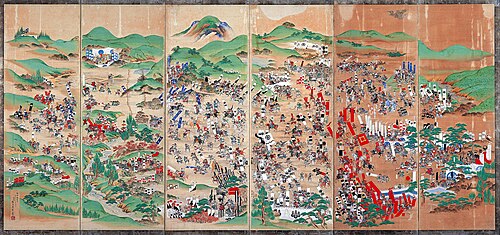
Start at the top for an easy introduction. Go further down for more detail and scholarship.
- Easy
- Intermediate
- Advanced
For young readers
When Toyotomi Hideyoshi, the ruler of Japan who had started the war against Korea, died in 1598, his son Hideyori was only five years old. Hideyoshi asked the most powerful lords to look after the boy until he grew up.
But the lords did not trust each other. The strongest of them, Tokugawa Ieyasu, began to act as if he were in charge. Another of Hideyoshi’s men, Ishida Mitsunari, gathered lords who were afraid of Ieyasu. Japan split into two camps, which people later called the Eastern Army and the Western Army.
On a foggy morning in the autumn of 1600 the two armies, tens of thousands of soldiers on each side, met in a narrow valley called Sekigahara. The fighting was fierce. At some point — historians still argue about exactly when — one of the Western commanders, a young lord named Kobayakawa Hideaki, attacked his own side, and several others did the same. The Western Army fell apart in a single day.
Ieyasu became the most powerful man in Japan. Three years later he became shogun, and his family ruled Japan for more than 260 years. Many of the lords who fought at Sekigahara had also fought in Korea a few years earlier, and the new Tokugawa government soon tried to make peace with Korea.
People in Japan still call Sekigahara “the battle that divided the realm”. But many historians now doubt some famous stories about it, like Ieyasu firing guns at Kobayakawa to make him change sides, because they were first written down long afterwards.
At a glance
- Date
- 15th day of the 9th month of Keichō 5 = 21 October 1600 (Gregorian). The main fighting took place in the morning and around midday; how long it lasted is debated
- Place
- Sekigahara (also called Aonogahara in some early sources), a valley in Mino Province where the Nakasendō road crosses the hills between the Ise Bay plain and Lake Biwa; today Sekigahara town, Gifu Prefecture
- Sides
- Eastern Army: Tokugawa Ieyasu with Fukushima Masanori, Kuroda Nagamasa, Hosokawa Tadaoki, Ii Naomasa, Tōdō Takatora and others / Western Army: nominally led by Mōri Terumoto (who stayed in Osaka Castle), with Ishida Mitsunari, Ukita Hideie, Ōtani Yoshitsugu, Konishi Yukinaga, Shimazu Yoshihiro and others
- Changed sides
- Kobayakawa Hideaki, Wakisaka Yasuharu, Kutsuki Mototsuna, Ogawa Suketada and Akaza Naoyasu attacked the Western Army; Kikkawa Hiroie had promised Ieyasu that the Mōri troops on Mount Nangū would not fight
- Forces
- Uncertain. Japanese reference works put both armies at about 80,000; one English study gives about 89,000 East and 82,000 West. Many figures go back to estimates made from domain sizes by the Imperial Army General Staff in 1893. A large part of the Western Army never fought
- Losses
- Unknown. A letter of the 20th day of the 9th month by the court noble Konoe Sakihisa reports 4,000–5,000 Western dead; later chronicles give about 8,000 (1656) or 32,600 (1713)
- Result
- Eastern victory. Ishida Mitsunari, Konishi Yukinaga and Ankokuji Ekei were executed in Kyoto; by one count 91 houses of Western lords lost their domains and four had them reduced; the Toyotomi kept Osaka but lost most of their wider lands. Ieyasu became shogun in 1603
- Main sources
- Letters written in the days after the battle (by Ieyasu, by his officials Ishikawa Yasumichi and Hikosaka Motomasa, by Kikkawa Hiroie and by Konoe Sakihisa); Ōta Gyūichi’s chronicle of 1601; later military chronicles and family histories of the Edo period
On the map
Meanwhile elsewhere in the world
Other subjects in this library from around the same years, in distant parts of the world.
- Benin Bronzesc. 1300–1897 · Benin City (Kingdom of Benin)
- William Shakespeare1589–1613 · London (England)
- Journey to the Westc. 1592 · Nanjing (Ming China)
- Akbar1556–1605 · Fatehpur Sikri (Mughal Empire)
- Selimiye Mosque1568–1575 · Edirne (Ottoman Empire)
- Florentine Codexc. 1545–1577 · Tlatelolco, Mexico City (New Spain)
Easy
What happened at Sekigahara?
The Battle of Sekigahara was fought on the 15th day of the 9th month of Keichō 5, which is 21 October 1600 in the Western calendar (in this article, month-and-day dates follow the Japanese lunisolar calendar of the time unless marked otherwise), at Sekigahara in Mino Province, in today’s Gifu Prefecture. On one side stood the Eastern Army of Tokugawa Ieyasu; on the other the Western Army raised by Ishida Mitsunari and other officials of the Toyotomi government in the name of Hideyoshi’s young son Hideyori.
Both armies were large. In the course of the fighting, Kobayakawa Hideaki, whose troops were posted on Mount Matsuo at the southern edge of the battlefield, attacked the Western Army, and four other Western commanders also turned against it; historians disagree about exactly when this happened. The Western line collapsed. The commander Ōtani Yoshitsugu took his own life, Ishida Mitsunari fled into the mountains, and the Shimazu troops of Satsuma cut their way out through the enemy.
The battle was part of a war that was fought all over Japan in 1600, from Tōhoku in the north to Kyushu in the south. But it was Sekigahara that decided the outcome. Within weeks the Western leaders had been captured and executed, and Ieyasu redistributed the lands of the defeated among his allies. In 1603 the emperor appointed him shogun.
For readers of this site, Sekigahara also belongs to the story of the Imjin War. Many of the commanders on both sides had led armies in Korea a few years earlier, and the new Tokugawa government that came out of the battle quickly sought peace with Korea. The battle is the bridge between Hideyoshi’s war and the long peace of the Edo period.
Easy
After Hideyoshi: a child ruler and rival lords
When Toyotomi Hideyoshi died at Fushimi in the 8th month of 1598, his heir Hideyori was five years old. Hideyoshi had arranged for the government to be run by five great lords, the Five Elders — Tokugawa Ieyasu, Maeda Toshiie, Mōri Terumoto, Ukita Hideie and Uesugi Kagekatsu — and five commissioners, among them Ishida Mitsunari, who had managed much of his administration. All of them swore again and again to serve Hideyori.
The balance broke down quickly. Early in 1599 Ieyasu was found to have arranged marriages between his family and other lords without the council’s approval, which Hideyoshi had forbidden; it nearly came to fighting between his supporters and those of Maeda Toshiie. After Toshiie died in the spring of 1599, seven generals, among them Katō Kiyomasa, Fukushima Masanori and Kuroda Nagamasa, moved against Ishida Mitsunari. Older books call this an attack; some recent historians think it was less an attack than a show of force backed by a legal complaint. Either way, Mitsunari had to give up his post and retire to his castle at Sawayama.
Ieyasu then took up residence in Fushimi Castle and, in the autumn of 1599, moved into Osaka Castle, where Hideyori lived, and began to reward and punish lords on his own authority. When Uesugi Kagekatsu, another of the Five Elders, refused to come to the capital to explain his military preparations in Aizu, Ieyasu declared a campaign against him and in the 6th month of 1600 marched east with many of the lords who were at odds with Mitsunari.
Easy
Summer 1600: from Aizu to Mino
With Ieyasu away in the east, his opponents rose. In the 7th month of 1600 Mōri Terumoto entered Osaka Castle and became the nominal head of the Western Army, and three of the commissioners issued a list of charges against Ieyasu, the “Naifu chigai no jōjō”, accusing him of breaking Hideyoshi’s rules. Western troops besieged Fushimi Castle, held for Ieyasu by his old retainer Torii Mototada, and took it on the 1st day of the 8th month.
Ieyasu’s allies turned back west. A famous story tells of a council of war at Oyama, north of Edo, where Fukushima Masanori declared for Ieyasu and the other lords followed. No letter of the time describes this meeting, and historians disagree about whether it took place in the form the later accounts describe. What is clear from the documents is that the lords from western and central Japan marched back along the Tōkaidō road, while Ieyasu returned to Edo and waited to see which way they would go.
On the 23rd day of the 8th month the eastern lords stormed Gifu Castle, held by Oda Hidenobu, Nobunaga’s grandson. Only then did Ieyasu leave Edo, on the 1st day of the 9th month. His son Hidetada, marching with another Tokugawa army along the Nakasendō, spent several days before Ueda Castle, held by Sanada Masayuki; he arrived too late for the battle. His late arrival is often explained by Ieyasu’s orders reaching him late and by bad weather, but historians dispute these causes and how much each mattered. The traditional story that he suffered a heavy defeat at Ueda is not supported by documents of the time.
On the 14th day of the 9th month Ieyasu reached Akasaka near Ōgaki Castle, where Mitsunari, Ukita, Konishi and Shimazu were based. That same day Kikkawa Hiroie, a leading Mōri commander, sent hostages to the Tokugawa side and agreed that the Mōri troops would not fight, in return for a promise that Terumoto’s lands would be safe. That night the Western leaders left Ōgaki in heavy rain and moved west to Sekigahara.
Easy
The 15th day of the 9th month
Sekigahara is a small basin where several roads meet. According to the traditional picture, the Western Army held the hills on its western and southern edges: Ishida Mitsunari on the north, then Shimazu, Konishi and Ukita in the centre, Ōtani Yoshitsugu and his allies in the south-west, and Kobayakawa Hideaki on Mount Matsuo. Mōri, Kikkawa and other troops stood behind the Eastern Army, on Mount Nangū to the east. Some recent research, using airborne laser surveys, suggests that the Western positions may have been further west, in the hills above the village of Yamanaka.
The morning was foggy after the night’s rain. When the fighting began, and in what order, are disputed: a letter written two days later by two of Ieyasu’s officials says that Ieyasu moved forward to Sekigahara around ten in the morning, while later accounts say skirmishing began around eight, in lingering fog. Later chronicles credit Ii Naomasa and Ieyasu’s son Matsudaira Tadayoshi with opening the attack, though some historians doubt this episode; Fukushima Masanori engaged Ukita’s troops, and Kuroda Nagamasa and others pressed Mitsunari’s positions.
At some point — at the very start of the fighting according to Shiramine Jun’s reading of the letters, after hours of fighting in the traditional account — Kobayakawa’s troops came down from Mount Matsuo and struck Ōtani Yoshitsugu’s force. Wakisaka, Kutsuki, Ogawa and Akaza, posted near Ōtani at the foot of the hill, also turned on him. Ōtani’s troops were destroyed and he killed himself, and the Western Army collapsed from the south. The Mōri troops on Mount Nangū never came down: Kikkawa Hiroie, whose troops were in front, blocked the way.
In a letter to Date Masamune dated the same day, Ieyasu reported a victorious engagement at around noon (the hour of the horse). Mitsunari, Konishi and Ukita fled into the mountains. Shimazu Yoshihiro, surrounded, broke out through the enemy lines, losing his nephew Shimazu Toyohisa and most of his men; Ii Naomasa was wounded by a Shimazu bullet in the pursuit. Eastern forces then attacked Mitsunari’s castle at Sawayama, which fell on the 18th; a letter of the time says Ieyasu reached Sawayama on the 15th itself, while later accounts date his advance to the following day.
Intermediate
Comrades in Korea, enemies at Sekigahara: why did the commanders split?
Sekigahara was fought less than two years after the last Japanese troops left Korea, and men who had served in the same army there now faced each other. On the Western side were Ukita Hideie, commander-in-chief in Korea during the first invasion, who had led the assault on Haengju; Konishi Yukinaga, the first commander to land at Busan in 1592; Shimazu Yoshihiro, who had fought at Sacheon and Noryang; and Ōtani Yoshitsugu, one of the commissioners sent to Korea. Kobayakawa Hideaki, the nominal commander-in-chief of the second invasion, and Wakisaka Yasuharu, whose fleet Yi Sun-sin had destroyed at Hansan Island in 1592, were also posted with the West, and both turned against it during the battle. On the Eastern side were Kuroda Nagamasa, Fukushima Masanori, Hosokawa Tadaoki, Tōdō Takatora, Katō Yoshiaki and others who had led troops or ships in Korea, while Katō Kiyomasa fought for the East in Kyushu. Ieyasu himself had sent no troops to Korea. How did the commanders of one army end up on opposite sides?
Part of the answer lies in Japan rather than in Korea. Hideyoshi left a five-year-old heir and a council of great lords and commissioners who were meant to govern together. Ieyasu, the strongest of the Elders, soon broke rules that Hideyoshi had laid down, and the death of Maeda Toshiie in 1599 removed the Elder who had balanced him. Every lord had to decide whom to trust with Hideyori’s government, and when the commissioners rose against Ieyasu in 1600, their list of charges was a list of such breaches.
The war in Korea added grievances of its own. During the second invasion Hideyoshi sent seven military inspectors (ikusa-metsuke) to watch his commanders. Their leader was Fukuhara Nagataka, the husband of Ishida Mitsunari’s younger sister, and Mitsunari oversaw their work. After the siege of Ulsan was lifted early in 1598, Fukuhara reported that Hachisuka Iemasa and Kuroda Nagamasa had not fought when the Ming army came near their positions, and blamed other inspectors for failing to supervise them. Hideyoshi was already furious that the commanders in Korea had proposed to shorten the front by giving up Ulsan and Suncheon. He ordered Hachisuka, who had backed the proposal, home into confinement, rebuked Kuroda and would not even accept his letters of explanation, and gave no rewards for what the commanders regarded as a hard-won victory. The commanders blamed the inspectors and Mitsunari. Yet they were not united either: Katō Kiyomasa, for one, had opposed the proposal that Hachisuka supported.
After Hideyoshi’s death the returning commanders reopened the case. According to one account, in the 3rd month of 1599 Katō Kiyomasa, Kuroda Nagamasa and Asano Yoshinaga, with the agreement of Fukushima Masanori, Hosokawa Tadaoki, Ikeda Terumasa and Katō Yoshiaki, asked Mitsunari to order the inspectors to commit seppuku, and Mitsunari refused, saying that the lack of rewards had been Hideyoshi’s own decision. When Maeda Toshiie died on the 3rd day of the intercalary 3rd month, they moved against Mitsunari. The sources disagree about who took part: the number seven is traditional, while a diary of the time speaks of about ten lords. Historians also debate whether it was an armed attack or a ‘lawsuit’ backed by a show of force. The outcome is clear. Mitsunari gave up his post and retired to Sawayama, Ieyasu moved into Fushimi Castle, and on the 19th Fukuhara and another inspector, Kumagai Naomori, were punished for ‘misconduct’ in Korea, while Hachisuka’s and Kuroda’s conduct at Ulsan was vindicated. Kasaya Kazuhiko sees Ieyasu’s handling of the affair as the moment he became the de facto head of the government; Mizuno Tomoki argues that the generals had acted with Ieyasu’s approval throughout.
Old grudges did not decide everything. Not all of the generals who turned on Mitsunari had fought at Ulsan — Fukushima and Hosokawa had not — and lords who later fought side by side for Ieyasu had quarrels of their own, such as Katō Yoshiaki and Tōdō Takatora over credit for the naval victory at Chilcheollyang in 1597. Katō Kiyomasa, the best-known enemy of Mitsunari, fell out with Ieyasu in 1599 by helping a rebel against the Shimazu in the Shōnai rebellion; he was kept out of the Aizu campaign, confined in practice to Higo and courted by the West, and historians disagree about whether he wavered. Konishi Yukinaga, Kiyomasa’s rival since the race to Hanseong in 1592, had served after his return from Korea as an intermediary (toritsugi) for Ieyasu, yet he joined the West; the long war had drained his army, and he had to borrow troops from Mitsunari. Shimazu Yoshihiro, according to accounts written later under Tokugawa rule, joined the West only after being refused entry to Fushimi Castle, but a letter of the 15th day of the 7th month shows him already committed to the league against Ieyasu; he had only about a thousand men, later joined by some 390 volunteers from home. Ukita Hideie, married to Hideyoshi’s adopted daughter and treated as a member of the Toyotomi family, led the largest Western contingent, but a feud in his house early in 1600 had driven away senior retainers such as Togawa Michiyasu, who went over to Ieyasu and fought against his former lord at Sekigahara.
Older histories turned these stories into a feud between Hideyoshi’s ‘civil officials’ (bunchi-ha), led by Mitsunari, and his ‘military men’ (budan-ha), led by Kiyomasa. Nakano Hitoshi and others argue that this scheme grew out of Edo-period chronicles: many anecdotes of the feud cannot be confirmed in documents of the time, and Kiyomasa himself had done mostly administrative work before the Korean war. Other explanations point to a struggle between Ieyasu and the commissioners over Hideyoshi’s rules, or to tension between officials who wanted to tighten central control and lords who resisted it, a view that has itself been questioned. Many historians now explain each lord’s choice in 1600 by a combination of factors.
So why did the commanders who came back from Korea fight each other two years later? Hideyoshi’s death left a child ruler and an open contest for control of his government; the Korean war left quarrels over merit and blame that set many returning commanders against Mitsunari and his inspectors; and Ieyasu made use of both, settling the crisis of 1599 in the generals’ favour, leading many of them east in 1600 and winning over others with letters and promises. But the two camps were not simply ‘the Korean veterans’ against ‘the officials’: veterans of Korea fought on both sides, and family ties, land, fear and calculation mattered as much as old grudges. What became of these men after the battle is told under ‘Punishments and rewards’ below.
Intermediate
Inside the basin, step by step: the traditional account and its problems
Sekigahara lies in a gap between the Ibuki mountains to the north and the Suzuka range to the south. The Nakasendō ran through it from east to west, and two roads branched off there: one north-west towards the Hokuriku region (the Hokkoku road) and one south-east towards Ise (the Ise road). In the traditional picture Ishida Mitsunari camped at the foot of Mount Sasao on the north-west side of the basin, covering the Hokkoku road. Kobayakawa Hideaki held the hill castle on Mount Matsuo to the south, which he had occupied only on the 14th, driving out the Western commander who held it. Mōri Hidemoto, Kikkawa Hiroie, Ankokuji Ekei, Natsuka Masaie and Chōsokabe Morichika were on and around Mount Nangū to the east, behind the Eastern Army, and Ieyasu’s first headquarters was on the low hill of Momokubari, east of the basin.
From north to south, Mitsunari, Shimazu Yoshihiro, Konishi Yukinaga and Ukita Hideie lined the western foothills. Ōtani Yoshitsugu, with Hiratsuka Tamehiro, Toda Katsushige and others, had been camped at Yamanaka, south-west of the basin, since the 2nd day of the 9th month; at the foot of Mount Matsuo stood Wakisaka Yasuharu, Kutsuki Mototsuna, Ogawa Suketada and Akaza Naoyasu, posted there to guard against Kobayakawa, who was already rumoured to be in touch with the East. The Eastern vanguard was Fukushima Masanori, south of the Nakasendō and facing Ukita, with Tōdō Takatora and Kyōgoku Takatomo beside him; north of the road Kuroda Nagamasa, Hosokawa Tadaoki, Katō Yoshiaki, Tanaka Yoshimasa and others faced Mitsunari, and Ii Naomasa and Matsudaira Tadayoshi were between them. Ikeda Terumasa, Asano Yoshinaga, Yamauchi Kazutoyo and others were left to watch Mount Nangū. No document of the time records these positions, however. The familiar battle map is based on the one published by the Army General Staff in 1893, and Shiramine Jun argues that it contradicts the General Staff’s own text and should not be cited uncritically.
How the fighting began is uncertain. According to the Kuroda kafu (1688), Ii Naomasa, taking with him Ieyasu’s fourth son Matsudaira Tadayoshi, who was also his son-in-law, tried to pass through Fukushima’s ranks; stopped by Fukushima’s officer Kani Saizō, he said he was only reconnoitring, went ahead with about 300 men, and Tadayoshi won the first honours. Kasaya Kazuhiko points out that Ieyasu’s regulations forbade stealing the lead and that Fukushima never complained, and suggests that Ii’s party used reconnaissance in the fog to make its first clash look like a chance encounter, securing first honours for the Tokugawa troops without openly breaking the rule; on this reading the battle proper began when Fukushima’s troops opened fire on Ukita’s. The description of the national historic site likewise defines the opening ground as the place where Fukushima challenged Ukita, who was camped at the southern foot of Mount Tenma. As for the hour, Edo-period chronicles give about eight in the morning, while the officials’ letter of the 17th gives about ten, which some historians take as the start of the battle.
In the traditional account the fighting then spread along the whole line. In the south Fukushima’s men fought Ukita’s vanguard of about 8,000 under Akashi Takenori and were at one point driven back, but held. In the north Tanaka, Kuroda, Hosokawa, Katō Yoshiaki and others attacked Mitsunari’s position, where his chief retainer Shima Sakon led the defence; one account says that Kuroda’s gunners under Kan Masatoshi shot him from the flank, but his fate is uncertain, and one tradition even has him surviving in Kyoto. In the south-west Tōdō and Kyōgoku fought Ōtani’s troops, and in the centre Ii Naomasa and Matsudaira Tadayoshi engaged the Shimazu. According to the Chōya kyūbun hōkō, a history compiled for the shogunate, Konishi’s troops fought only minor actions before noon, and Konishi turned down a Shimazu request to advance because Kobayakawa’s intentions were unclear. Kobayakawa on Mount Matsuo and the troops on Mount Nangū did not move.
When Kobayakawa’s troops came down from Mount Matsuo — the timing is discussed below in the section on the defection debate — Ōtani met them with some 600 men he had kept ready for just such a betrayal and, joined by Hiratsuka and Toda returning from the front, is said to have driven them back up the hill two or three times; Okudaira Sadaharu, the officer the East had attached to Kobayakawa, was mortally wounded. Then Wakisaka, Kutsuki, Ogawa and Akaza, whom Tōdō Takatora had approached in advance, also turned on Ōtani’s force, and it was destroyed; Ōtani killed himself. Wakisaka was the commander whose fleet Yi Sun-sin had destroyed at Hansan Island eight years earlier. In the order given by the Chōya kyūbun hōkō, after Ōtani’s collapse and the retreat of Ukita’s and Mitsunari’s forward units, Konishi’s vanguard wavered and his whole force broke under Eastern attack; Ukita’s army was routed, and Mitsunari, who held out longest, fled north-west into the Ibuki mountains.
The troops on and below Mount Nangū — Mōri Hidemoto, Kikkawa Hiroie, Ankokuji Ekei, Natsuka Masaie and Chōsokabe Morichika — never joined the battle. Kikkawa, whose troops were in front, blocked the way in keeping with his agreement of the day before. A well-known story that Hidemoto put off his allies by saying that his men were eating their lunch is an anecdote. Whether Mōri Terumoto in Osaka had authorised Kikkawa’s deal is debated: Watanabe Daimon sees it as Terumoto’s own peace with Ieyasu, while Mitsunari Junji thinks it unlikely that Kikkawa acted on Terumoto’s orders, though Terumoto may have tolerated his move while keeping his own options open. After the defeat Ikeda and Asano pursued the retreating Natsuka and Chōsokabe, but not the Mōri, Kikkawa and Ankokuji troops.
Intermediate
The Shimazu retreat
When the Western Army broke, the Shimazu contingent — about 1,500 men when it took up position, according to a guide map published for the city of Ōgaki, though other records give smaller or larger numbers — was left among the enemy. According to a later Shimazu biographical collection, Yoshihiro first meant to charge Ieyasu’s headquarters and die, but his nephew Shimazu Toyohisa and others persuaded him to try to get home. Rather than retreat west into the mountains, the Shimazu went forward: they broke through Fukushima’s troops, passed close by Ieyasu’s headquarters and headed south down the Ise road. Why they chose this route is debated: the confused battlefield may have been easier to cross than the mountains, the way behind them led away from Satsuma, or Yoshihiro, then in his sixties, may not have been able to cross the Ibuki range. Yoshihiro is said to have sent his retainer Kawakami Tadae to tell Ieyasu that he was going home to Satsuma and would apologise later.
The pursuit was fierce. Ii Naomasa and Matsudaira Tadayoshi followed with their troops. Toyohisa commanded the rearguard; one tradition has him killed fighting at Utōzaka, while other accounts say that he was wounded and took his own life further on, or that he died early, near the post town of Sekigahara. According to local tradition, another retainer, Chōjuin Moriatsu, put on Yoshihiro’s surcoat and died as his double, and a Shimazu gunner, Kashiwagi Gentō, shot Ii Naomasa off his horse near the foot of the Kachiji pass; Tadayoshi was also wounded in the fighting. The tactic later called sutegamari — leaving small groups behind to hold off the pursuers while the main body escaped — is associated with this retreat, but when the name came into use is unclear; it appears in a book on Sekigahara published in 1893.
In the route reconstructed by the Ōgaki guide map from local records and traditions — other routes have also been proposed — Yoshihiro’s main body crossed the Yōrō hills by the Komano pass, spent the night in the hills, and then crossed the Gosō pass into Ōmi — the pass later known as the ‘Shimazu crossing’ — before making its way to Sakai and home by sea. About eighty men are said to have reached Satsuma with him, though figures for both the force and the survivors differ from record to record. The retreat became a point of pride in Satsuma: the Myōenji pilgrimage in Kagoshima commemorates it, and since 1960 children from Kagoshima have walked the route in an annual event. After two years of negotiation the Shimazu house kept all its lands.
Intermediate
Who fought, and how many?
The war of 1600 was not a war between the Tokugawa and the Toyotomi. Both sides claimed to act for Hideyori. The Eastern Army was made up largely of lords who owed their rise to Hideyoshi, such as Fukushima Masanori, Katō Kiyomasa, Kuroda Nagamasa, Ikeda Terumasa and Hosokawa Tadaoki, together with Ieyasu’s own vassals. The Western Army was led by Hideyoshi’s commissioners and by great western lords: Mōri Terumoto, Ukita Hideie, the Shimazu and others.
Why lords chose one side or the other is a central question. Older histories explained it by a feud between Hideyoshi’s “civil officials”, such as Mitsunari, and his “military men”, such as Katō Kiyomasa. Historians such as Nakano Hitoshi argue that this picture comes mainly from Edo-period chronicles. Recent research points instead to many separate reasons: family ties, quarrels over land, fear of Ieyasu or of Mitsunari, and calculations about who would win.
Numbers are uncertain. The Japanese encyclopedia Nihon daihyakka zensho says that both armies had about 80,000 men, but that only about 35,000 of the Western troops actually fought. Many of the figures for individual contingents repeated in modern books come from the Imperial Army General Staff’s study of 1893, which estimated what each lord could have mobilised at three men per 100 koku of land, not what he actually brought. A court noble who received a report three days after the battle was told that Ieyasu had about 50,000 men.
Large forces never reached Sekigahara. Tokugawa Hidetada’s army, the core of the Tokugawa forces, was still on the road. Western troops were tied down besieging Ōtsu Castle and Tanabe Castle, and fighting went on in the north, where the Uesugi fought the Mogami and Date, and in Kyushu.
Intermediate
A Korean witness, and the road to peace with Joseon
A Korean was watching. The scholar Kang Hang, taken captive in 1597, was living at Fushimi in 1599, and his account of his captivity, the Ganyangnok, records rumours about the rivalries among the powerful lords after Hideyoshi’s death. Historians use it, with care, as a source for these years.
Sekigahara also affected diplomacy. The Sō family of Tsushima, which lived on trade with Korea, had been trying to reopen talks since 1599, and the battle interrupted them. Diplomatic contacts and the return of some captives had thus begun before Sekigahara. Joseon had already replied in the summer of 1600, deferring to the Ming, and in the 9th month of that year it made the return of captives a condition for any settlement. Ieyasu’s victory changed the political setting: the talks, interrupted by the upheaval in Japan, resumed with the Sō now working for the new ruler. Joseon, for its part, wanted its captives back and assurance against a new invasion, and Tsushima kept the talks moving partly by forging letters. They led in 1607 to the first formal Joseon embassy to the Tokugawa shogunate, officially an embassy “in reply and for bringing back captives”. The story of those embassies is told in the article on the Joseon missions to Japan.
Intermediate
Punishments and rewards
Ishida Mitsunari was captured in the mountains of northern Ōmi, Konishi Yukinaga near Mount Ibuki, and the Mōri adviser Ankokuji Ekei in Kyoto. After being paraded through Osaka and Sakai, they were taken to Kyoto and beheaded at Rokujō-gawara on the 1st day of the 10th month. Ukita Hideie escaped to Satsuma; he was later handed over, spared at the request of the Maeda and Shimazu, and exiled in 1606 to the island of Hachijō, where he lived until 1655.
Mōri Terumoto left Osaka Castle after being assured that his lands would be safe. Ieyasu then broke that promise, saying that captured letters showed Terumoto’s leading role. According to the traditional account, Kikkawa Hiroie, offered the provinces of Suō and Nagato for himself, asked that they be given to the Mōri instead — though, as explained below, the letters supporting this story are of doubtful authenticity. In the end the Mōri were reduced from about 1.2 million koku in eight provinces to about 300,000 koku in the two provinces of Suō and Nagato. Uesugi Kagekatsu lost three-quarters of his lands. The Shimazu, far away in Satsuma, negotiated for two years and kept all their territory.
Ieyasu rewarded his allies with large new domains, often far from the capital, and placed his relatives and own vassals along the roads between Edo, Kyoto and Osaka. Kobayakawa Hideaki received Ukita’s domain at Okayama, but he died there in 1602, traditionally aged twenty-one by the Japanese count, and his house came to an end. Figures for the land taken from the defeated differ; one Japanese reference work counts ninety-one houses and 4.2 million koku, and the English Wikipedia speaks of about eighty-seven daimyo.
The Toyotomi themselves were not treated as defeated enemies. Hideyori remained in Osaka Castle, and the war had been fought, at least formally, in his name. But the Toyotomi’s directly held lands shrank from about 2.2 million to about 650,000 koku, and the power to redistribute land passed in practice to Ieyasu, although Hideyori continued to recommend court ranks for his own retainers. Whether the Toyotomi had become just one great lord among others, or still held a special position above the daimyo, is debated; many historians now favour the second view, which helps to explain why it took a further war at Osaka in 1614–1615 to destroy them.
For the commanders who had fought in Korea, the battle decided their fates. Konishi Yukinaga, a Catholic, is said to have refused to take his own life because his faith forbade suicide; at his execution he is said to have raised an image of Christ and Mary over his head. Fukuhara Nagataka, the inspector whose Ulsan report had caused so much anger, held the inner citadel of Ōgaki Castle until the 23rd day of the 9th month and surrendered on terms, but he was not pardoned and took his own life on the 2nd day of the 10th month. On the winning side Kuroda Nagamasa received Chikuzen, assessed at about 523,000 koku, and Fukushima Masanori received Aki and Bingo, about 498,000 koku, with Mōri Terumoto’s castle at Hiroshima. Katō Kiyomasa, who had taken Konishi’s castles in Kyushu, received Konishi’s lands and ruled most of Higo, assessed at about 520,000 koku. Wakisaka Yasuharu kept his domain through Tōdō Takatora’s mediation, while Kutsuki Mototsuna’s lands were reduced and Ogawa Suketada and Akaza Naoyasu lost theirs.
Intermediate
Remembering Sekigahara
Under the Tokugawa, Sekigahara became the founding victory of the ruling house, and histories written for the shogunate and for the families who had fought there told the story in ways that flattered Ieyasu and their own ancestors. The phrase tenka wakeme, “the division of the realm”, became attached to the battle.
In 1893 the General Staff of the Imperial Japanese Army published a volume on the Sekigahara campaign in its series on Japanese military history, whose estimates of each lord’s troops are still repeated in many modern books. Novels, films and television dramas have made the main characters — the cautious Ieyasu, the loyal but unpopular Mitsunari, the hesitant young Kobayakawa — familiar to every Japanese reader.
The battlefield was designated a national historic site in 1931. Mounds where the heads of the dead were buried, the sites of the commanders’ camps and memorial stones can still be visited. In 2020 Gifu Prefecture opened the Gifu Sekigahara Battlefield Memorial Museum on the site of Ieyasu’s last camp, with the historian Owada Tetsuo as its director. The town has twinned itself with other famous battlefields, such as Gettysburg and Waterloo.
Advanced
Did Kobayakawa decide in advance? The defection debate
The most famous scene of the battle is Kobayakawa Hideaki’s hesitation. In the version popularised by later chronicles, Hideaki had secretly promised to join Ieyasu but waited on Mount Matsuo until midday; Ieyasu, biting his nails, ordered his gunners to fire at Hideaki’s position, and the frightened young lord finally attacked the West. This “inquiring fire” (toi-deppō) appears in countless novels and dramas.
Historians have taken this story apart. Fujimoto Masayuki argued that no reliable source of the time confirms it. Shiramine Jun has shown that the earliest chronicles, including Ōta Gyūichi’s work of 1601, do not mention it, that the versions that do appear later disagree about who fired, and that the form in which the shots immediately made Hideaki attack first appears in the Ochibo-shū of 1727. Goza Yūichi notes that the earliest known version comes from a chronicle printed in 1663, more than sixty years after the battle. Turnbull and others add that Mount Matsuo is so far from Ieyasu’s position that shots would hardly have been noticed.
Whether Hideaki had decided beforehand is a separate question. Letters show that the Eastern side had been working on him since before the 28th day of the 8th month; a joint letter from Kuroda Nagamasa and Asano Yoshinaga to him survives. A letter written two days after the battle by two of Ieyasu’s officials says that the Eastern vanguard attacked and that Kobayakawa, Wakisaka, and Ogawa Suketada and his son Sukeshige “betrayed” the West at that point, which Shiramine reads as a defection right at the start of the fighting. In his view the battle was short and one-sided.
Other historians are not convinced. Kasaya Kazuhiko points to the memoirs of Shimazu Yoshihiro and his retainers, which say that the fighting went on for some hours before Kobayakawa moved, and argues that a start at around eight in the morning leaves room for a period of hesitation. He also notes that phrases such as “we crushed them at once” were standard in victory letters. Kasaya also argues that the gunfire story, although known only from later accounts, cannot be dismissed outright, since independent later sources mention shooting near Kobayakawa’s camp. The present state of research is therefore that many historians doubt the gunfire story while some defend a version of it, that Kobayakawa had been in contact with the East for weeks, and that the exact moment of his attack is still debated.
Advanced
Letters, chronicles and family histories
There are very few records written on the day. The most important are letters: Ieyasu’s note to Date Masamune of the 15th, reporting a victory around noon; a letter of the 17th from his officials Ishikawa Yasumichi and Hikosaka Motomasa to Matsudaira Ienori, describing the battle and the defections; a letter by Kikkawa Hiroie; and a letter of the 20th by the retired regent Konoe Sakihisa to his son, passing on a report from Ieyasu’s camp, which gives 4,000–5,000 Western dead.
Ōta Gyūichi, the biographer of Oda Nobunaga, completed his account of Ieyasu’s campaign in 1601, the year after the battle, which makes it the earliest of the narrative works. Most details in modern retellings, however, come from later chronicles such as the Sekigahara shimatsuki of 1656 and the Sekigahara gunki taisei of 1713. The compiler of the standard collection of Sekigahara sources, Fujii Jizaemon, judged that hardly any of the chronicles of the battle could be trusted in every detail.
Family histories are a particular problem. Each house wanted to show its ancestors in the best light. Research on the Kikkawa family has shown that the Iwakuni domain, founded by Kikkawa Hiroie, paid the authors of chronicles to include its version of Hiroie’s conduct and tolerated the creation of documents to support it. The famous story that Hiroie saved the Mōri by giving up the provinces offered to him rests on letters whose originals do not survive.
Other well-known episodes have also been questioned: the Oyama council, which some historians think never happened in the form described; the night attack that Shimazu Yoshihiro is said to have proposed and Mitsunari to have refused, which appears in later chronicles such as the Kuroda kafu (1688) and, in more elaborate form, the Ochibo-shū (1727), without confirmation from documents of the time; and the quarrel between Fukushima Masanori and Ii Naomasa about who would attack first. Testing such stories against letters of the time has been an active field of Japanese research in recent decades.
Advanced
Was it really the decisive battle?
Sekigahara is often called the most important battle in Japanese history, and the English Wikipedia repeats this. There are good reasons: the Western leaders were destroyed, Ieyasu took control of land grants, and he increased the Tokugawa domain from about 2.55 to about 4 million koku, including major cities such as Kyoto, Sakai and Nagasaki and the great mines of Sado, Iwami and Ikuno.
Yet the battle did not end the Toyotomi. Hideyori remained in Osaka, the lords who had won the battle were mostly former vassals of Hideyoshi, and Ieyasu did not issue formal documents of enfeoffment to them at first. Many historians now think that the Toyotomi kept a special position outside the Tokugawa order until the Osaka campaigns of 1614–1615 removed it.
Research has also changed the picture of the battle itself. Historians have questioned why Mitsunari left Ōgaki for Sekigahara: the traditional explanation, that Ieyasu lured him out by spreading word that he would march on Sawayama and Osaka, is doubted, and Shiramine and others suggest that the Western leaders moved because they had learned of Kobayakawa’s betrayal. A 2020 television documentary presented the hypothesis, based on laser surveys and a Jesuit report, that the Western Army had built a large field fortress called Tamajō in the hills west of Sekigahara. These ideas are under discussion and not yet settled.
What all sides agree on is the consequence. Sekigahara created the political conditions for the Tokugawa shogunate, for two and a half centuries of largely peaceful rule, and for the restoration of relations with Korea — a peace that Joseon and Japan negotiated with their own aims, and that led to the return of captives and, in 1607, the first formal Joseon embassy to the Tokugawa shogunate.
Key ideas
- A war fought in Hideyori’s name
- Both armies claimed to serve Hideyoshi’s young son. The battle decided who would control the Toyotomi government, not at first whether it would exist.
- Defection as strategy
- Ieyasu won as much by letters and promises before the battle as by fighting: Kobayakawa and four other commanders changed sides, and the Mōri stayed out.
- Veterans of the Korean war
- Many commanders on both sides had fought in Korea in 1592–1598, and rivalries from that war are part of the story, though historians debate how much they mattered.
- Land as reward and punishment
- After the battle Ieyasu redrew the map of Japan, taking land from the losers and moving the winners, which gave him the authority of a national ruler.
- Legends under review
- Famous scenes such as the gunfire at Kobayakawa or the Oyama council come mostly from later chronicles, and modern historians test them against letters written at the time.
- From war to peace with Korea
- The new Tokugawa government wanted peace and trade, and Joseon wanted its captives back and security; negotiations under the new regime led to the return of captives and the Joseon embassies to Japan.
Records
- 1598 — Early in the year, after the siege of Ulsan in Korea is lifted, the inspector Fukuhara Nagataka’s report leads Hideyoshi to punish Hachisuka Iemasa and Kuroda Nagamasa.
- 1598 — 18th day of the 8th month (18 September): Toyotomi Hideyoshi dies; the Japanese armies withdraw from Korea by the end of the year.
- 1599 — Quarrel over Ieyasu’s unauthorised marriage alliances; death of Maeda Toshiie; Ishida Mitsunari forced to retire to Sawayama; Ieyasu enters Fushimi Castle and the inspectors Fukuhara Nagataka and Kumagai Naomori are punished for their conduct in Korea; in the autumn Ieyasu moves into Osaka Castle.
- 1600 — 6th month: Ieyasu leaves Osaka to campaign against Uesugi Kagekatsu in Aizu.
- 1600 — 7th month: Mōri Terumoto enters Osaka Castle; the commissioners issue their charges against Ieyasu; the siege of Fushimi Castle begins.
- 1600 — 1st day of the 8th month: Fushimi Castle falls. 23rd day: the Eastern lords take Gifu Castle.
- 1600 — 1st day of the 9th month: Ieyasu leaves Edo. Tokugawa Hidetada is held up at Ueda Castle.
- 1600 — 14th day of the 9th month: Ieyasu reaches Akasaka; Kikkawa Hiroie agrees that the Mōri will not fight; the Western Army moves to Sekigahara at night.
- 1600 — 15th day of the 9th month (21 October): Battle of Sekigahara.
- 1600 — 1st day of the 10th month: Ishida Mitsunari, Konishi Yukinaga and Ankokuji Ekei are beheaded in Kyoto. 10th day: the Mōri are reduced to the two provinces of Suō and Nagato.
- 1602 — The Shimazu keep their lands after long negotiations; Kobayakawa Hideaki dies at Okayama.
- 1603 — Tokugawa Ieyasu is appointed shogun.
- 1607 — The first Joseon embassy of the Tokugawa period reaches Edo.
- 1615 — Fall of Osaka Castle; the Toyotomi line ends.
- 1931 — The battlefield is designated a national historic site.
- 2020 — Opening of the Gifu Sekigahara Battlefield Memorial Museum.
Glossary
- Eastern Army (Tōgun)
- The coalition led by Tokugawa Ieyasu in 1600.
- Western Army (Seigun)
- The coalition formed in 1600 by Toyotomi commissioners and western lords, nominally led by Mōri Terumoto.
- Five Elders (go-tairō)
- The five great lords Hideyoshi appointed to govern for his son: Tokugawa, Maeda, Mōri, Ukita and Uesugi.
- Five Commissioners (go-bugyō)
- Hideyoshi’s chief administrators, among them Ishida Mitsunari.
- Toi-deppō
- “Inquiring fire”: the story that Ieyasu had guns fired at Kobayakawa’s position to force him to choose. Modern historians doubt it.
- Koku
- A measure of rice used to value land; domains were ranked by their assessed yield in koku.
- Kubizuka
- Mounds where the heads of soldiers killed in the battle were buried; two survive at Sekigahara.
- Shimazu no nokiguchi
- “The Shimazu retreat”: Shimazu Yoshihiro’s breakout through the Eastern Army at the end of the battle.
- Naifu chigai no jōjō
- The list of charges against Ieyasu (“the Inner Minister’s violations”) issued by three commissioners in the 7th month of 1600.
- Ikusa-metsuke
- Military inspectors who reported on commanders’ conduct; in the second invasion of Korea seven were sent, led by Fukuhara Nagataka.
- Sutegamari
- A rearguard tactic associated with the Shimazu retreat: small groups left behind to hold off pursuers while the main body escaped. When the name came into use is unclear.
Questions and answers
Who won the Battle of Sekigahara?
The Eastern Army of Tokugawa Ieyasu. Three years later Ieyasu became shogun, and his family ruled Japan until 1867.
Was it a battle between the Tokugawa and the Toyotomi?
Not directly. Both sides claimed to serve Hideyori, and many of Ieyasu’s allies were Hideyoshi’s former generals. The war against the Toyotomi themselves came later, at Osaka in 1614–1615.
Why did Kobayakawa Hideaki change sides?
He never explained it himself, and he died two years later. Letters show that the Eastern side had been persuading him for weeks before the battle. Stories that he hated Mitsunari because of events in Korea are not supported by documents of the time.
Did Ieyasu really fire at Kobayakawa’s camp?
Probably not. The story first appears in chronicles written more than sixty years later, and the earliest accounts do not mention it.
How many soldiers died?
Nobody knows. A letter written five days after the battle mentions 4,000–5,000 Western dead; later chronicles give much larger numbers.
Why did Japanese commanders who had fought together in Korea fight each other at Sekigahara?
Hideyoshi’s death left a child heir and a struggle over who would run his government, and the Korean war left grievances — above all over an inspector’s report after the siege of Ulsan in 1598 — that turned many returning commanders against Ishida Mitsunari. Ieyasu sided with them in 1599 and led many of them in 1600. But veterans of Korea fought on both sides, and family ties, land, fear and calculation mattered as much as old grudges.
What does Sekigahara have to do with Korea?
Many of its commanders had fought in the Imjin War. The Tokugawa government it brought to power negotiated peace with Joseon, which wanted its captives back and security against a new invasion; the talks, helped along by Tsushima, led to the return of captives and the Joseon missions to Japan.
Can you visit the battlefield?
Yes. It is a national historic site in Sekigahara, Gifu Prefecture, with camp sites, head mounds and a museum opened in 2020.
Sources and further reading
- Okamoto Ryōichi (岡本良一) (Nipponica entry), 関ヶ原の戦い (Battle of Sekigahara), in Nihon daihyakka zensho (Nipponica) and Britannica kokusai daihyakka jiten. Shogakukan / Britannica Japan, via Kotobank
- 関ヶ原の戦い. Wikipedia (Japanese)
- Battle of Sekigahara. Wikipedia
- 小早川秀秋 (Kobayakawa Hideaki). Wikipedia (Japanese)
- 文禄・慶長の役 (The Bunroku and Keichō campaigns). Wikipedia (Japanese)
- 柳川一件 (The Yanagawa affair). Wikipedia (Japanese)
- 朝鮮後期 朝·日講和와 朝·明關係 (Joseon–Japan peace and Joseon–Ming relations in the late Joseon period), section I: the start of Japan’s peace negotiations with Joseon. 國史館論叢 (Guksagwan nonchong) vol. 12, National Institute of Korean History
- 간양록 (看羊錄, Ganyangnok). Encyclopedia of Korean Culture (Academy of Korean Studies)
- 岐阜関ケ原古戦場記念館 (Gifu Sekigahara Battlefield Memorial Museum). Wikipedia (Japanese)
- Shiramine Jun (白峰旬), 新解釈 関ヶ原合戦の真実 — 脚色された天下分け目の戦い (A new interpretation: the truth about the Battle of Sekigahara). Miyaobi Shuppansha, 2014
- Anthony J. Bryant, Sekigahara 1600: The Final Struggle for Power. Osprey (Campaign series), 1995
- 七将襲撃事件 (The move of the seven generals against Ishida Mitsunari, 1599). Wikipedia (Japanese)
- 福原長堯 (Fukuhara Nagataka). Wikipedia (Japanese)
- 加藤清正 (Katō Kiyomasa). Wikipedia (Japanese)
- 小西行長 (Konishi Yukinaga). Wikipedia (Japanese)
- 島津義弘 (Shimazu Yoshihiro). Wikipedia (Japanese)
- 宇喜多秀家 (Ukita Hideie). Wikipedia (Japanese)
- 脇坂安治 (Wakisaka Yasuharu). Wikipedia (Japanese)
- 関ヶ原本戦の配置 (Positions at the main battle of Sekigahara). Wikipedia (Japanese)
- 関ケ原町 (Sekigahara town). Wikipedia (Japanese)
- 笹尾山 (Mount Sasao). Wikipedia (Japanese)
- 関ヶ原古戦場 (Sekigahara battlefield), national historic site description. Cultural Heritage Online (Agency for Cultural Affairs)
- 井伊直政 (Ii Naomasa). Wikipedia (Japanese)
- 福島正則 (Fukushima Masanori). Wikipedia (Japanese)
- 黒田長政 (Kuroda Nagamasa). Wikipedia (Japanese)
- 島清興 (Shima Kiyooki, known as Shima Sakon). Wikipedia (Japanese)
- 大谷吉継 (Ōtani Yoshitsugu). Wikipedia (Japanese)
- 島津の退き口 (The Shimazu retreat). Wikipedia (Japanese)
- 捨て奸 (Sutegamari). Wikipedia (Japanese)
- 敵中突破! 関ケ原合戦と島津の退き口 — 上石津ガイドマップ (Breaking through the enemy: the Battle of Sekigahara and the Shimazu retreat — Kamiishizu guide map). Ōgaki Tourism Association / Kamiishizu town-development council (Ōgaki city centenary project)
- 上田合戦 (Battles of Ueda). Wikipedia (Japanese)
Related
- Tokugawa IeyasuJapanese warlord who won the Battle of Sekigahara in 1600 and founded the Tokugawa shogunate, ruling from Edo.
- Wars of Japan’s UnificationThe wars of 1560–1615 in which Oda Nobunaga, Toyotomi Hideyoshi and Tokugawa Ieyasu ended Japan’s century of civil war and founded the Tokugawa shogunate.
- Ukita HideieLord of Okayama, treated as a member of Toyotomi Hideyoshi’s family, who held senior command in Korea in 1592–1593 and led the Left Army that took Namwon in 1597; after Sekigahara he was exiled to the island of Hachijō.
- Joseon missions to Japan (Tongsinsa)Twelve embassies of several hundred people each that the kings of Joseon sent to the Tokugawa shoguns between 1607 and 1811; born of the peace after Hideyoshi’s invasions, they became the main channel of diplomacy and cultural exchange between Korea and Japan.
- Konishi YukinagaChristian daimyō from a Sakai merchant family who led the First Division in the 1592 invasion of Korea and conducted Japan’s peace talks with the Ming envoy Shen Weijing.
- Katō KiyomasaJapanese commander from Owari who served Toyotomi Hideyoshi from boyhood, led the Second Division into Hamgyeong Province in 1592 and later built Kumamoto Castle.
- Kuroda NagamasaSon of Kuroda Kanbei who led the Third Division in the 1592 invasion of Korea and met the Ming at Jiksan in 1597; after siding with Tokugawa Ieyasu at Sekigahara he became the first lord of Fukuoka.
- Shimazu YoshihiroSatsuma general who held the Japanese castle at Sacheon in 1597–1598, beat back a Ming–Joseon assault there and led the relief fleet that the allied navy fought at Noryang; in 1600 he made a famous breakout at Sekigahara.
Written with AI assistance from the published sources listed above, and revised as new research appears.