Start at the top for an easy introduction. Go further down for more detail and scholarship.
- Easy
- Intermediate
- Advanced
For young readers
In 1597 Japan invaded Korea, then the kingdom of Joseon, for the second time. By the end of that year the Japanese soldiers had pulled back to the south coast, where they built strong castles in the Japanese style beside the sea. The castle furthest east stood on a small hill at Ulsan.
China, then ruled by the Ming dynasty, had sent a large army to help Korea. In the middle of winter the Chinese and Korean soldiers marched to Ulsan together. They wanted to catch Katō Kiyomasa, one of Japan’s most famous generals, before his new castle was finished.
The attackers burned the camps outside the castle and broke through its outer fence, but the stone walls on top of the hill were too strong. The Japanese inside had very little food and almost no water, and it was bitterly cold. The attackers suffered too, in freezing rain, and many were shot when they came close to the walls.
As the siege went on, more Japanese soldiers gathered by land and by sea to rescue the castle. After about twelve days the Chinese and Korean army gave up and marched away, and many were killed as they retreated. The Chinese commander, Yang Hao, told his emperor they had nearly succeeded, but he was later accused of hiding the losses and lost his post.
In the autumn of 1598 the allies attacked Ulsan again, and failed again. In December the Japanese went home anyway, because their ruler Hideyoshi had died in September and his successors ordered the army back. Today the hill is a park in the city of Ulsan, and parts of the old stone walls can still be seen.
At a glance
- Date
- First siege: fighting outside the castle on the 22nd or 23rd day of the 12th lunar month of 1597 (28 or 29 January 1598, Gregorian, converted with the Korea Astronomy and Space Science Institute table); siege lifted on the 4th day of the 1st month of 1598 (9 February). Second siege: from late in the 9th lunar month of 1598 (the Encyclopedia of Korean Culture dates the fighting from the 22nd, 21 October) until Ma Gui’s infantry pulled back on the 4th day of the 10th month (2 November)
- Place
- Ulsan wajō (Japanese castle), called Dosan (“island hill”) by the allies, on a hill about 50 m high by the mouth of the Taehwa River, in today’s Hakseong-dong, Jung-gu, Ulsan; north of the Japanese castle at Seosaengpo
- War
- Second Japanese invasion (Jeongyu War, 1597–1598) of the Imjin War (1592–1598)
- Commanders
- Ming: Yang Hao (jingli, civil commissioner for Korea) and Ma Gui (tidu, commander), with Li Rumei, Gao Ce, Li Fangchun and others / Joseon: Gwon Yul, commander-in-chief (dowonsu) / Japan: Katō Kiyomasa, with Asano Yoshinaga, Ōta Kazuyoshi and Mōri troops; relief under Mōri Hidemoto, Kuroda Nagamasa, Hachisuka Iemasa, Nabeshima Naoshige and others
- Forces
- Ming: about 40,000 in three divisions according to the Ming History / Joseon: figures range from the 3,500 that Yang Hao and Ma Gui said had arrived at the start to 12,500 in a Japanese general-staff history; the Encyclopedia of Korean Culture gives Gwon Yul over 50,000 / Japan: “about 10,000” inside according to a Ming officer and to the Japanese account Kiyomasa Kōraijin oboegaki; prisoners told Yang Hao fewer than 3,000
- Losses
- Ming: nearly 700 dead and over 3,000 wounded during the siege (Yi Deok-hyeong’s report), plus heavy but uncounted losses in the retreat (“some say 3,000, some say 4,000”); the later Ming History claims almost 20,000 / Joseon and Japan: not counted reliably in the sources used here
- Result
- Japanese defensive victory: the allies withdrew to Gyeongju and Yang Hao to Hanseong. Yang was impeached in 1598 for concealing the losses and dismissed; the second siege also failed, and Katō burned and left the castle on the 18th day of the 11th lunar month (15 December 1598)
- Main sources
- Veritable Records of King Seonjo (reports of Yi Deok-hyeong, Gwon Yul, Yi Si-eon and others; Yang Hao’s memorial), Revised Annals of King Seonjo, Yu Seong-ryong’s Jingbirok, the Ming History; Japanese clan records as summarised in Japanese reference works
On the map
Meanwhile elsewhere in the world
Other subjects in this library from around the same years, in distant parts of the world.
- Benin Bronzesc. 1300–1897 · Benin City (Kingdom of Benin)
- William Shakespeare1589–1613 · London (England)
- Akbar1556–1605 · Fatehpur Sikri (Mughal Empire)
- Selimiye Mosque1568–1575 · Edirne (Ottoman Empire)
- Florentine Codexc. 1545–1577 · Tlatelolco, Mexico City (New Spain)
- Nzinga of Ndongo and Matamba1624–1663 · Ndongo and Matamba (Mbundu kingdoms, present-day Angola)
Easy
What happened at Ulsan?
The siege of Ulsan was the first major allied attack on the Japanese castles of the south coast during the second Japanese invasion of Korea (1597–1598), the last phase of the Imjin War. Korean records place the first fighting outside the castle on the 22nd or 23rd day of the 12th lunar month of 1597 and the end of the siege on the 4th day of the 1st month of 1598. Converted with the table of the Korea Astronomy and Space Science Institute (KASI), that is 28 or 29 January to 9 February 1598.
The target was a new castle in the Japanese style (wajō) that the Japanese were building to Katō Kiyomasa’s plan on a hill at Ulsan, at the eastern end of the Japanese line. A Ming army under the civil commissioner Yang Hao and the commander Ma Gui, together with Joseon troops under the commander-in-chief Gwon Yul, attacked before it was finished. They drove the Japanese out of their camps, took the outer earthwork and shut the garrison into the stone-walled castle on the summit.
The castle did not fall. The garrison was short of food and water, and both sides suffered in the winter rain and cold, but assaults on the high stone walls cost the attackers dearly. When Japanese relief forces gathered by land and sea, Yang Hao and Ma Gui lifted the siege; their army was attacked as it withdrew, and Yang later reported the campaign to the emperor as a near success. He was impeached and dismissed in 1598.
In the autumn of 1598 Ma Gui attacked Ulsan a second time, as one of four simultaneous allied offensives. That attack also failed, and Katō left Ulsan only when Japan withdrew from Korea after the death of Toyotomi Hideyoshi. The later sections of this page look at the castle, the siege, the reports about it and what the sources say about numbers.
Easy
A castle built in about forty days
In the autumn of 1597 the Japanese advance into Korea was halted, and the armies fell back to the south coast. There they kept the fortresses built in 1593 and began a new outer ring of castles; Japanese and Korean reference works list eight, from Ulsan in the east to Suncheon in the west. Ulsan was the easternmost, north of Katō Kiyomasa’s base at Seosaengpo on the coast. The Ming commanders regarded Katō as the strongest of the Japanese generals, and Yang Hao wrote to the emperor that he had to be struck first.
The site was a low, isolated hill at the head of Ulsan Bay, with the Taehwa River estuary along its south side. In 1597 the water reached the foot of the hill, so ships could moor directly below the castle. According to the Encyclopedia of Korean Culture, Katō drew up the plan, Asano Yoshinaga built it with 16,000 men in some forty days from the 12th day of the 10th month, and Ōta Kazuyoshi supervised the work; Japanese accounts date the start of construction to the middle of the 11th month and name Mōri Hidemoto’s troops among the builders, while Yang Hao’s memorial says the castle was begun in the 12th month. The records do not agree on when work started. Stone was taken from the walls of Ulsan town and of the old army headquarters nearby; excavators found a Joseon naval commander’s memorial stele of 1585 reused as a gate stone.
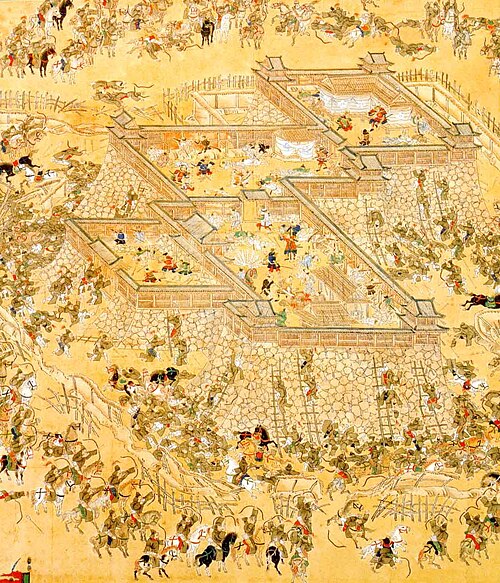
The finished plan had a main enclosure (honmaru) on the summit and two lower enclosures to the north and north-west, with twelve turrets and stone walls built at a slant in the Japanese manner. Around the landward sides ran a long earthen outer wall with a palisade and a ditch, and on the south a landing place for boats. A Ming officer described the castle to the Joseon court as four rings: a low earthen outer wall that could be broken, and three inner rings of stone with buildings along the tops of the walls, from which the defenders could fire down on anyone below.
When the allies attacked, the work was almost but not quite finished. The castle had not yet been stocked with food, and the hill had no well. Japanese accounts say that the Mōri troops had already begun to leave, and that Katō himself was away at Seosaengpo.
Easy
The outer works fall, the castle holds: January 1598
Yang Hao and Ma Gui marched south from Hanseong (Seoul) in the 12th lunar month and joined Gwon Yul’s Joseon forces at Gyeongju. To keep Konishi Yukinaga in the west from helping, the Encyclopedia of Korean Culture says, they made a show of moving toward Suncheon. The Ming troops were divided into three divisions; the Joseon commanders included Seong Yun-mun, Yi Si-eon and Jeong Gi-ryong, and the Gyeongsang naval commander Yi Un-ryong was ordered to watch Seosaengpo from the sea.
The allies set out from Gyeongju in three columns in the early hours of the 23rd. Gwon Yul and Yi Deok-hyeong reported that the vanguard of the left division under Li Rumei reached the Japanese camps at dawn, pretended to flee, then turned on the pursuers and took more than 500 heads; other accounts put this first fight on the 22nd. The Japanese camps outside the castle were burned, and the survivors fled up the hill. Katō, at Seosaengpo, came back that night with a small escort; Korean reports say he came on horseback, Japanese accounts by ship.
On the next day the allies attacked the outlying earthworks and the outer wall. Ming troops broke in, burned the buildings and two ships on the river, and the defenders retreated into the stone castle. Ten Ming soldiers got onto the wall and did not come back. The Revised Annals and Jingbirok add that the Ming troops, intent on plunder after taking the outer palisade, did not press on at once, and the defenders shut the gates. From then on every assault failed: the walls stood on a steep hill, the defenders fired through loopholes, and the Ming cannon, as a Joseon official later told the king, overshot the walls because the castle stood so high.
The allies then surrounded the hill, hoping that hunger and thirst would finish the garrison. They also tried to burn their way in: troops were sent forward carrying bundles of brushwood and shields to pile at the foot of the walls. The Joseon commanders Yi Si-eon and Seong Yun-mun reported a second large attack on the 27th (2 February), and wrote that almost all the Korean soldiers from Gyeongju and Ulsan who had carried brushwood for the fire attack were killed, and that the people of six or seven districts, including Andong, had been exhausted by carrying grain for the army.
Intermediate
Hunger, thirst and cold
The castle had been surrounded before it was supplied. A Ming officer told the Joseon court that there was little food inside and the water had run out. Yu Seong-ryong, who visited the allied camp on the 29th, wrote in Jingbirok that Dosan had no water, so the Japanese slipped out every night; on Yang’s orders Kim Eung-seo set an ambush by a spring outside the castle and over several nights caught more than a hundred men, all emaciated by hunger and barely alive.
Prisoners told Yang Hao that the garrison numbered fewer than 3,000, that the bodies of men killed by cannon and arrows or worn out by hunger and thirst lay everywhere, and that the 200 musketeers were each receiving one hop (a small measure) of raw rice a day. The Encyclopedia of Korean Culture adds that the defenders drank the blood and urine of their horses and boiled paper and the earth of the walls for food; Japanese Wikipedia repeats this, citing the encyclopedia. These stories come from later compilations and testimony and cannot all be checked; several accounts describe severe hunger and thirst, although its scale and the particular details remain uncertain.
One story about Katō himself reached the Joseon court in the 3rd month of 1598. A Korean sailor who had been a prisoner at Seosaengpo said that Katō had entered the castle with fifty men, twenty of whom were killed on the way, and that when things became desperate he twice tried to kill himself and was stopped by his officers. This is hearsay and is not found in the Japanese accounts used here; Japanese Wikipedia, citing Japanese sources, says Katō entered with about 500 men.
The besiegers suffered too. The Revised Annals say that heavy rain was followed by bitter cold, so that the soldiers were exhausted and frostbitten and many horses froze to death. Jingbirok describes the troops’ hands and feet cracked with cold in the winter rain, and Yu Seong-ryong reported that the men were camped in the open as an east wind brought rain. The allies had expected to finish the siege quickly and were not ready for a long one: a Joseon official later said that in the first rush the Ming troops had dropped much of their equipment and had no siege engines when they needed them.
Intermediate
Relief by land and sea, and a costly retreat
While the castle held, the other Japanese commanders gathered at Seosaengpo. According to Japanese accounts, Yamaguchi Munenaga (for Kobayakawa Hideaki), Kuroda Nagamasa, Mōri Hidemoto, Hachisuka Iemasa, Nabeshima Naoshige and his son and Katō Yoshiaki arrived one after another, and a fleet including Chōsokabe Motochika came by sea. Joseon reports already noted more than forty Japanese ships anchored on the lower Taehwa River, and Yang Hao posted 2,000 Zhejiang infantry and 1,000 cavalry on the bank to stop them landing.
There were also talks. Yang Hao’s memorial and Korean reports say that Katō, through interpreters, offered to surrender, or to withdraw if he were allowed to leave as Konishi had once been, and that Yang refused; Japanese accounts say that the allies sent envoys to demand surrender, and that Katō used the talks to gain time. The sources agree only that letters passed and that no agreement was reached.
On the 2nd day of the 1st month (7 February) Japanese troops appeared with many banners on distant hills facing the castle, and on the 3rd they came down to skirmish. That night the allies made a last assault by torchlight from all sides, from midnight until dawn. According to Yi Si-eon and Seong Yun-mun, the Japanese fire fell like rain, losses were very heavy, and no one reached the wall.
On the 4th (9 February) Yang and Ma Gui decided to withdraw. The infantry was sent off first while the cavalry covered the rear, and stores and gunpowder left behind were burned. The Zhejiang troops guarding the ford at Jeontan were not told and were caught by the Japanese coming down from the hills; few of the infantry escaped, and many threw away their armour to get away. Li Rumei’s Joseon liaison officer reported that the Japanese pursued for thirty li, that Ming dead were “some say 3,000, some say 4,000”, and that the retreating troops plundered villages, raped village women and even killed people on their way north. Yang withdrew to Hanseong, leaving Ma Gui and Gwon Yul to hold Gyeongju.
Intermediate
A victory on paper: Yang Hao’s report and impeachment
The first news to reach Hanseong was triumphant. Messengers spoke of hundreds of heads taken and of Katō trapped in his “earthen caves”, and King Seonjo thanked the Ming commanders for the victory. But Yi Deok-hyeong, the Joseon official attached to Yang Hao, reported that Yang would not allow the heads to be counted until the castle had fallen and told him not to report the allies’ own losses.
After the retreat Yang sent the emperor a memorial that told the story as a near success. His troops had stormed the Japanese positions for forty li, he wrote, killing uncounted numbers by fire and drowning and beheading or capturing more than 1,300; Katō had been on the point of capture when a relief army of tens of thousands arrived, and he had withdrawn to save his tired men. The imperial reply praised his courage and the many heads taken, but asked why he now offered to resign instead of planning to finish the war. Joseon’s own reports were less flattering: Yi Deok-hyeong counted nearly 700 Ming dead and over 3,000 wounded during the siege, not including the men lost at Jeontan in the retreat.
In 1598 the Ming war ministry official Ding Yingtai, who served on the staff in Korea, impeached Yang. The Ming History, compiled under the Qing, says that the army’s rolls showed almost 20,000 dead, that Yang suppressed them and reported only a hundred or so, and that Ding listed 28 crimes; King Seonjo spoke of 29 capital charges. Other charges, as reported in Seoul, were that Yang had made peace with Katō and that he had encouraged Joseon to build fortresses. Yang was dismissed and replaced by Wan Shide; news of the dismissal had reached Seoul by the 23rd day of the 6th lunar month (25 July 1598).
The Joseon court defended him. Its officials blamed quarrels between the Ming northern and southern troops over credit for the battle, and the king sent the envoys Choe Cheon-geon and then Yi Won-ik to Beijing to plead for Yang. Jingbirok says the king saw him off in tears when he left. Ding then accused the Joseon king himself of conspiring with Japan, a charge the Joseon court now had to answer. Yang Hao later returned to office and commanded the Ming army defeated by Nurhaci’s Jurchens at Sarhu in 1619; he was executed in 1629.
Intermediate
The second siege: October–November 1598
In the autumn of 1598 the Ming supreme commander Xing Jie tried again with a larger plan: four simultaneous attacks. Ma Gui was to take Ulsan in the east, Dong Yiyuan Sacheon in the centre and Liu Ting Suncheon in the west, while the admiral Chen Lin, with Yi Sun-sin’s Joseon fleet, attacked from the sea. Toyotomi Hideyoshi had in fact died on 18 September 1598, but his death was being kept secret.
According to the Encyclopedia of Korean Culture, Ma Gui led about 24,000 Ming troops and Kim Eung-seo 5,500 Koreans out of Gyeongju on the 21st day of the 9th month (20 October), and the attack on the castle began on the 22nd (21 October); a Korean report summarised in Japanese Wikipedia has the fighting at the castle begin on the 20th. Kim struck first at the Japanese near Dongnae to cut the road between Ulsan and Busan; Ming troops cleared the Japanese post at the Onjeong hot springs and brought out more than a thousand Korean captives. A Ming messenger reported that Ma Gui had burned large Japanese grain stores across the river and that over 1,100 Koreans, probably including these captives, had come over to his lines.
This time Katō was ready. The same messenger said that the Japanese had dug a moat and let sea water into it so that no one could cross, and that the castle looked impossible to take. Japanese accounts say that Katō kept his men inside and refused to be drawn out. On the night of the 22nd a Japanese raid killed five Ming soldiers. Ma Gui’s liaison officer soon reported that after falling back from the inner castle the commander had lost heart and wanted to retire to Gyeongju.
The news of Dong Yiyuan’s disastrous defeat at Sacheon on the 1st day of the 10th month (30 October) settled it. On the 4th (2 November) Ma Gui’s infantry withdrew with all its baggage and weapons, leaving only cavalry at Gyeongju. The Encyclopedia of Korean Culture dates the fighting at Ulsan to the 22nd–25th of the 9th month, while Korean reports show the army staying near the castle until early in the 10th month. Katō burned the castle and left on the 18th day of the 11th month (15 December 1598), as the Japanese withdrew from Korea; Ma Gui’s troops then entered it.
Intermediate
Meanwhile in the world, 1598
On 17 January 1598, less than two weeks before the siege began, Tsar Feodor I of Russia died without an heir. With him the ruling line descended from Ivan the Terrible, the Rurikid tsars, came to an end; his brother-in-law Boris Godunov became tsar, and Russia slid toward the crisis known as the Time of Troubles.
In France, King Henry IV signed the Edict of Nantes in April 1598, granting the Protestant Huguenots substantial rights and helping to end the French Wars of Religion. In May France and Spain made peace at Vervins, and in September King Philip II of Spain died at the age of 71.
None of these events had anything to do with Ulsan. Placing them side by side shows only that 1598, the last year of the war in Korea, was also a year of endings and settlements elsewhere.
Intermediate
Ulsan wajō today: Hakseong Park
After the war the burned castle was not abandoned at once. According to Korean Wikipedia, the Joseon navy used the site for a time, and from 1624 it held a shipyard for building warships, which the Encyclopedia of Korean Culture says was moved to Gaeunpo in 1654. In the late Joseon period the hill came to be called Hakseong (“crane castle”), a name that was later attached to the castle itself.
In 1913 a local notable, Kim Hong-jo, bought the hill and began planting it with black pines, cherry and plum trees to make a park, which later passed to the local authorities of Ulsan. It is now Hakseong Park, one of the city’s best-known parks. The paths, flower beds and other facilities built for the park, Korean Wikipedia notes, destroyed much of the north-western walls and the lower enclosures.
The castle’s heritage designation has changed several times. Designated a historic site under Japanese rule, it was made Historic Site No. 9 of the Republic of Korea in 1963 under the name Ulsan Hakseong, removed from the national list in 1997 together with other Japanese castles, and on 30 October 1997 designated Ulsan Metropolitan City Cultural Heritage Material No. 7 under the name Ulsan Waeseong (Ulsan Japanese castle). Excavations in 1986, 2011 and 2015 have traced the enclosures, a section of wall on the plain and the east gate.
Today the stone walls of the main enclosure on the summit can still be seen, while the river bank where ships once moored lies under houses and the estuary has moved far to the east. In Kumamoto, the city of Katō Kiyomasa’s later castle, a tram stop called Ulsan-machi is said to take its name from Ulsan or from people brought from there.
Advanced
Counting soldiers and dead: what the sources say
The allied army is usually put at 40,000–60,000 men. The Ming History speaks of 40,000 Ming troops in three divisions; a Japanese general-staff history, followed by Japanese Wikipedia, lists about 56,900 men including 12,500 Koreans; Korean Wikipedia gives 40,000 Ming and 11,500 Koreans; English Wikipedia speaks of 50,000. The Encyclopedia of Korean Culture gives 44,000 Ming and over 50,000 under Gwon Yul, a figure much larger than the others. At the start of the siege Yang Hao and Ma Gui said that only 3,500 Korean soldiers had actually arrived.
Estimates of the garrison vary even more. A Ming officer told the Joseon court that some 10,000 Japanese were inside, and the Japanese account Kiyomasa Kōraijin oboegaki, as cited in Japanese Wikipedia, gives 10,000; Yi Deok-hyeong and Gwon Yul thought there seemed to be about 2,000, and prisoners told Yang fewer than 3,000. Later Japanese works give 20,000 or 23,000, which Japanese Wikipedia considers too high. The numbers present may also have changed as stragglers and workers were driven into the castle.
Allied losses during the siege are best documented. Yi Deok-hyeong’s count, in a report dated the 6th day of the 1st month, gave nearly 700 Ming dead and more than 3,000 wounded, with the losses in the retreat still uncounted; a liaison officer reported rumours of 3,000 or 4,000 Ming dead in the retreat. English Wikipedia gives 1,621 dead and 2,908 wounded according to Ming sources. Against these stand much larger figures: the Ming History’s “almost 20,000”, and the 10,386 bodies that a document of the Asano family says were counted around the castle. Korean losses, which the Joseon commanders described as very heavy among the troops of Gyeongju and Ulsan, are not totalled in the sources used here.
Japanese losses are uncertain. Allied reports claimed more than 500 heads on the first day, 800 on the next, more than 1,300 beheaded or captured according to Yang Hao and about 690 for Li Rumei’s division; the Encyclopedia of Korean Culture gives 661 heads. These were claims made in a contest for credit and cannot be checked. The number of Japanese who died of hunger, thirst and cold inside the castle is not known.
Advanced
Sources and their problems
Most of what we know comes from Joseon reports in the Veritable Records of King Seonjo: dispatches from Gwon Yul, from the officials attached to the Ming commanders (Yi Deok-hyeong with Yang Hao, Jang Un-ik with Ma Gui, Yi Deok-yeol with Li Rumei) and from provincial commanders, as well as Ming messengers questioned at court. They were written within days or weeks, but each writer saw only part of the field, and the date heading an entry is the date of recording or of the court’s discussion, not necessarily the date of the events described. Yang Hao’s own memorial to the emperor is preserved in the same records. Yu Seong-ryong, who visited the siege, gives a brief account in Jingbirok.
The Ming History, compiled under the Qing dynasty, gives a strongly critical account of Yang Hao, and it should be compared with the contemporary Joseon reports. Its story that Yang called off a successful attack by Chen Yin so that his friend Li Rumei could take the credit, and its figure of 20,000 dead, are not found in those reports. Joseon officials, who admired Yang, blamed the quarrels between Ming factions and gave a different account of who had fought best; Yi Deok-hyeong told the king that the troops blamed Yang for sounding the retreat after the first day’s victory.
Japanese sources include clan records and later war tales, summarised in Japanese reference works. Some are very unreliable: one later chronicle claims an allied army of 800,000 and puts Kobayakawa Hideaki at Ulsan, although he was not there. The monk Keinen, a physician-monk in the service of Ōta Kazuyoshi, one of the commanders in the castle, kept a diary of the 1597–1598 campaign (Chōsen nichinichiki). Japanese Wikipedia mentions it in passing, but this page has not checked its Ulsan passages and does not rely on it.
Even the dates need care. Joseon, Ming and Japan all used lunar calendars, but not always the same one. Korean records place the first fight on the 22nd or the 23rd of the 12th month; Japanese accounts give the 22nd, which Japanese Wikipedia converts as 29 January 1598, the same day as the Korean 23rd. This page uses the Joseon dates converted with the KASI table. English Wikipedia’s end date of 19 February does not match the 4th day of the 1st month given in the Korean records, which is 9 February.
Advanced
What the sieges show about wajō warfare and the sea
Ulsan shows how hard the Japanese coastal castles were to take by storm. Built on steep hills, with layered enclosures, slanting stone walls and buildings from which musketeers could fire down, they suited defence by musketeers, whom the Japanese had in large numbers. Joseon observers reported that the allied cannon could not hit the castle on its height, that men carrying brushwood were shot down before they reached the walls, and that the soldiers who first got onto the wall did not return. Even unfinished, the castle held.
It also shows the weakness of such castles. Ulsan had no well and had not been provisioned, and within days the garrison was starving and desperate for water. The Korean Wikipedia article on the castle says that Katō remembered this when he later built Kumamoto Castle with many wells; the sources used here do not document that connection directly. In the autumn of 1598, with the castle complete, a sea-water moat dug and the garrison prepared, the allies could make no headway against it.
Above all, Ulsan depended on the sea. Ships could moor below the castle; Japanese boats from Seosaengpo came by water every day during the siege, and Ming reports say they were turned back; but Japanese ships still gathered in the river, and the relief army came by land and sea together. The allies could surround the hill on land, but they could not stop the Japanese from bringing ships up to it; the Joseon navy had been almost destroyed at Chilcheollyang in 1597. In the end the castles of Ulsan, Sacheon and Suncheon were all still in Japanese hands when Japan decided to withdraw, and the last great battle of the war was fought at sea, at Noryang.
The siege had consequences in Japan as well. Japanese accounts say that thirteen commanders, alarmed by Ulsan, proposed to Hideyoshi that Ulsan, Suncheon and Yangsan be abandoned; he refused. His inspectors reported that Hachisuka Iemasa and Kuroda Nagamasa had failed to fight in a preliminary clash during the relief, and both were reprimanded and confined to their domains; the punishments were reversed in 1599 after Hideyoshi’s death. One interpretation, cited in Japanese Wikipedia, links the resentment this caused among commanders such as Katō against Ishida Mitsunari, a relative of one of the inspectors, to the split that led to the Battle of Sekigahara in 1600.
Key ideas
- Wajō
- Japanese-style castles built on the Korean coast in 1593 and 1597, with stone walls, layered enclosures and harbours; Ulsan was the easternmost of the new castles of 1597.
- Taking the outer works is not taking the castle
- In the first two days the allies burned the camps and broke through the outer defences, but the stone castle on the summit held out against every assault.
- Hunger and thirst as weapons
- The unfinished castle had no well and little food, so the allies tried to starve it out; the garrison was close to collapse when help came.
- The sea as a lifeline
- Ships at the foot of the castle and the base at Seosaengpo connected Ulsan to the rest of the Japanese army; the allies surrounded it on land but could not keep Japanese ships away.
- Winter warfare
- Rain, frost and wind wore down the besiegers as well as the besieged and made a long siege very costly.
- Reports and politics
- Yang Hao presented the campaign as a near victory; rival Ming officials accused him of hiding the losses, and the Joseon court defended him.
- Calendars
- Dates in the records follow lunar calendars; converted with the KASI table, the first siege ran from 28/29 January to 9 February 1598.
Records
- 1597 — Summer–autumn: in the second Japanese invasion the Japanese take Namwon and overrun Jeolla, but are halted at Jiksan in October and fall back to the south coast.
- 1597 — Late 1597: the Japanese build a new castle at Ulsan to Katō Kiyomasa’s plan.
- 1598 — 28/29 January (22nd/23rd day of the 12th lunar month of 1597): Ming and Joseon troops attack the camps outside Ulsan; the garrison retreats into the castle.
- 1598 — 30 January – 8 February: repeated assaults on the castle fail; the siege drags on in rain and cold.
- 1598 — 9 February (4th day of the 1st lunar month): Japanese relief forces arrive and the allies withdraw, suffering heavy losses.
- 1598 — 22 March (16th day of the 2nd lunar month): Yang Hao’s memorial to the emperor is recorded in the Veritable Records.
- 1598 — By 25 July (23rd day of the 6th lunar month): news reaches Seoul that Yang Hao has been dismissed after Ding Yingtai’s impeachment.
- 1598 — 18 September: Toyotomi Hideyoshi dies.
- 1598 — About 21 October – 2 November: Ma Gui’s second siege of Ulsan fails.
- 1598 — 15 December (18th day of the 11th lunar month): Katō Kiyomasa burns the castle and leaves Ulsan.
- 1913 — Kim Hong-jo buys the hill and lays out what becomes Hakseong Park.
- 1963 — The castle is designated Historic Site No. 9 under the name Ulsan Hakseong.
- 1997 — Removed from the national list and designated Ulsan Metropolitan City Cultural Heritage Material No. 7 as Ulsan Waeseong.
Glossary
- Wajō (waeseong)
- A Japanese-style castle built in Korea during the Imjin War; Koreans call them waeseong.
- Dosan
- “Island hill”, the name the allies gave to the hill of the Ulsan castle, which water surrounded on several sides.
- Honmaru
- The main, highest enclosure of a Japanese castle, where the commander stayed.
- Jingli
- Ming civil commissioner (經理) in charge of the war effort in Korea, the post Yang Hao held.
- Tidu
- Ming field commander (提督); Ma Gui held this post in 1597–1598.
- Dowonsu
- Commander-in-chief of the Joseon army in wartime; Gwon Yul held the post at Ulsan.
- Jeopbansa
- A Joseon official attached to a Ming commander to look after him and report back to the court, such as Yi Deok-hyeong with Yang Hao.
- Four-route offensive
- The allied plan of autumn 1598 to attack Ulsan, Sacheon and Suncheon by land and Suncheon by sea at the same time.
- Li
- A traditional unit of distance; in Ming and Joseon usage roughly half a kilometre.
- Lunisolar calendar
- The calendar of Joseon, Ming and Japan: months follow the moon, with an extra month added from time to time. Its dates must be converted to the Western (Gregorian) calendar.
Questions and answers
Did the allies capture Ulsan castle?
No. They took the camps and the outer earthwork on the first days, but never the stone castle on the summit, in either the first or the second siege. Katō left it only when Japan withdrew from Korea in December 1598.
Why did the siege fail if the defenders were starving?
The walls were too high and well defended to storm, the winter weather wore down the besiegers, and a Japanese relief army arrived by land and sea before hunger finished the garrison.
Did Yang Hao lie about the battle?
He reported it as a near victory and, according to Joseon records, would not let the losses be reported during the siege. He was impeached for concealing them and dismissed. The Joseon court defended him, but the surviving reports disagree about the losses, and the full total cannot be established securely.
Is it 19 February or 9 February?
The Korean records say the allies withdrew on the 4th day of the 1st lunar month of 1598, which is 9 February in the Western calendar. The 19 February given in some English sources does not match that date.
Why is the castle sometimes called Dosan or Hakseong?
Dosan (“island hill”) was the allies’ name for the hill in 1598. Hakseong (“crane castle”) is a later name; today the official name is Ulsan Waeseong.
Can you visit the castle?
Yes. It is in Hakseong Park in Jung-gu, Ulsan. Parts of the stone walls of the main enclosure survive, though much of the rest was damaged when the park was built.
Sources and further reading
- 김석희, 울산전투 (蔚山戰鬪). Encyclopedia of Korean Culture (Academy of Korean Studies)
- 나동욱, 울산왜성 (蔚山倭城). Encyclopedia of Korean Culture (Academy of Korean Studies)
- Revised Annals of King Seonjo (선조수정실록), 1st day of the 12th month of the 30th year of Seonjo (1597), entry 2: Commissioner Yang and Commander Ma attack the enemy camp at Ulsan without success and return. Annals of the Joseon Dynasty database, National Institute of Korean History
- Veritable Records of King Seonjo (선조실록), 28th day of the 12th month of 1597, entry 4: Jang Un-ik, Gwon Yul and Yi Deok-hyeong report the Ming victory in Gyeongsang Province. Annals of the Joseon Dynasty database, National Institute of Korean History
- Veritable Records of King Seonjo (선조실록), 30th day of the 12th month of 1597, entry 2: the king receives Commander Ma’s messenger with the victory report. Annals of the Joseon Dynasty database, National Institute of Korean History
- Veritable Records of King Seonjo (선조실록), 1st day of the 1st month of the 31st year of Seonjo (1598), entry 9: the Royal Secretariat reports Katō Kiyomasa surrounded in his earthen caves at Ulsan. Annals of the Joseon Dynasty database, National Institute of Korean History
- Veritable Records of King Seonjo (선조실록), 3rd day of the 1st month of 1598, entry 1: report on the positions of the two armies, from Commander Ma’s messenger. Annals of the Joseon Dynasty database, National Institute of Korean History
- Veritable Records of King Seonjo (선조실록), 4th day of the 1st month of 1598, entry 2: Yu Seong-ryong reports the attack on the inner castle and the wounding of Chen Yin. Annals of the Joseon Dynasty database, National Institute of Korean History
- Veritable Records of King Seonjo (선조실록), 6th day of the 1st month of 1598, entry 4: Yi Deok-hyeong and Gwon Yul report the fighting at Ulsan. Annals of the Joseon Dynasty database, National Institute of Korean History
- Veritable Records of King Seonjo (선조실록), 9th day of the 1st month of 1598, entry 3: Yi Si-bal reports that the siege was lifted and the army returned to Gyeongju. Annals of the Joseon Dynasty database, National Institute of Korean History
- Veritable Records of King Seonjo (선조실록), 15th day of the 1st month of 1598, entry 3: Yi Deok-hyeong reports the Ming casualties. Annals of the Joseon Dynasty database, National Institute of Korean History
- Veritable Records of King Seonjo (선조실록), 16th day of the 1st month of 1598, entry 2: Yi Si-eon and Seong Yun-mun report the fighting and the retreat. Annals of the Joseon Dynasty database, National Institute of Korean History
- Veritable Records of King Seonjo (선조실록), 16th day of the 1st month of 1598, entry 3: Yi Deok-yeol reports the losses in the retreat and the suffering of the people. Annals of the Joseon Dynasty database, National Institute of Korean History
- Veritable Records of King Seonjo (선조실록), 16th day of the 2nd month of 1598, entry 2: the memorial of Commissioner Yang Hao to the Ming court. Annals of the Joseon Dynasty database, National Institute of Korean History
- Veritable Records of King Seonjo (선조실록), 20th day of the 3rd month of 1598, entry 2: Yi Ho-min relays a former captive’s account of Katō Kiyomasa during the siege of Dosan. Annals of the Joseon Dynasty database, National Institute of Korean History
- Veritable Records of King Seonjo (선조실록), 27th day of the 5th month of 1598, entry 1: the king and Jang Un-ik discuss Commander Ma and the battle of Dosan. Annals of the Joseon Dynasty database, National Institute of Korean History
- Veritable Records of King Seonjo (선조실록), 23rd day of the 6th month of 1598, entry 2: the king and his ministers discuss the impeachment of Commissioner Yang. Annals of the Joseon Dynasty database, National Institute of Korean History
- Revised Annals of King Seonjo (선조수정실록), 1st day of the 7th month of 1598, entry 1: Choe Cheon-geon is sent to the Ming court with a memorial defending Yang Hao. Annals of the Joseon Dynasty database, National Institute of Korean History
- Revised Annals of King Seonjo (선조수정실록), 1st day of the 9th month of 1598, entry 1: angered by Joseon’s defence of Yang Hao, Ding Yingtai accuses Joseon before the emperor. Annals of the Joseon Dynasty database, National Institute of Korean History
- Revised Annals of King Seonjo (선조수정실록), 1st day of the 10th month of 1598, entry 1: the Ming commanders attack the enemy positions at the same time without success. Annals of the Joseon Dynasty database, National Institute of Korean History
- Veritable Records of King Seonjo (선조실록), 27th day of the 9th month of 1598, entry 9: Commander Ma’s messenger reports on the second siege of Dosan. Annals of the Joseon Dynasty database, National Institute of Korean History
- Veritable Records of King Seonjo (선조실록), 30th day of the 9th month of 1598, entry 4: Yi Gwang-jeong reports the strength of the enemy at Dosan. Annals of the Joseon Dynasty database, National Institute of Korean History
- Veritable Records of King Seonjo (선조실록), 2nd day of the 10th month of 1598, entry 3: Yi Gwang-jeong reports that Commander Ma intends to fall back to Gyeongju. Annals of the Joseon Dynasty database, National Institute of Korean History
- Veritable Records of King Seonjo (선조실록), 10th day of the 10th month of 1598, entry 7: Yi Gwang-jeong reports Commander Ma’s withdrawal after the defeat on the central route. Annals of the Joseon Dynasty database, National Institute of Korean History
- Veritable Records of King Seonjo (선조실록), 20th day of the 10th month of 1598, entry 4: Gyeongsang governor Jeong Gyeong-se reports Commander Ma’s movements. Annals of the Joseon Dynasty database, National Institute of Korean History
- Veritable Records of King Seonjo (선조실록), 25th day of the 11th month of 1598, entry 7: Yi Gwang-jeong reports the Japanese withdrawal from Dosan. Annals of the Joseon Dynasty database, National Institute of Korean History
- Yu Seong-ryong (柳成龍), 懲毖錄 (Jingbirok), vol. 2 (classical Chinese text). Wikisource
- Zhang Tingyu (張廷玉) et al., 明史 (Ming History), vol. 259, biography of Yang Hao (楊鎬). Wikisource
- 울산왜성 (蔚山倭城), Ulsan Metropolitan City cultural heritage. Korea Heritage Service, National Heritage Portal
- 음양력 변환 계산 (Lunar–solar calendar conversion). Korea Astronomy and Space Science Institute
- Imjin War. Wikipedia
- Siege of Ulsan. Wikipedia
- Second siege of Ulsan. Wikipedia
- 울산성 전투. Wikipedia (Korean)
- 蔚山城の戦い. Wikipedia (Japanese)
- 울산왜성. Wikipedia (Korean)
- 蔚山倭城. Wikipedia (Japanese)
- 加藤清正. Wikipedia (Japanese)
- 太田一吉. Wikipedia (Japanese)
- 文禄・慶長の役. Wikipedia (Japanese)
- Yang Hao (Ming dynasty). Wikipedia
- Feodor I of Russia. Wikipedia
- Edict of Nantes. Wikipedia
- Peace of Vervins. Wikipedia
- Philip II of Spain. Wikipedia
Related
- Katō KiyomasaJapanese commander from Owari who served Toyotomi Hideyoshi from boyhood, led the Second Division into Hamgyeong Province in 1592 and later built Kumamoto Castle.
- Gwon YulJoseon official and commander who helped stop the Japanese at Ichi in 1592 and defeated a major Japanese assault on Haengju Fortress in 1593.
- Konishi YukinagaChristian daimyō from a Sakai merchant family who led the First Division in the 1592 invasion of Korea and conducted Japan’s peace talks with the Ming envoy Shen Weijing.
- Yi Sun-sinJoseon naval commander who defeated Japanese fleets during the invasions of 1592–1598 and kept the war diary Nanjung ilgi.
Written with AI assistance from the published sources listed above, and revised as new research appears.