Commencez en haut pour une introduction simple. Descendez pour découvrir plus de détails et de travaux de recherche.
- Facile
- Intermédiaire
- Avancé
Pour les jeunes lecteurs
After the terrible war of 1592–1598, when Japanese armies invaded Korea, the two countries did not talk to each other. Many Koreans had been taken to Japan as prisoners, and their families wanted them back.
When a new ruler, Tokugawa Ieyasu, took power in Japan, he wanted peace and trade. Korea agreed to send messengers. In 1607 a big group of Korean officials sailed to Japan, and some of the prisoners came home with them.
Over the next two hundred years Korea sent twelve of these groups. Most had three leaders and hundreds of other people: writers, doctors, painters, interpreters, musicians, soldiers, cooks and sailors. They sailed from Busan to the island of Tsushima, through the Inland Sea of Japan, and most of them then travelled on land all the way to Edo, today’s Tokyo. The journey there and back took many months.
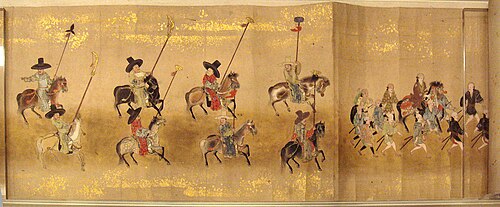
Crowds of Japanese people came out to watch the colourful parades. Scholars and artists visited the Korean guests to swap poems, to talk by writing Chinese characters to each other, and to ask for paintings and calligraphy. Some Japanese towns still hold festival dances that people link to the Korean visitors.
The last mission went only as far as Tsushima in 1811. Today Korea and Japan remember these journeys as a symbol of peace after war, and after a joint nomination by groups from both countries in 2016, UNESCO listed the records of the missions as a “Memory of the World” in 2017.
En bref
- Period
- Twelve missions from 1607 to 1811 to the Tokugawa shoguns. Missions also called tongsinsa had gone to the Ashikaga shoguns in the 15th century and to Hideyoshi in 1590
- Names
- The first three (1607, 1617, 1624) were officially “envoys in reply and for bringing back captives” (hoedap-gyeom-swaehwansa); from 1636 they were called tongsinsa. The Tokugawa government called them raihei, a word that implied bringing tribute
- Size
- Usually about 300–500 people: three envoys (chief envoy, deputy envoy and secretary), officials, writers, doctors, painters, interpreters, soldiers, musicians, mounted acrobats and oarsmen (270 in the rules revised in 1682); Tsushima added a large escort
- Route
- Hanseong (Seoul) – Busan – Tsushima – Iki – Ainoshima – Akamagaseki (Shimonoseki) – Seto Inland Sea – Osaka – by river to Yodo – Kyoto – overland by the Tōkaidō to Edo. Ten of the twelve reached Edo; 1617 stopped at Fushimi near Kyoto and 1811 at Tsushima
- Purpose
- At first: making peace, checking on Japan’s intentions and bringing captives home. Later: congratulating a new shogun, settling practical questions and keeping the relationship of “neighbourly relations” (gyorin) alive
- Why it continued
- Watching Japan to prevent another invasion and keeping the southern frontier quiet, and maintaining an order of equal neighbourly relations. The embassies went at the shogunate’s request, Japan paid the costs inside Japan, and Tsushima, whose livelihood depended on it, kept the relationship going. The memory of the enemy never disappeared
- Go-between
- The Sō family of Tsushima, who depended on trade with Korea and handled the negotiations — at first by forging state letters, a fraud exposed in the 1630s
- Reopening (1599–1609)
- Tsushima’s overtures from 1599 → Yujeong’s journey and the Fushimi meeting, 1604–1605 → Korea’s two conditions (a Japanese letter first, the tomb robbers handed over) and a letter in Ieyasu’s name, 1606 (widely thought forged or rewritten by Tsushima) → the first reply-and-repatriation embassy, 1607 → the Giyu Agreement, 1609 (twenty ships a year, Busan only)
- Records
- Travel diaries by mission members (such as Shin Yu-han’s Haeyurok of 1719), Korean government registers, Tsushima domain archives, Japanese scroll paintings, screens and poetry collections
- Memory of the World
- “Documents on Joseon Tongsinsa/Chosen Tsushinshi” — 111 items (333 pieces) held in Korea and Japan — were inscribed on UNESCO’s Memory of the World Register in October 2017 after a joint Korean–Japanese nomination
Sur la carte
Pendant ce temps, ailleurs dans le monde
D’autres sujets de cette bibliothèque, à peu près des mêmes années, dans des régions lointaines du monde.
- Vieille ville de Hội Anv. 1500–1900 · Hội An (Đàng Trong, sous les seigneurs Nguyễn)
- Isaac Newton1665–1687 · Trinity College, Cambridge (royaume d’Angleterre)
- Sor Juana Inés de la Cruzv. 1648–1695 · Mexico City, Viceroyalty of New Spain
- Le Rêve dans le pavillon rougev. 1754–1791 · Pékin (Empire Qing)
- Nzinga du Ndongo et du Matamba1624–1663 · Ndongo et Matamba (royaumes mbundu, dans l’actuel Angola)
- Taj Mahal1632–1653 · Agra (Empire moghol)
Facile
What were the Joseon missions to Japan?
The Joseon tongsinsa were official embassies sent by the kings of Joseon Korea to the rulers of Japan. The word tongsin means “communicating trust”, and it described envoys exchanged between two states that treated each other as equals. Korea had sent such missions to the Ashikaga shoguns in the fifteenth century and to Toyotomi Hideyoshi in 1590, but when people speak of “the Tongsinsa” today they usually mean the twelve embassies sent to the Tokugawa shoguns between 1607 and 1811.
Each embassy carried a letter from the Korean king to the shogun, together with gifts such as ginseng, tiger skins, fine cloth, writing brushes and ink. It was normally led by three envoys, chosen from senior civil officials, and included hundreds of other people. The Korean ships sailed from Busan to Tsushima and through the Inland Sea to Osaka, and from there most embassies travelled overland to Edo, where the letters were exchanged in a formal ceremony at the shogun’s castle; the mission of 1617 was received at Fushimi near Kyoto, and that of 1811 stayed on Tsushima.
The missions began as part of the peace settlement after Hideyoshi’s invasions of Korea, and the first three were also meant to bring home Koreans who had been carried off to Japan. Later, a mission was usually sent to congratulate a new shogun. For the shogunate, Joseon was the only fully independent state with which it kept formal diplomatic relations, so these were its most prestigious foreign embassies; for Korea they were a way to keep peace with a dangerous neighbour and to see what was happening there.
Along the way the missions became great cultural events. Japanese scholars, poets, doctors and painters met the Korean visitors to exchange poems and ideas, and crowds lined the roads to watch. In 2017 the surviving records of the missions, held in both countries, were inscribed on UNESCO’s Memory of the World Register as a history of “peace building and cultural exchanges” between Korea and Japan.
Facile
Making peace after the Imjin War
When the last Japanese troops left Korea at the end of 1598, Joseon had every reason to distrust Japan. But the Sō family of Tsushima, whose island lived on trade with Korea, began sending envoys and returning captives as early as 1599, and after Tokugawa Ieyasu won the Battle of Sekigahara in 1600 he supported their efforts. Korea, for its part, wanted its people back, needed peace in the south while the Jurchens were growing stronger in the north, and wanted to know whether Japan might attack again.
In 1604 the Korean court sent the monk Yujeong (better known as Samyeong Daesa), who had led monk soldiers in the war, together with Son Mun-uk, to find out what Japan intended. In the spring of 1605 Yujeong met Ieyasu at Fushimi Castle near Kyoto. According to Japanese accounts, the Tokugawa side said that it had taken no part in the invasion and promised to return captives. The revised Annals of King Seonjo say that Yujeong brought back more than 3,000 men and women, but the figures differ from source to source.
Joseon then set conditions. In the court debates of 1606 recorded in the Annals of King Seonjo, and in the account of the Northeast Asian History Foundation, there were two: Japan (that is, Ieyasu) had to send a state letter first, and it had to hand over the men who had desecrated royal tombs south of Seoul during the war. The Encyclopedia of Korean Culture’s article on the Giyu Agreement adds the return of captives and speaks of three conditions. At the end of 1606 Tsushima delivered a letter in Ieyasu’s name and two prisoners described as the tomb robbers. But the revised Annals themselves record that the two were Tsushima criminals already condemned to death, and the letter is now widely regarded as fabricated or rewritten in Tsushima.
On this basis the first embassy left Seoul early in 1607. It met the shogun Hidetada at Edo and, on the way back, Ieyasu at Sunpu. Two years later, in 1609, Joseon and Tsushima concluded the Giyu Agreement, which allowed the lord of Tsushima to send up to twenty ships a year to Busan under tight rules. Japanese envoys were not allowed to travel to Seoul any more, because the invaders had used their old road in 1592; they were received only at the Japanese house (waegwan) in Busan, from 1607 at Dumopo. The four sections below on 1599–1609 tell this story in detail, and the section “Why did two enemies reopen relations?” sums up why the two countries made peace.
Facile
The long road from Hanseong to Edo
A mission began with months of preparation. When a new shogun took office, Tsushima sent envoys to Busan to announce it and then to ask for an embassy; the Korean court decided, chose the envoys and worked out the details with Tsushima. The embassy then took about two months to travel from Hanseong to Busan. Before sailing, the envoys held a sacrifice to the sea god at the pavilion of Yeonggadae in Busan.
The embassy sailed in six Korean ships, three for people and three for cargo, escorted by Tsushima vessels. They landed first on Tsushima, where the Sō lord entertained them, and then went on by way of Iki, Ainoshima off the coast of Chikuzen and Akamagaseki (Shimonoseki) into the Seto Inland Sea. Ports such as Tomonoura, Ushimado and Hyōgo prepared lodgings and banquets for them.
At Osaka the Koreans changed to river boats provided by the daimyo and were towed up the Yodo River to Yodo, then continued by land through Kyoto. Near Lake Biwa they were allowed to use a special road, later called the Chōsenjin kaidō (“Korean road”), which Ieyasu had taken after his victory at Sekigahara; then they followed the Tōkaidō highway to Edo. The envoys travelled in palanquins, senior members on horseback and others on foot.
The whole journey usually took between five and eight months according to the Encyclopedia of Korean Culture; Japanese accounts speak of eight to ten months, and some missions took longer. On the mission of 1719 the voyage from Tsushima to Osaka took 45 days, and the land journey from Osaka to Edo 18 days. In Edo the envoys presented the king’s letter and gifts at the castle; some days later they received the shogun’s reply and gifts in return, and set off home by the same route. The joint Korean–Japanese nomination to UNESCO’s Memory of the World puts the round trip between Hanseong and Edo at more than 4,500 kilometres.
Facile
Who went? Three envoys and hundreds of others
Each embassy was normally headed by the “three envoys”: the chief envoy, who carried the king’s letter, a deputy envoy and a secretary (jongsagwan) who kept the record. The chief envoy was a senior civil official, usually holding the rank of chamui, an assistant minister. Each of the three led his own group of followers and travelled in his own ship. The reduced last mission of 1811 had only a chief and a deputy envoy.
Below them came officials of many kinds. Interpreters of Japanese handled daily business. A writer (jesulgwan) and several secretaries were chosen for their skill in classical Chinese poetry, because Japanese scholars would ask them for poems wherever they went. There were doctors, a painter, a calligrapher, military officers, musicians, flag-bearers, cooks and grooms. From 1636 the shogunate asked for displays of trick riding, and from the 1680s two mounted acrobats (masangjae) were sent as a rule. In the staffing rules revised in 1682, the largest single group was 270 oarsmen.
The Encyclopedia of Korean Culture lists the size of each mission: 504 people in 1607, 428 in 1617, 460 in 1624, 478 in 1636, 477 in 1643, 485 in 1655, 473 in 1682, 500 in 1711, 475 in 1719, 477 in 1748, 477 in 1764 and 328 in 1811. Other sources give slightly different figures — for example 468 for 1607, and 334 or 336 for 1811 — and the reasons for the differences are not always clear.
Japan added its own escort. Tsushima sent guides and guards, about 1,500 people according to one Japanese account, and the domains along the route supplied boats, horses, porters and food. A Korean embassy on the move was therefore a procession of thousands of people.
Intermédiaire
1599–1605: Tsushima’s overtures and Yujeong’s journey to Japan
No one needed peace more urgently than Tsushima. The island, the part of Japan closest to Busan, is so mountainous that farming is difficult, and it had long lived on trade with Korea. Its lord, Sō Yoshitoshi, was the son-in-law of Konishi Yukinaga and had landed at Busan with Konishi in the vanguard of the First Division in 1592. At Sekigahara in 1600 he sided with the Western Army, but Ieyasu, who wanted relations with Korea restored quickly, did not punish him and confirmed him in his domain; at that point Yoshitoshi divorced his wife, Konishi’s daughter. The day-to-day negotiating was done by his senior retainer Yanagawa Shigenobu, Shigenobu’s son Kagenao (Pyeong Gyeong-jik in Korean records) and the diplomat-monk Genso.
From 1599 Tsushima sent men to Korea, returning captives and asking for peace. At first Ming troops were still in Korea and Joseon could not answer on its own; Tsushima envoys who came in 1599 were even handed over to the Ming army. According to the annotated edition of the Byeollye jibyo, Joseon could pursue its own Japan policy only after April 1600, when the Ming hostages held in Japan had been returned. Tsushima mixed pleas with threats: in 1600 Jang Beon-seok of Ulsan and others who came back from Japan reported Yanagawa Shigenobu as saying that if no answer came before the fourth or fifth month, a great army would strike without warning in the seventh or eighth month, when the grain was ripe. The historian Hong Seong-deok counts twenty-two Japanese peace missions before Joseon sent its reply envoys; the Northeast Asian History Foundation counts twenty-three.
Joseon began to look for itself. Early in 1602, on the proposal of Yi Deok-hyeong, the court sent Jeon Gye-sin, Son Mun-uk and others to Tsushima to gather information (the Northeast Asian History Foundation dates this mission to 1601). Son Mun-uk had been taken captive during the war and had come back. In 1604 the court sent the monk Yujeong. He had led monk soldiers in the war and had met Katō Kiyomasa at Ulsan four times to probe the Japanese position and their peace terms. To avoid the appearance that Korea, the injured party, was sending a formal peace embassy first, the court gave him the task of a “scout of the enemy” (tamjeoksa). Yujeong took his leave of the king on the 22nd day of the sixth lunar month (18 July 1604) and crossed to Tsushima on the 20th day of the eighth (13 September). When more than four months passed without news, King Seonjo worried that Tsushima had sent him on to Japan proper: “It is now nearly half a year — for what reason would he not come back?”
Guided by Tsushima men, Yujeong went on to Kyoto and in the spring of 1605 — the third lunar month, according to tradition — met Ieyasu at Fushimi Castle. Accounts of the exact date differ, and who else was present is uncertain. One Japanese biographical dictionary says he met both Ieyasu and Hidetada, but Hidetada only entered Fushimi Castle with his great army on the 21st of the third month. No detailed record of the talks survives. A letter that Tsushima sent to Korea quotes Ieyasu as saying: “What has been said to Joseon is all reasonable. If you bring the envoy quickly, I will meet him myself and tell him of our sincerity.” Japanese accounts say that Honda Masanobu and others declared that the Tokugawa government had taken no part in the invasion and would send captives home quickly. It is true that Ieyasu sent no troops to Korea, but he did come to Nagoya in Hizen, the invasion’s base, in 1592, so “no part in the invasion” should be read as the Tokugawa side’s claim.
Yujeong came home in the fourth lunar month of 1605, and many captives returned with him. The revised Annals say he brought back more than 3,000 men and women, and a Japanese biographical dictionary also says “over 3,000”, but no contemporary count confirms the figure. What he did not bring back was a state letter from Ieyasu. The next year King Seonjo asked why, if Ieyasu really wanted peace quickly, “he did not send even a single letter when Yujeong returned”. The famous stories of Yujeong surviving a red-hot iron room in Japan and humbling the Japanese king by magic are legends of the Imjillok tradition, not records of the time.
[69][58][24][65][25][12][59][26][27][68][70][29][10][71][28][30][60]
Intermédiaire
1606: who writes first? Two conditions and a rewritten letter
The question now was who would bow first. In the fifth lunar month of 1606 King Seonjo voiced his suspicion of Japan’s aims: “The enemy’s intention is that we send an envoy and a letter first, so that they can say ‘Korea sent envoys to ask for peace’, or ‘begged to surrender and served us devotedly’, and boast of it to later generations.” The Border Defence Council proposed writing to Ieyasu’s ministers to ask why, if he really wanted friendship, he had never sent a single letter, and to say that if he arrested the men who had dug up the royal tombs and sent them “together with a letter”, Korea would reply. In the ninth lunar month of 1592 Japanese troops had dug into Seolleung and Jeongneung, the tombs of King Seongjong and King Jungjong south of Seoul (today’s Samseong-dong in Gangnam), an outrage Joseon could not forget. A Japanese letter first and the surrender of the tomb robbers thus became the conditions for reopening relations.
In the autumn of 1606 the Korean envoy Jeon Gye-sin, sent to Tsushima, was shown a document said to be Ieyasu’s letter, but he refused it as discourteous and improper in form, and it said nothing about handing over the culprits. Tachibana Tomomasa of Tsushima told him that even this letter had been obtained with difficulty, through a favourite of Ieyasu, after Ieyasu had at first refused: “How could I send a letter first and beg for peace?” Tsushima then sent a man to Japan to ask about revising the letter, and Jeon reported news that Ieyasu, hearing of this, had grown suspicious and would not readily agree. Yanagawa Kagenao pressed the Koreans: “Even if a phrase in the letter is not quite clear, what great harm is done to propriety?”
Soon afterwards, however, a letter in Ieyasu’s name arrived that said exactly what Korea wanted. Recorded in the Annals under the 12th day of the eleventh lunar month (11 December 1606), it promised that “since the criminals are on Tsushima, I have firmly ordered Yoshitoshi, and he will certainly bind them and send them”, and asked Korea to send envoys quickly so that “the people of our sixty-odd provinces may know that friendship is real”. Since the work of Tashiro Kazui and others, the view that Tsushima fabricated this letter has been widely accepted; the Japanese Wikipedia attributes it to Yanagawa Kagenao and Shimakawa Takumi. Whether it was made from scratch or rewritten from an original letter of Ieyasu cannot be settled. Tsushima had altered messages between the two countries before: before the war it had turned Hideyoshi’s demand that Korea “guide the conquest of the Ming” into a request to “lend the road to the Ming”.
The two men sent as the culprits were also suspect. In his deposition Magosaku, aged 37, said that in 1592 he had come over as a servant of a Tsushima officer and “only stayed at the boatyard in Busan and never went up to Seoul”; according to the Encyclopedia of Korean Culture the two had been 13 and 23 in 1592. The revised Annals record that Tsushima had sent two men “who had committed crimes deserving death”, falsely calling them the tomb robbers. King Seonjo ruled that “even if they are not the real culprits, they are still enemies and should be beheaded”, and “what man of Tsushima is not our enemy?” The two were executed. The date is unclear: the revised Annals put the matter under the eleventh month, but the original Annals show ministers still debating what to do with them on the 23rd day of the twelfth month.
The court decided to send a reply embassy without resolving all its doubts. In the first lunar month of 1607 the Border Defence Council explained that even in its report to the Ming court it had said that “it is hard to tell whether Ieyasu’s conduct is true or false, or whether the bound criminals are genuine or not, but since they have made these approaches, we cannot but reply”. It was improper, the Council said, for Korea to send envoys first for no reason; replying because the other side had sent a letter was correct. Because the form of a Japanese letter coming first had been achieved, Korea could call its embassy “reply envoys”.
Intermédiaire
1607: the journey of the first reply-and-repatriation embassy
On the 12th day of the first lunar month of 1607 (8 February), an embassy of 504 people led by the chief envoy Yeo U-gil, the deputy envoy Gyeong Seom and the secretary (seojanggwan, later called jongsagwan) Jeong Ho-gwan left Seoul. It was first called the “reply embassy”; when the task of bringing back captives was added, its name became hoedap-gyeom-swaehwansa, “envoys in reply and for bringing back captives”. King Seonjo’s letter, too, was framed as an answer: since Japan had written “first” to say that it had “corrected the errors of the previous regime”, Korea was sending envoys in reply. The former vice-minister Yun An-seong criticised the mission in a farewell poem — “Go out to the Han River and look upstream: / the pines and cypresses of the two tombs have not yet grown back” — which was widely recited. The king also gave the envoys silver to buy Japanese muskets, and on the way home they bought 500 at Sakai.
The deputy envoy Gyeong Seom kept a daily diary, the Haesarok. The embassy sailed from Busan on the 29th day of the second lunar month (26 March); in mid-sea a storm split the bottom of Gyeong Seom’s ship and “the water inside the ship rose above our shoulders”. By way of Tsushima, Iki, Ainoshima and Akamagaseki (Shimonoseki) and through the Seto Inland Sea, it reached the sea off Osaka on 2 May and entered Kyoto on 7 May, lodging at Daitokuji. Among the crowds along the Kyoto streets were Korean women “who wept and grieved at the sight of people from home”. On 2 June the envoys passed Sekigahara and were shown the site of Ieyasu’s camp.
Ieyasu, at Sunpu, sent word: “I have already handed over my office and cannot receive the state letter. The envoys should go straight to Edo, deliver their message to the new shogun, and we will meet on their way back.” The embassy reached Edo on 18 June and on 29 June (the 6th day of the sixth month by the Korean calendar, the 6th of the fifth by the Japanese) presented the letter and gifts to the shogun Hidetada at Edo Castle. Gyeong Seom wrote that Hidetada was “29 years old, with a brave face and much daring”. On the way back, on 13 July, the envoys met Ieyasu at Sunpu Castle; Gyeong Seom noted that he was “66 years old, of large build, and his strength had not declined”. The embassy returned to Busan on 24 August. Because in 1607 Japan added an intercalary fourth month and Korea an intercalary sixth, Korean and Japanese dates differ by up to a month, so this section also gives Gregorian dates.
The envoys were suspicious of the letters. On Tsushima Gyeong Seom asked Genso whether the letter Jeon Gye-sin had taken back the year before was really Ieyasu’s, and pressed him: “If he has no royal title, how is it that his seal reads ‘King of Japan’?” Genso answered that it was the seal brought earlier by envoys of the Ming. What caused trouble after the envoys came home was Hidetada’s reply. According to the revised Annals it was signed only “Minamoto no Hidetada”, without the title of king, and the reply to the Korean Ministry of Rites called Koreans “people from afar”. It did not match the form of the earlier “letter of Ieyasu”. The censor Choe Yu-won charged that Yeo U-gil and his colleagues had disgraced the country by failing to have it corrected. Research also suggests that Tsushima swapped the Korean king’s reply for a version consistent with the forged Japanese letter before it was delivered; such alterations came to light in the Yanagawa affair of the 1630s.
On the way back the envoys gathered Koreans in Kyoto, Osaka and elsewhere, and received word that Ieyasu had ordered that “all captives who wish to go home be returned, and any master who holds them back be punished”. But Gyeong Seom wrote that “their masters vied with one another to hide them, and the captives, too, had settled comfortably, so few wished to return”. The returnees he counted on Tsushima numbered “only 1,418, men and women together” — “not even one hair plucked from nine oxen”, he lamented. The revised Annals give some 1,240 instead. The Encyclopedia of Korean Culture explains the small numbers by Japanese non-cooperation, captives who did not want to return, and the discrimination and contempt that returned captives met in Joseon society.
[45][38][39][40][58][1][55][64][46][48][49][50][51][52][53][57][47][41][10][67][23][54][56][62]
Intermédiaire
1609: the Giyu Agreement — one port, twenty ships a year
Right after the war Joseon set up a temporary Japanese house on Jeolyeong Island (today’s Yeongdo), a little off the mainland, and in 1607 it built a new waegwan at Dumopo (around today’s Sujeong-dong in Dong-gu, Busan) instead of the old site inside the fortress of Busanjin, a military post. In the third lunar month of 1609 Genso and Yanagawa Kagenao arrived at the Busan waegwan with more than 300 men, but Joseon refused to let them go up to Seoul and received their letters at Busan. The interpreter Bak Dae-geun rebuked them — “your country raised troops without cause and slaughtered our innocent people” — and told them that settling an agreement at Busan was entirely for Tsushima’s sake. Kagenao retorted that “Joseon is afraid of fighting but brave in argument, fussing only over etiquette and wording”.
That year the Giyu Agreement was concluded between Joseon and the lord of Tsushima. Sources differ on its exact date and even on the number of articles: the Encyclopedia of Korean Culture, following the Tongmun’gwanji, gives thirteen, while the National Institute of Korean History’s New History of Korea (Sinpyeon Hanguksa) gives twelve. An entry in the Gwanghaegun ilgi for the 28th day of the sixth lunar month (28 July) shows officials discussing how to divide into large, medium and small ships the twenty yearly ships, including three “special” ships, in “the agreement to be sent to the lord of Tsushima”. The main terms, as summarised by the Encyclopedia of Korean Culture, were these: the lord received a yearly gift of 100 seok of rice and beans; he could send twenty ships a year, including three special ships; every ship coming to Korea had to carry a pass issued by the lord; and anyone without a pass, or anchoring anywhere other than Busan, was to be treated as an enemy.
The agreement was much less favourable to Tsushima than the pre-war arrangements. The yearly ships fell from thirty just before the war to twenty, Japanese ships could call only at Busan — a restriction that confirmed the pre-war rule, under which only the Busan waegwan had remained since 1547 — and the partners allowed to deal with Korea were limited to the “King of Japan” (the shogun), the lord of Tsushima and Tsushima men holding Korean titles. Japanese envoys could no longer go to Seoul and were received only at the Busan waegwan; the Japanese envoys’ lodge in Seoul, the Dongpyeonggwan, was closed in 1609. Even so, the agreement gave Tsushima back its trade and confirmed its position as the sole channel between Korea and Japan. It remained the basic framework of relations until about 1872, when the Meiji government took over Tsushima’s diplomatic duties.
Intermédiaire
From “reply envoys” to “envoys of trust”
The first three Tokugawa-era missions, in 1607, 1617 and 1624, were not officially called tongsinsa. Joseon named them hoedap-gyeom-swaehwansa, “envoys in reply and for bringing back captives”: they were answering a Japanese letter and fetching Korean prisoners. The Encyclopedia of Korean Culture explains that Joseon did not yet recognise the Tokugawa as a state with which it could “communicate trust”. Japan, by contrast, regarded all twelve missions as tsūshinshi, including the first three.
Behind the scenes the go-betweens of Tsushima kept the negotiations going by forging and altering letters on both sides, so that each government saw what it expected: the Korean king writing to the “King of Japan” as an equal, and the shogun receiving what looked like a respectful embassy. In 1631 Yanagawa Shigeoki, a senior retainer of the Sō who wanted to become a direct vassal of the shogun, and his lord Sō Yoshinari took their feud to the shogunate, and in the course of the dispute the forgeries and alterations came to light. After hearings in 1633–1634, the shogun Iemitsu judged the case himself in 1635: the Sō lord was cleared, Yanagawa was exiled, and some of those involved were executed or banished. Monks from the great Zen temples of Kyoto were then sent in rotation to Tsushima to handle the correspondence.
The affair changed the forms of diplomacy. From the mission of 1636 Joseon used the name tongsinsa, and letters to the shogun called him not “King of Japan” but taikun, usually translated “great prince”, while the Japanese side dated its letters by Japanese era names. The Encyclopedia of Korean Culture links the change of name to the rise of the Manchu Qing in the north, which gave both Joseon and Japan reason to stabilise their relationship; in 1636–1637 Joseon itself was invaded by the Qing.
The missions of 1636, 1643 and 1655 also visited the shrine of Ieyasu at Nikkō. The Encyclopedia of Korean Culture says the envoys were at times “forced” to pay their respects, and the diaries show what that pressure looked like: in 1636 they agreed after debating an earnest request from the shogunate and Tsushima under political pressure over the lord of Tsushima’s position, and that in 1643 and 1655 they were formal rites prepared in advance — an incense offering rehearsed in Busan in 1643, and the presentation of King Hyojong’s calligraphy in 1655 (see the section on 1636–1637 below). From 1655 a mission for each new shogun became the rule, though some missions also marked other occasions, such as the birth of a shogun’s heir.
Intermédiaire
The twelve missions: congratulations in name, other aims in fact
Following the table in the Encyclopedia of Korean Culture (for the chief envoys) and Japanese summaries (for the shoguns), the twelve missions were: 1607, Yeo U-gil (shogun Hidetada); 1617, O Yun-gyeom (Hidetada, received at Fushimi); 1624, Jeong Rip (Iemitsu); 1636, Im Gwang (Iemitsu); 1643, Yun Sun-ji (Iemitsu); 1655, Jo Hyeong (Ietsuna); 1682, Yun Ji-wan (Tsunayoshi); 1711, Jo Tae-eok (Ienobu); 1719, Hong Chi-jung (Yoshimune); 1748, Hong Gye-hui (Ieshige); 1763–1764, Jo Eom (Ieharu); 1811, Kim I-gyo (Ienari, ceremony on Tsushima). The first three were “reply and captive-return envoys”; the nine from 1636 onwards were tongsinsa in name too. The stated purpose of the 1643 mission was to celebrate the birth of the shogun’s heir Ietsuna, and from 1655 most missions officially congratulated a new shogun on his succession.
The Encyclopedia of Korean Culture (in Son Seung-cheol’s entry) explains, however, that behind the congratulations each mission had its own aims. In 1636 they were to build solidarity with Japan amid the Ming–Qing transition, to support the lord of Tsushima after the letter-forgery affair and to gather intelligence; in 1643, to counter Qing pressure, to negotiate a reduction in the growing volume of trade, and to look into Japan’s maritime restrictions and the Shimabara Rebellion; in 1655, to check reports that Japan would “borrow the road through Korea”; in 1682, to settle market regulations controlling trade with Tsushima; in 1711, to keep face against Arai Hakuseki’s revision of the ceremonies while keeping the peace; and in 1719, to convey Korea’s position on the restored ceremonies and to settle the return of castaways. The same encyclopedia holds that once the continent had stabilised in the 18th century, the missions of 1748 and 1764 became largely ceremonial, aimed at congratulating the shogun and confirming neighbourly relations.
Intermédiaire
1624–1635: the third reply embassy and the exposure of the forged letters (the Yanagawa affair)
When Iemitsu became shogun in 1623 the shogunate asked for a congratulatory embassy, and the next year a third “reply and captive-return” embassy set out under the chief envoy Jeong Rip, the deputy envoy Gang Hong-jung and the secretary Sin Gye-yeong. According to Gang Hong-jung’s Dongsarok, the embassy presented its letter to Iemitsu in Edo on the 19th day of the 12th lunar month (27 January 1625; on that day the two calendars agreed), and the shogun “came out in court dress and barefoot, took off his long sword, handed it to an attendant and sat down wearing only his short sword”. Almost no captives came home, however: the Encyclopedia of Korean Culture records only 21 from Japan and 15 from Tsushima (other counts exist). This was the last embassy to bear the name “reply and captive-return envoys”.
Meanwhile a quarrel was growing inside Tsushima. The senior retainer Yanagawa Shigeoki (1603–1684) was heir to a family that had risen under his grandfather Shigenobu by handling relations with Korea; held as a hostage in his childhood at the side of Ieyasu and Hidetada, he had strong connections among the shogun’s officials. Arano Yasunori explains that his conflict with Sō Yoshinari, who became lord of Tsushima in 1615, began from Shigeoki’s attempt to use that position to become a direct vassal of the shogun. In 1631 (Kan’ei 8) Shigeoki offered to give back the lands and trading-ship rights he held from the Sō; both sides then took their case to the shogunate, and Shigeoki accused the domain of forging state letters. While full hearings were held in 1634, trade between Tsushima and Korea was suspended for a time on the shogunate’s orders.
The hearings exposed the rewriting and swapping of state letters whenever Korean embassies came, and the sending of men to Korea under the false name of shogunal envoys. The Japanese Wikipedia describes how Tsushima forged or altered letters at the time of the 1617 and 1624 embassies. In 1624 a Tsushima retainer is said to have changed the words “ruler of Japan” (日本國主) in a reply drafted by the shogunate’s diplomatic monk Konchiin Sūden into “King of Japan” (日本國王), quietly supplying the royal title that Korea expected of an equal sovereign. The details differ between sources: the Japanese encyclopedia entry on the “title affair” (殊号事件) dates the discovered insertion of the character “king” to a letter of 1616. The forgery itself was established, but where responsibility lay was not. Nor is it clear whether the trial formally confirmed the forgery of the so-called “Ieyasu letter” of 1606; the full picture of the rewritten letters comes from modern research such as that of Tashiro Kazui.
On the 11th day of the 3rd month of 1635 (27 April), Iemitsu summoned the senior Tokugawa houses, daimyo and bannermen to Edo Castle and had the two men confront each other in his presence. Although Shigeoki had been rumoured to have the upper hand, the verdict, given the next day (28 April), went for Yoshinari. Shigeoki was exiled to Tsugaru; those involved in forging and swapping letters were executed or banished; and Tsushima’s diplomatic monk Kihaku Genpō was exiled too. Arano Yasunori notes the story that Yoshinari’s wife being a relative of the shogun’s wife influenced the ruling, but argues that the decision also fitted the shogunate’s foreign policy and its control of the daimyo, and judges that the rewriting of letters stemmed less from the guilt of the Sō or the Yanagawa than from the shogunate’s tolerance of practices inherited from the Middle Ages.
After the verdict the shogunate left Korean affairs with the Sō but began to supervise them directly. Learned monks from the five great Zen temples of Kyoto were sent in rotation to the Iteian on Tsushima to draft diplomatic documents and to watch for any rewriting of letters (the Iteian rotation system); Korean letters were to address the shogun as “Great Prince of Japan” (日本國大君, taikun) instead of “King of Japan”; and Japanese letters were to be dated by Japanese era names. Arano explains that these reforms were accepted by Korea too, and that with the embassy of the following year the early modern “taikun diplomatic system” took root. Korea did not simply comply, however. According to the Encyclopedia of Korean Culture’s entry on the Haesarok of Kim Se-ryeom, deputy envoy in 1636, the envoys asked for the Japanese era name and titles such as “king” and “great prince” in the letters to be rewritten or removed, and seem to have obtained no more than the removal of some titles, without resolving the era-name question. As for who devised the title taikun, Nakamura Hidetaka once conjectured that it was the shogunate’s Confucian scholar Hayashi Razan, as an older Heibonsha encyclopedia also states; but according to the Japan–Korea Joint History Research report, Nakao Hiroshi’s examination has shown it to be Gyokuhō Kōrin, one of the rotating monks of the Iteian.
Intermédiaire
1636–1637: the first “tongsinsa”, Nikkō and the Qing invasion
The first embassy after the war to bear the name tongsinsa was led by the chief envoy Im Gwang, the deputy envoy Kim Se-ryeom and the secretary Hwang Ho, each of whom left a diary: the Byeongja Ilbon ilgi, the Haesarok and the Dongsarok. It was not sent to congratulate a new shogun. The Encyclopedia of Korean Culture gives its underlying aims as building solidarity with Japan amid the Ming–Qing transition, supporting the lord of Tsushima after the letter-forgery affair and gathering intelligence; its entry on Hwang Ho’s Dongsarok says the embassy answered a request in which the lord of Tsushima explained away the forgery and the shogun asked to see Korean mounted acrobats and musicians. According to Japanese accounts, Yoshinari arranged the embassy as a token of gratitude to the shogunate. Bringing back captives was also on the agenda, but so long after the war those who had families in Japan did not want to return, and nothing came of it.
The embassy left Hanseong on the 11th day of the 8th lunar month (9 September 1636) and entered Edo on the 7th day of the 12th month (2 January 1637). When Tsushima asked them to make an excursion to Nikkō before they had even delivered their letter, the envoys refused: “The state letter has not yet been delivered, and you suddenly ask us to go sightseeing — what kind of propriety is this?” That evening the day for presenting the letter was fixed, and the secretary Hwang Ho ended his diary entry: “Japan’s 13th is our 14th.” The two countries’ calendars were a day apart. The envoys presented the king’s letter to the shogun Iemitsu at Edo Castle on the 14th day of the 12th month by the Korean calendar — the 13th by the Japanese — that is, on 9 January 1637.
The shogunate badly wanted the envoys to visit the Tōshōgū at Nikkō, the shrine of Ieyasu. A Tsushima retainer pleaded with the interpreter Hong Hui-nam, “The master’s house is on fire and the guest will not help put it out — is that humane?”, and confided that a faction in the shogunate meant to use a refusal to slander the lord of Tsushima. The interpreters urged acceptance — “The lord’s position is extremely precarious… An outing costs us little, but for them it matters greatly” — and the envoys, recalling that Jeong Mong-ju of Goryeo had travelled widely in Japan, agreed that one visit would do no harm. They went to Nikkō on the 22nd day of the 12th month (17 January 1637). Looking at the gilded shrine, the chief envoy Im Gwang wrote: “Heaven surely hates what is impure; if things are done like this, how can it last long?” He sent back the 80 pieces of silver offered by the abbot of the temple at Nikkō. That night the Tsushima retainer thanked them: “Although Shigeoki was defeated, his partisans are still many… Had you not agreed, it could not be known whether our lord would live or die.”
Later embassies also went to Nikkō, in 1643 and 1655, but the visits changed in character. The 1643 envoys rehearsed the rite of offering incense at Nikkō while still in Busan, and in 1655 the envoys presented calligraphy by King Hyojong at the Tōshōgū. The Encyclopedia of Korean Culture’s main entry on the tongsinsa says the envoys were at times “forced” to pay their respects. The diaries show that in 1636 they accepted after debate under political pressure, and that by 1643 and 1655 the visits had become formal rites prepared in advance. According to the Jeungjeong gyorinji, the rites at Nikkō were discontinued in 1682.
At the very time the envoys were in Edo, Korea was collapsing in the north. According to the Encyclopedia of Korean Culture’s entry on the Byeongja war, Qing troops crossed the Yalu on the 9th day of the 12th lunar month (4 January 1637), and King Injo entered the fortress of Namhansanseong on the night of the 14th — the very day (9 January 1637) on which the envoys presented their letter at Edo Castle. Injo surrendered to the Qing emperor at Samjeondo on the 30th day of the 1st month (24 February). On their way home the envoys first heard the news on Tsushima on the 21st day of the 2nd month (17 March), from a boat arrived from Busan: “the western barbarians invaded deep into the country; the capital fell and was soon recovered, and the royal carriage has returned to Seoul”. Not knowing whether it had ended in battle or in peace, the envoys “gathered and wept all night”. Whether there was any causal link between diplomacy in the south and war in the north cannot be established from the sources; but the encyclopedia entry on Kim Se-ryeom’s Haesarok describes this as a time when, amid the upheavals of the Jeongmyo and Byeongja wars, Korea felt the need for amity with Japan.
Intermédiaire
Japan at the same time: “sakoku” and the four gateways
In the 1630s, as the missions became established, Japan too was narrowing its doors to the outside world. The shogunate had already banned Christianity in its own cities in 1612 and down to the common people in 1616, and believers were tortured and executed in many places. A series of orders issued in five successive versions from the instructions to the Nagasaki magistrates in 1633 up to 1639 (often called the “Kan’ei seclusion edicts”) restricted Japanese travel abroad; from 1635 all Japanese ships were forbidden to go overseas, and Japanese living abroad faced death if they returned. In the same year Chinese ships were confined to Nagasaki.
In the 10th lunar month of 1637 (December), peasants and Christians in Shimabara and Amakusa in Kyushu rose against crushing taxes and the persecution of their faith (the Shimabara Rebellion). The rebels, reported at between twenty-odd thousand and 37,000, held out in the abandoned Hara Castle; the shogunate mobilised well over a hundred thousand men — 124,000 by one account — and ordered the Dutch factory at Hirado to bombard the castle from a ship. Hara Castle fell to a general assault at the end of the 2nd month of 1638 (April), and almost all its defenders were killed. In 1639 the shogunate banned Portuguese ships, and in 1641 it moved the Dutch factory from Hirado to Dejima, an artificial island off Nagasaki. Asao Naohiro regards 1641 as the year in which the so-called sakoku was completed.
Yet sakoku (“closed country”) is not a word of the time. It comes from the title the Nagasaki interpreter and Dutch-learning scholar Shizuki Tadao gave in 1801 to his translation of a chapter of Engelbert Kaempfer’s History of Japan; the “sakoku edicts” are a name given by scholars after the Meiji period, and no law of that name existed. The word is thought to have been used inside the shogunate for the first time in 1853. From around 1980 Arano Yasunori argued that Japan was connected to the outside world through “four gateways” (yottsu no kuchi): Nagasaki (the Dutch and Chinese), Tsushima (Korea), Satsuma (Ryukyu) and Matsumae (the Ainu and, beyond them, Qing China); with Ronald Toby and others, more scholars began to compare Tokugawa policy with the “maritime prohibitions” of contemporary China and Korea rather than speak of a closed country. Others, however, object to abandoning the word sakoku altogether.
Within this system Korea held a special place. Asao Naohiro explains that relations with Korea were restored in 1635 and a regular embassy came the following year, and that Korea and Ryukyu were placed as “countries of communication” (tsūshin no kuni), China and the Netherlands as “countries of trade” (tsūshō no kuni), together upholding an order centred on the shogun. Arano argues that, since Korea was the only independent state with which Japan had formal diplomatic relations, the arrival of its embassies had great political significance as a test of the Tokugawa shogun’s international standing. Even for a Japan that had narrowed its doors, Korea was a partner with which state letters were exchanged.
Intermédiaire
The Japan House at Busan: from Dumopo to Choryang
After the war Joseon no longer allowed Japanese envoys to travel up to the capital. Instead the Japan House (waegwan) at Busan became the stage for diplomacy and trade between the two countries. Right after the war there was a temporary house on Jeolyeongdo (today’s Yeongdo island); from 1607, avoiding the military stronghold of Busanjin, the house stood at Dumopo (around today’s Sujeong-dong in Dong-gu, Busan). Dumopo was cramped, its quay was shallow and it faced the south wind, and the Japanese side asked from the start for it to be moved; there were eight rounds of negotiation between 1640 and 1673, when the move was agreed.
Work on the new house began in 1675 and was finished in the 4th month of 1678. The Choryang Japan House, around today’s Yongdusan Park, covered some 330,000 square metres (100,000 pyeong), about ten times the Dumopo house; the Japanese Wikipedia compares it with Dejima at Nagasaki, about 4,000 tsubo, and calls it twenty-five times larger. Around Yongdusan, the eastern compound held the residence of the head of the house and the buildings for negotiation and trade, and the western compound three halls where envoys from Japan stayed. Usually 400–500 adult men from Tsushima lived there, at times more than a thousand; they could not bring their families, and movement in and out was strictly controlled. Food was bought at a morning market held every day outside the gate.
The Japan House was the everyday channel that sustained the embassies. When a new shogun took office, Tsushima, on the shogunate’s orders, sent one envoy to Busan to announce it and another to request an embassy, and the details of each mission were negotiated at the house. It was at Busan, too, that Amenomori Hōshū learned Korean. The Japan House changed its character after the Japanese Foreign Ministry of the Meiji government took it over in 1872, and the treaty of 1876 changed the framework of relations between the two countries altogether.
Intermédiaire
Bringing the captives home
Tens of thousands of Koreans had been taken to Japan during the war — soldiers, farmers, women and children, scholars and craftsmen. Estimates vary enormously: the Japanese historian Naitō Shunsuke suggested 20,000–30,000, other scholars about 50,000, and some Korean estimates are higher still. Many were put to work in Japan to replace labour lost in the war, and some were sold abroad as slaves, including to Portuguese traders.
Bringing them home was a main task of the first three missions. The first embassy of 1607 brought back 1,418 people according to the deputy envoy Gyeong Seom’s Haesarok, some 1,240 according to the revised Annals of King Seonjo, and about 1,300 according to Japanese accounts. But the longer the captives stayed, the harder it became. Many had married and had children in Japan, some were in debt to their masters, and some had been sold abroad. The deputy envoy of 1624, Gang Hong-jung, recorded in his diary that the Japanese authorities promised help but did little, and the Encyclopedia of Korean Culture notes that his mission brought back only a few dozen people. The same encyclopedia counts no more than 6,000 people returned through the embassies and other channels (768 via Tsushima envoys, 4,885 via Yujeong’s mission and the reply-and-repatriation embassies, 14 via later tongsinsa), while among Japanese studies Naitō Shunsuke counted some 7,500 or more and Yonetani Hitoshi, pointing out possible double counting, recounted about 6,100; either way, a small fraction of those taken.
Some captives stayed and shaped Japanese culture. Korean potters brought to Kyushu and western Japan by daimyo such as the Nabeshima of Saga passed on techniques of continental porcelain-making. The best-known story, that a Korean potter called Yi Sam-pyeong discovered porcelain clay at Arita in 1616 and founded Japanese porcelain, is honoured locally, but historians such as Nakamura Tadashi have shown that it was built up in the eighteenth and nineteenth centuries and is not confirmed by sources of the time.
The Korean Confucian official Kang Hang, captured by Tōdō Takatora’s fleet in 1597, was held at Ōzu and then at Fushimi, where he came to know Fujiwara Seika, a founder of Neo-Confucian learning in Edo Japan, and helped him with his work on the Confucian classics. He left Fushimi in 1600 and later wrote an account of his captivity, the Ganyangnok. Stories like his show how the war’s violence and its cultural consequences were tangled together.
Intermédiaire
Poems, paintings and brush talk
Korean officials and Japanese scholars did not share a spoken language, but both wrote classical Chinese. Wherever the embassy stopped, Japanese Confucian scholars, doctors and poets came to its lodgings to exchange poems in Chinese and to hold “brush talks” (pildam), conversations written on paper. Collections of these exchanges were printed in Japan. The demand for calligraphy was so great that the shogunate forbade people from asking the envoys directly from 1682 onwards.
The missions brought learning in both directions. Korean doctors discussed medicine with Japanese physicians, and Korean painters such as Kim Myeong-guk and Kim Yu-seong left works in Japan; Kim Yu-seong met Japanese painters such as Ike no Taiga. Japanese artists painted the processions on scrolls and screens, and the ukiyo-e artist Katsushika Hokusai included a Korean procession beneath Mount Fuji in his One Hundred Views of Mount Fuji. Printed broadsheets listing the names and ranks of mission members were sold as guidebooks to spectators.
Places along the route kept the memory of the visitors. In 1711 the secretary of the mission praised the view from the guest hall of Fukuzen-ji at Tomonoura as “the most beautiful scenery east of Korea”, and in 1748 the chief envoy named the hall Taichōrō, a name that still hangs there. Knowledge also travelled from Japan to Korea. On the outward journey of the 1763–1764 mission, the chief envoy Jo Eom saw sweet potatoes on Tsushima in November 1763 (the tenth lunar month), sent seed sweet potatoes to Busanjin to be planted and obtained more on the way home; in a diary entry of 1764 (the eighteenth day of the sixth lunar month) he wrote that they could carry people through famine years. Sweet potato cultivation in Korea is traditionally linked to him.
The missions also left traces in Japanese popular culture. Some local festival performances are associated with the Korean processions, such as the Tōjin odori of Tsu and the Karako odori of Ushimado — though for the Karako odori the link is one theory among several and its origin remains uncertain — and people in Edo dressed up as Korean envoys for the parades of the Kanda festival.
Intermédiaire
What each side saw
One purpose of the missions, from the Korean point of view, was to observe Japan. Many members wrote travel diaries, which were later collected in the Haehaeng chongjae. The most famous is the Haeyurok of Shin Yu-han, the writer of the 1719 mission. The Encyclopedia of Korean Culture notes that it describes Japan’s geography, customs and institutions down to its plants, records his written conversations with Japanese monks, and ends with a section of miscellaneous observations about Japanese customs and Neo-Confucian learning.
Korean visitors were struck by the splendour of Kyoto, Osaka and Edo. Shin Yu-han praised Japanese literacy, publishing, medicine and cleanliness, but criticised the fact that official posts were inherited rather than won in examinations. Korean envoys also puzzled over the relationship between the emperor in Kyoto and the shogun in Edo, and the chief envoy of the 1763–1764 mission, Jo Eom, argued that the shogun had no right to be addressed as a king.
Japanese reactions were also mixed. The shogunate treated the missions as a demonstration of its prestige and spent enormous sums on them. The word it used for the missions, raihei, implied that the Koreans had come to pay homage, and a Joseon court record of 1748 reports that the shogunate’s notices to the provinces announced that “Joseon is coming to offer tribute” — a description the Korean envoys, fearing trouble, pretended not to hear, although Joseon understood the relationship as diplomacy between equals. Many Japanese, encouraged by popular books, believed that Korea sent tribute out of fear of another invasion. Writers such as Yamaga Sokō and Motoori Norinaga treated the missions as tribute and praised Hideyoshi’s invasion in that light, ideas that later fed into the nineteenth-century arguments for invading Korea.
Others saw the relationship differently. Amenomori Hōshū, a scholar in the service of Tsushima who had learned Korean at the Japanese house in Busan and accompanied the missions of 1711 and 1719, wrote a handbook on relations with Korea, the Kōrin teisei, that urged respect for the other side’s customs; modern scholars see in it a kind of cultural relativism. In it he also criticised the plan to entertain the envoys at Hōkō-ji, next to the Mimizuka, the mound of Korean noses from the war.
Intermédiaire
Frictions: titles, costs and a killing
Receiving a mission cost Japan a great deal. The shogunate paid for food, lodging and transport inside Japan, and Japanese reference works give differing estimates of the cost of a mission, from 500,000 to 1,000,000 ryō of gold, without always specifying which mission or which expenses are counted. The burden fell on domains and villages along the route, which had to supply porters, horses and boats. Joseon also spent heavily on gifts and preparations.
In 1711 the scholar-official Arai Hakuseki, adviser to the shogun Ienobu, reduced the banquets along the route and insisted that the Korean letter address the shogun as “King of Japan” instead of taikun. Because the change was announced shortly before the embassy arrived, it caused a serious diplomatic quarrel, and Amenomori Hōshū opposed Hakuseki on the point. In 1719 the shogun Yoshimune restored the earlier forms.
The memory of the war never disappeared. In 1719 the mission refused to attend a banquet at Hōkō-ji in Kyoto, the temple founded by Hideyoshi, next to the Mimizuka. Japanese officials claimed that the temple had nothing to do with Hideyoshi; in the end only the chief and deputy envoys attended, and the mound was screened off. A Korean deputy envoy had already visited the mound in 1625.
In 1764, at the embassy’s lodging in Osaka, the Korean officer Choe Cheon-jong was killed by Suzuki Denzō, a Tsushima interpreter; accounts of the motive differ (see the section on 1763–1764 below). The incident inspired kabuki and puppet plays. Some historians have argued that misunderstandings like these, and the belief that Korea was a tribute state, helped to harden prejudices on both sides.
Intermédiaire
1711–1719: Hakuseki’s reforms, the Hōkō-ji dispute, Hōshū and Shin Yu-han
In 1711 Arai Hakuseki, the scholar-official close to the shogun Ienobu, overhauled the reception of the embassy. According to the Japanese Wikipedia, he at first opposed inviting it at all, because a reception cost about a million ryō, but gave way when the senior councillor Tsuchiya Masanao objected; instead he cut the banquets along the route to a few places and had the other lodgings provide only food (the Encyclopedia of Korean Culture lists Osaka, Kyoto, Nagoya and Sunpu, with Akamagaseki on the way out and Ushimado on the way back, while the Japanese Wikipedia names six places; the sources differ slightly). The cost is said to have fallen to 600,000 ryō, but the basis of these figures is unclear. He also had the Korean letter address the shogun as “King of Japan” rather than taikun. According to Miyazaki Michio, Hakuseki held that taikun infringed the emperor’s titles in Japan and, since in Korea it denoted a king’s son, was in fact not a title of equality.
Because the change was announced unilaterally just before the embassy arrived, it caused a serious diplomatic quarrel. The Japanese Wikipedia explains that what Korea objected to was the procedure, the title “king” itself being desirable in relations between equals; Britannica Japan notes that Korea also objected but revised its letter after Hakuseki’s persuasion. The deputy envoy Im Su-gan’s Dongsa ilgi contains an account of how the embassy asked in the 11th lunar month of 1711 for the Japanese state letter to be corrected, and Im also exchanged brush talk with Hakuseki on Chinese history, Western learning and the affairs of both countries. Amenomori Hōshū clashed sharply with Hakuseki over the title. Back in Korea the chief envoy Jo Tae-eok was stripped of office and banished from the capital the following year “because the Japanese state letter violated the proper form”. Hakuseki’s reforms lasted only once: in 1719 the shogun Yoshimune restored the title taikun and the earlier forms of reception.
The embassy of 1719 (chief envoy Hong Chi-jung) showed that the memory of the war was still alive. According to the Haeyurok of its writer Shin Yu-han, when Tsushima announced at Ōtsu on the day before the embassy entered Kyoto (10 December) that a banquet would be given at the Great Buddha temple (Hōkō-ji) on the shogun’s orders, the envoys refused: “We have heard that the Great Buddha temple is Hideyoshi’s votive temple. That bandit is our country’s enemy of a hundred years, with whom righteousness forbids us to share the same sky; how could we drink wine in his temple?” The wrangling continued all day in Kyoto on the 1st day of the 11th lunar month (11 December). Tsushima’s officials and Amenomori Hōshū (Usamdong in the Korean record) said that no Japanese had ever heard of it being his votive temple, but the envoys held firm: “Even if it takes ten years, we shall not find it hard to stay.” The next day, shown a Japanese chronicle supplied from the Kyoto side and persuaded that the temple had been rebuilt under Iemitsu, the chief and deputy envoys agreed to call in briefly, but the secretary refused to the end. The chief envoy concluded that “it has also been made well known in Japan that we have not forgotten our enemy”. The Japanese Wikipedia explains that the Great Buddha of Hōkō-ji had in fact been founded by Hideyoshi, and that Hōshū himself later criticised, in his Kōrin teisei, the plan for the banquet as inconsiderate towards the envoys and the repeated falsehood that the temple had nothing to do with Hideyoshi. It is also said that the Mimizuka was screened off during the banquet.
Nor can the relationship between Shin Yu-han and Hōshū be told simply as a story of friendship. At their parting on Tsushima on the 28th day of the 12th month (6 February 1720), when Shin wrote in their brush talk the line “In this life there is no way to meet you again”, Hōshū wept: “I am old now… I shall become a ghost on this island.” Yet on the same day Shin wrote in his diary that Hōshū “pretends outwardly to literature but harbours spears and swords in his heart”, and that his tears at parting “were tears for himself”. Shin described the crowds asking for his writing in Osaka as being “like a poor man pressed by old debts while new debts pile up”, and on finding that Kim Seong-il’s Haesarok, Yu Seong-ryong’s Jingbirok and Gang Hang’s Ganyangnok had been printed in Osaka he lamented: “How is this different from reporting to the enemy what we spied on the enemy?” Cultural exchange and vigilance existed side by side within the same embassy.
Intermédiaire
1763–1764: King Yeongjo’s tears and a killing in Osaka
On the 3rd day of the 8th lunar month of 1763 (9 September), King Yeongjo received the departing chief envoy Jo Eom, deputy envoy Yi In-bae and secretary Kim Sang-ik. Reciting the phrase “the pines and cypresses of the two tombs” (二陵松柏), which recalled the royal tombs Seolleung and Jeongneung dug up during the Imjin War, he choked and held back tears, and wrote for them the four characters “go well and come back well” (好往好來). Jo Eom noted in his diary that day that he had already summed up the embassy in eight characters before the king: “We swallow our grief and resentment, but are pressed by necessity” (忍痛含寃 迫不得已). More than 160 years after the war, its wound was still vivid in the memory of the royal house.
The next spring, on its way back from Edo, the embassy stopped in Osaka. According to Jo Eom’s Haesa ilgi, in the small hours of the 7th day of the 4th lunar month of 1764 (7 May; the two calendars agreed that day), Choe Cheon-jong, a duty officer attending the chief envoy, was stabbed in the throat as he slept by a man who sat on his chest. He said that the attacker was “clearly a Japanese” and that “on this journey I have quarrelled with no Japanese and given no one cause for a grudge”, and died after sunrise. The weapon left in the room bore Japanese marks. Jo Eom wrote that Choe had been an officer he trusted when he was governor of Gyeongsang Province, and called the killing a calamity without precedent since the embassies began.
According to Seong Dae-jung, one of the embassy’s scribes, the Tsushima side pretended ignorance and pressed the embassy to leave, but Jo Eom stayed in Osaka and refused to go, and Tsushima could not hide the culprit. He was Suzuki Denzō, an interpreter of the Tsushima domain. As Jo Eom heard on the 19th day of the 4th month, Denzō confessed under questioning that he had killed Choe in a rage “because Choe, having lost a mirror and suspecting him of stealing it, had beaten him with a riding whip”, and that he had acted alone. Denzō was executed on the 2nd day of the 5th month (1 June) in the presence of Korean officials. Seong Dae-jung wrote that Jo Eom “did not come home until, within a month, the case was concluded and he had watched the execution”.
The motive still cannot be settled. The Korean records give Denzō’s confession — the accusation over the mirror and resentment at the beating. The Japanese Wikipedia gives an account in which the quarrel began when Denzō took issue with Choe’s remark that “the Japanese are good at stealing”, and a Japanese biographical dictionary records a money motive: that the two had together sold ginseng from the embassy’s gifts, claiming it had been spoiled by seawater, and that Denzō killed Choe so as not to share the proceeds. Seong Dae-jung regarded the killing as the doing of Tsushima men. According to the Japanese Wikipedia, the affair was turned into a kabuki play in 1767 that was soon banned, and later inspired further plays known as “Tōjin-goroshi” (killing of a foreigner); the same article says the shogunate considered reporting on the case to Korea directly, bypassing Tsushima, but dropped the idea when the Sō objected.
Intermédiaire
The last mission and the end of an era
After the shogun Ienari took office in 1787, the senior councillor Matsudaira Sadanobu asked Korea, amid the financial strain that followed the Tenmei famine, to postpone the expected mission. In 1791 the shogunate proposed that the ceremony be held not in Edo but on Tsushima. Joseon at first refused, and negotiations dragged on for twenty years, but Joseon too wanted to cut costs, and in 1810 King Sunjo agreed.
According to the Japanese Wikipedia, Matsudaira Sadanobu’s request for postponement in 1788 was so unprecedented and so unclear in its reasons that Korea for a time treated his messenger as a false envoy. When the shogunate proposed a ceremony on Tsushima in 1791, the reason it gave was that repeated bad harvests made it hard to receive an embassy. Korea replied that it could not accept a ceremony on Tsushima but would postpone the embassy; in 1805 Korean interpreters who had taken bribes from the Tsushima domain to bring about the change of venue were exposed and executed. Serious negotiations began only in 1806.
The twelfth embassy, under the chief envoy Kim I-gyo and the deputy envoy Yi Myeon-gu, left Hanseong on the 12th day of the 2nd lunar month of 1811 (6 March), crossed to Tsushima, and on the 22nd day of the 5th month (12 July) presented the Korean king’s letter to the shogunate’s chief and deputy envoys at Fuchū on Tsushima (the Encyclopedia of Korean Culture places it in the guest hall; a study of the ceremonies places it at the residence of the lord of Tsushima) (the shogun’s reply was received at a separate ceremony). This scaled-down “exchange of credentials in a changed place” (yeokji tongsin in Korean, ekichi heirei in Japanese), without a secretary-envoy, saved money but removed the public spectacle of the journey to Edo. The Encyclopedia of Korean Culture notes that the Japanese authorities forbade ordinary people to approach the Koreans, unlike in earlier missions.
Why Tsushima? Interpretations differ. Japanese reference works point to financial difficulties after the Tenmei famine, and the Japanese Wikipedia adds that Korea too wanted to avoid the cost. The Encyclopedia of Korean Culture’s entry on Yu Sang-pil’s Dongsarok suggests that the rise of loyalism towards the emperor and of “national learning” in Japan had reduced the value of the embassies as a source of Confucian learning; it attributes the brevity of the officer Yu Sang-pil’s diary to Japan’s waning interest and reads in the Japanese side “an attitude that everything worth learning had been learned”. The Japanese Wikipedia judges that the shogunate saved money but lost the other purpose of the embassies, the display of the shogun’s authority at home.
Later missions were repeatedly scheduled for Osaka or Tsushima but never took place. Both governments faced financial difficulties, and in the following decades Western ships pressed on East Asia. The Encyclopedia of Korean Culture notes that the 1811 mission was the last sent to Japan under the name tongsinsa before the “envoys for renewing relations” (susinsa) of 1876 and after. After the Meiji Restoration of 1868 the new Japanese government sought to replace the old relationship on new terms; the treaty of 1876, imposed after the Ganghwa Island incident of 1875, opened a very different phase in which Japan moved step by step towards control of Korea.
Avancé
Why did two enemies reopen relations?
Two countries that had fought for seven years reopened relations within a decade because three parties, each with its own calculation, found their interests meeting. For Tsushima, restoring relations was a matter of survival. The island could not hold out without Korean trade, and the Sō, who had sided with the Western Army at Sekigahara, had to prove their usefulness to the new ruler Ieyasu. Joseon’s Border Defence Council saw this in 1606: after Shigenobu’s death, it said, Yoshitoshi and Kagenao, “finding themselves isolated, mean to win Ieyasu’s favour through this affair to protect themselves”. That was why Tsushima was willing to fabricate or rewrite letters to make the negotiations succeed.
Tokugawa Ieyasu needed peace with Korea too. According to the Northeast Asian History Foundation, Ieyasu, who had founded his shogunate in 1603 but did not yet fully control the daimyo of the west, needed stable foreign relations so that he could concentrate on governing at home; he used Korean embassies to show his political superiority over the daimyo, and also hoped to open a way to the Ming. In 1606 Joseon’s Border Defence Council judged coolly that “for Ieyasu, peace gives him something to boast about, and no peace costs him nothing”. Tsushima reported that Ieyasu would not send a letter asking for peace first, and this became the greatest obstacle — though it was word passed on through Tsushima, and Jeon Gye-sin himself said, “We did not hear Ieyasu’s words ourselves; how can we know whether they are true?”
Joseon could not, in principle, make peace with its enemy, but reality was different. The Northeast Asian History Foundation names three practical motives: stability on the southern frontier, intelligence about Japan, and bringing back captives. Rebuilding after the war required stable foreign relations; in the north the Jurchens were growing stronger; and Korea needed to know whether Japan’s new regime would attack again. Bringing back its people was something a court that claimed to rule by royal virtue could not ignore. Because Tsushima was more desperate, Korea could demand a Japanese letter first and the surrender of the tomb robbers, saving face, and in the Giyu Agreement it imposed far stricter controls than before the war. The Foundation adds that Joseon justified the reopening by Japan’s acceptance of its conditions and by the fact that the Tokugawa had replaced the Toyotomi regime.
The peace that resulted therefore rested on different calculations and rewritten letters. Korea kept the principle of “replying”, having obtained the form of a Japanese letter sent first and of culprits handed over; the shogunate treated the arrival of Korean envoys as prestige for the new regime. What joined the two was the letter-rewriting of Tsushima, whose livelihood depended on it. How much the Korean court knew is disputed. It chose to reply while knowing that the culprits might be false; its envoys questioned the titles and seals of the letters; and they found that Hidetada’s reply did not match the letter in Ieyasu’s name. Some Japanese accounts say that Korea knew of the forgery and tolerated it, but no contemporary record clearly shows the court certain of the forgery and raising it.
Tsushima’s rewriting of letters came to light in 1631, when a feud between the Tsushima lord Sō Yoshinari and his senior retainer Yanagawa Shigeoki became a lawsuit before the shogunate; after hearings in 1633–1634, the shogun Iemitsu settled it in person in 1635 (the Yanagawa affair). Afterwards the forms of diplomatic letters were reorganised, and from 1636 the name tongsinsa was used again. What made the peace was not a feeling of reconciliation but each side’s interests and the middleman who stitched them together — yet the relationship opened in this way lasted through twelve embassies to 1811 and more than 260 years of trade at Busan.
Avancé
Why did Joseon keep sending envoys to its enemy for two hundred years?
Joseon, which had suffered the Imjin War, sent twelve embassies to Japan over more than two hundred years, from 1607 to 1811 — not because it had forgiven Japan. Jo Eom, chief envoy in 1763, summed up the meaning of his mission before King Yeongjo in eight characters: “We swallow our grief and resentment, but are pressed by necessity.” The memory of an enemy and the reality that the relationship could not be broken off coexisted for two centuries. The reasons shown by the sources and by research can be grouped roughly under four headings. This is a synthesis of several explanations; how much weight each deserves is judged differently for different periods and by different scholars.
First, security. The Encyclopedia of Korean Culture names the purposes of the late-Joseon embassies as ending the state of war, bringing back captives, gathering intelligence about Japan and congratulating new shoguns. While the Jurchens (later the Qing) grew stronger in the north, the south at least had to be kept quiet, and Korea needed to know whether Japan showed any sign of attacking again. An embassy was a rare chance to observe Japan over hundreds of miles from Busan to Edo: the 1643 mission was charged with looking into Japan’s maritime restrictions and the Shimabara Rebellion, the 1655 mission with checking reports that Japan would “borrow the road through Korea”, and the envoys’ diaries, full of Japan’s geography, institutions, armaments and politics, were later gathered in the Haehaeng chongjae. A claim that diplomacy in the south enabled Korea to survive war in the north, however, cannot be confirmed from the sources; the envoys of 1636 did not even learn for more than two months that their own country had been invaded by the Qing.
Second, principle and order. Within the framework of sadae (“serving the great”) towards China and gyorin (“neighbourly relations”) towards its neighbours, Joseon exchanged letters in a form of equality with Japan’s supreme ruler. The Encyclopedia of Korean Culture interprets the embassies after 1636, when the Ming–Qing transition broke the Chinese-centred order, as establishing an independent diplomacy of equals between the two countries outside the Qing investiture system. The arrangement was also not unfavourable to Korea. Embassies went at the shogunate’s request, and Japan paid for transport, lodging and entertainment inside Japan. Korea kept Japanese envoys out of the capital as a rule, so that the old road to Seoul that the invaders had followed in 1592 was never reopened, and confined everyday negotiation and trade with Japan to the Japan House at Busan.
Third, the other side’s needs and the middleman. For the Tokugawa shogunate Korea was the only independent state with which it had formal relations, and Arano Yasunori and Ronald Toby see the procession of hundreds of foreign envoys coming to present a letter to the shogun as a stage that displayed his international standing and legitimacy at home. For Tsushima, Korean trade was a matter of survival, so the Sō asked for an embassy whenever a new shogun took office and kept the relationship going even by rewriting letters. Because it was Japan and Tsushima that wanted the relationship more keenly, Korea could insist on the form and conditions of the letters.
Fourth, Korea did not forget. In 1719 the envoys refused to drink wine in the temple of “our country’s enemy of a hundred years”, and in 1763 King Yeongjo choked at the memory of the desecrated tombs. The tongsinsa were embassies of friendship, but not embassies that erased the memory of an enemy. The exchange of poems, paintings and brush talks that flourished along the road was a great fruit of the relationship, but more a result of the embassies than a reason for sending them. And when the reasons weakened, the embassies ended. Once the continent had stabilised in the 18th century the missions became ceremonies, and Japan’s financial troubles after the Tenmei famine, the cost to Korea, and — on one interpretation — a decline in the political and cultural meaning of the embassies on the Japanese side combined to make the exchange on Tsushima in 1811 the last. Two centuries of tongsinsa were a relationship made by the calculations of a Joseon that kept the memory of invasion and a Japan that weighed prestige, security and trade as both managed the peace, and by Tsushima, which stitched those calculations together. Whether to see it as equal neighbourly diplomacy or as a stage for shogunal prestige is discussed in the section on interpretation below.
Avancé
Equal neighbours, tribute or legitimacy? Interpretations
Historians have argued about what the missions meant. In the Korean framework of sadae–gyorin — “serving the great” towards China and “neighbourly relations” with neighbours — Japan was an equal neighbour, and the tongsinsa were an expression of equality between the Korean king and the Japanese ruler. Korean scholars such as Son Seung-cheol, the author of the Encyclopedia of Korean Culture article, stress that from 1636 the missions represented an independent, equal diplomacy between Joseon and Japan outside the Qing tributary order.
Some Japanese writers of the Edo period, and some later scholars, treated the missions as tribute, pointing out that Japan sent no equivalent embassies to Seoul. Korean historians answer that this was because Joseon had banned Japanese envoys from Seoul after the war, that the missions were sent at the shogunate’s request, and that their costs inside Japan were borne by the shogunate. Reference works by scholars in both countries, such as Son Seung-cheol’s article in the Encyclopedia of Korean Culture and Arano Yasunori’s in the Japanese encyclopedias, describe the relationship as one of formal equality between the two rulers; at the same time each side interpreted the ceremonies for its own domestic purposes.
The American historian Ronald Toby has argued that the shogunate used the Korean and Ryukyuan embassies to build its own legitimacy, presenting the shogun at home as a ruler to whom foreign kingdoms sent envoys. His work, together with that of Arano Yasunori and others, has challenged the older picture of Tokugawa Japan as a “closed country” (sakoku) and shown that it maintained managed relations with Korea, the Ryukyus, the Ainu, the Chinese and the Dutch.
There are also debates about details. The numbers of mission members, the numbers of captives returned and the costs of the missions differ from source to source. The forged letters revealed in the Yanagawa affair, studied in detail by Tashiro Kazui, raise the question of how much each government knew about what was being said in its name. And the view, still common in popular books, that the missions brought a one-way flow of culture from Korea to Japan has been qualified by studies of what Korean visitors learned from Japan, from sweet potatoes to the ideas of Japanese Confucian scholars.
Avancé
Rediscovery and the Memory of the World
For much of the twentieth century the missions received little public attention. From the 1970s, Korean scholars living in Japan led efforts to rediscover the sites, paintings and documents of the missions, and found a warmer response from Japanese people than they had expected. Events began first on Tsushima and then in towns along the route in Honshu, and grew into joint Korean–Japanese festivals.
In Korea a Joseon Tongsinsa History Museum opened in Busan in 2011. Re-enactments of the procession are held in Busan and in Japanese cities, and a replica of a mission ship, built by Korea’s National Research Institute of Maritime Cultural Heritage, left Busan on 28 April 2025 and entered Osaka harbour on 11 May, during the Osaka Expo and the sixtieth anniversary of the normalisation of Korean–Japanese relations.
The Memory of the World nomination was prepared jointly by the Busan Cultural Foundation and a Japanese network of towns linked to the missions, and was inscribed in October 2017. It covers diplomatic documents, travel records and records of cultural exchange — 111 items, or 333 pieces, from the twelve missions of 1607–1811. UNESCO describes the missions as having restored the relations broken by Hideyoshi’s invasion and as having contributed to peaceful relations and exchange.
The missions are often presented today as a model of reconciliation. Historians add that the peace they symbolised rested on hard bargaining, forgery, mutual suspicion and very different readings of the same ceremonies. That more complicated story — of two neighbours who, after a devastating war, kept talking for two hundred years — is perhaps the more useful lesson.
Idées clés
- Peace after war
- The missions grew out of the settlement after Hideyoshi’s invasions: the return of captives, the end of hostilities and the reopening of controlled trade at Busan.
- Neighbourly relations (gyorin)
- Joseon treated Japan as an equal neighbour, unlike China, to which it was a tributary. The tongsinsa expressed that equality between the Korean king and the Japanese ruler.
- The middleman
- The Sō family of Tsushima depended on Korean trade and made the relationship work, even by forging letters, until the Yanagawa affair exposed them.
- Who bows first?
- Korea insisted that Japan write first, and Tsushima reported that Ieyasu would not write first to ask for peace. Tsushima made the forms fit, even by rewriting letters, so that the 1607 embassy could be a “reply” embassy.
- A peace of swallowed grievances
- The embassies were not a reconciliation that forgot old wrongs but a managed peace kept up, in the words of the chief envoy Jo Eom in 1763, by those who “swallow their grief and resentment, but are pressed by necessity”.
- Two readings of one ceremony
- Korea saw the missions as equal diplomacy and a chance to observe Japan; many Japanese saw them as homage that raised the shogun’s prestige.
- Culture on the road
- Poems, brush talks, paintings, medicine and festivals turned each mission into months of cultural exchange along the route from Busan to Edo.
- Shared memory
- Inscription on the Memory of the World Register in 2017, after a joint Korean–Japanese nomination in 2016, turned the missions into a symbol of reconciliation, though historians stress their complexities.
Notices
- 1590 — A Joseon mission under Hwang Yun-gil and Kim Seong-il meets Toyotomi Hideyoshi; two years later Japan invades Korea.
- 1592 — Japanese troops dig into Seolleung and Jeongneung, royal tombs south of Seoul.
- 1598 — End of the Imjin War; the Japanese leave Korea.
- 1599 — Sō Yoshitoshi of Tsushima begins sending envoys to ask for peace.
- 1604 — The monk Yujeong (Samyeong Daesa) crosses to Tsushima as a “scout of the enemy”; in the spring of 1605 he meets Tokugawa Ieyasu at Fushimi Castle.
- 1606 — Korea demands a Japanese letter first and the tomb robbers; Tsushima sends a letter in Ieyasu’s name and two “culprits”.
- 1607 — First mission of the Tokugawa period (“reply and captive-return envoys”) under Yeo U-gil presents its letter to Hidetada at Edo on 29 June and meets Ieyasu at Sunpu on 13 July; 1,418 captives return, by the Haesarok’s count.
- 1609 — The Giyu Agreement with Tsushima reopens regulated trade at Busan alone, with the lord’s ships limited to twenty a year.
- 1617 — Second mission, received by Hidetada at Fushimi Castle.
- 1624 — Third mission (chief envoy Jeong Rip), which presents its letter to Iemitsu in Edo on 27 January 1625 — the last called “reply and captive-return envoys”.
- 1631 — A feud between the lord of Tsushima and his retainer Yanagawa Shigeoki goes to the shogunate, exposing the forged letters.
- 1635 — The Yanagawa affair: on 27 April the shogun Iemitsu has the two parties confront each other at Edo Castle, and the next day rules for Sō Yoshinari; the Iteian rotation and the title taikun follow.
- 1636 — The first post-war embassy called tongsinsa, led by Im Gwang, leaves Hanseong on 9 September.
- 1637 — On 9 January, the day the envoys present their letter at Edo Castle, King Injo enters Namhansanseong; Nikkō visit on 17 January; Injo surrenders on 24 February; the envoys first hear of the war on Tsushima on 17 March. In December the Shimabara Rebellion breaks out.
- 1639 — The shogunate bans Portuguese ships.
- 1641 — The Dutch factory is moved to Dejima at Nagasaki.
- 1655 — From this mission onwards, an embassy for each new shogun becomes the rule.
- 1678 — The Japan House at Busan moves from Dumopo to Choryang (today’s Yongdusan area).
- 1711 — Arai Hakuseki cuts the receptions and has the shogun styled “King of Japan”, causing a diplomatic dispute.
- 1719 — Mission whose writer Shin Yu-han writes the Haeyurok; dispute over a banquet at the Great Buddha temple (Hōkō-ji) in Kyoto.
- 1763 — King Yeongjo chokes at the memory of the desecrated tombs as he sees off the envoys; the chief envoy Jo Eom sees sweet potatoes on Tsushima and sends seed sweet potatoes to Busanjin.
- 1764 — On 7 May Choe Cheon-jong, a member of the mission, is killed at the Osaka lodging by the Tsushima interpreter Suzuki Denzō, who is executed on 1 June.
- 1801 — Shizuki Tadao coins the word sakoku in translating Kaempfer.
- 1811 — Last mission: on 12 July it presents the king’s letter to the shogun’s envoys on Tsushima instead of in Edo.
- 2017 — The records of the missions are inscribed on UNESCO’s Memory of the World Register.
- 2025 — A replica mission ship sails from Busan and enters Osaka harbour.
Glossaire
- Tongsinsa
- “Envoys of trust”: Joseon’s name for embassies sent to the Japanese ruler as an equal.
- Hoedap-gyeom-swaehwansa
- “Envoys in reply and for bringing back captives”: the official name of the missions of 1607, 1617 and 1624.
- Tamjeoksa
- “Scout of the enemy”: the title of Yujeong’s mission of 1604, used instead of a formal peace embassy.
- Tomb robbers (beomneungjeok)
- The men who dug into the royal tombs Seolleung and Jeongneung in 1592; handing them over was a condition for reopening relations.
- Yearly ships (segyeonseon)
- Trading ships that the lord of Tsushima and others were allowed to send to Korea each year; the Giyu Agreement fixed the lord’s at twenty.
- Giyu Agreement
- The agreement of 1609 (a giyu year) between Joseon and the lord of Tsushima, which set the number of ships and the single port of Busan and framed relations until about 1872.
- Gyorin
- “Neighbourly relations”: Joseon’s policy towards Japan and other neighbours, as opposed to sadae, “serving the great”, towards China.
- Three envoys (samsa)
- The chief envoy, deputy envoy and secretary who normally led a mission (the 1811 mission had no secretary-envoy).
- Waegwan
- The walled Japanese trading house at Busan, where Tsushima officials lived and Japanese envoys were received.
- Taikun
- “Great prince”: the title used for the shogun in letters to Korea from 1636 (except in 1711).
- Pildam
- “Brush talk”: conversation by writing classical Chinese, used between Koreans and Japanese who could not speak each other’s language.
- Masangjae
- Mounted acrobatics performed by Korean riders before the shogun.
- Raihei
- The Japanese word used for the Korean embassies, meaning “coming to pay respects”, which many Japanese read as tribute.
- Ekichi heirei / yeokji tongsin
- The 1811 arrangement by which credentials were exchanged on Tsushima instead of in Edo.
- Iteian rotation (Iteian rinbansei)
- The system, set up after the Yanagawa affair of 1635, by which learned monks from the great Zen temples of Kyoto took turns at the Iteian on Tsushima to draft diplomatic documents with Korea and to prevent the rewriting of letters.
- Sakoku
- “Closed country”: a later name for the Tokugawa policies of banning Christianity, controlling trade and forbidding travel abroad, taken from the title of Shizuki Tadao’s translation of 1801.
- Four gateways (yottsu no kuchi)
- Nagasaki, Tsushima, Satsuma and Matsumae: a scholarly term, used by Arano Yasunori from around 1980, for the four channels linking Tokugawa Japan to the outside world.
- Choryang Japan House
- The Japan House built in 1678 around today’s Yongdusan in Busan, covering about 100,000 pyeong, where men from Tsushima lived and handled diplomacy and trade.
Questions et réponses
How many Tongsinsa missions were there?
Twelve to the Tokugawa shoguns, from 1607 to 1811. Counting earlier missions to the Ashikaga shoguns and to Hideyoshi, the Encyclopedia of Korean Culture counts twenty in the whole Joseon period.
Why did Korea make peace so soon after the war?
It wanted the captives back, needed to know Japan’s intentions, and faced a growing threat from the Jurchens (later the Qing) in the north. Japan, under the new Tokugawa rulers, wanted peace and trade.
Was Ieyasu’s letter of 1606 genuine?
It is now widely regarded as fabricated or rewritten by Tsushima. It said exactly what Korea had demanded, it did not match the form of Hidetada’s reply in 1607, and Tsushima’s practice of rewriting letters came to light in the Yanagawa affair of the 1630s (though whether that trial formally confirmed the forgery of the 1606 letter is unclear). Whether it was made from scratch or altered from an original cannot be settled.
Did Samyeong Daesa really humble the Japanese king by magic?
No. The stories of his surviving a red-hot iron room and forcing the Japanese king to submit are legends of the Imjillok tradition. In fact Yujeong met Ieyasu at Fushimi Castle in the spring of 1605 and came home with many captives, but without a letter from Ieyasu.
How many captives did the 1607 embassy bring back?
The deputy envoy Gyeong Seom’s diary counts 1,418 returnees checked on Tsushima; the revised Annals of King Seonjo say some 1,240. Gyeong Seom, who did not know how many tens of thousands remained in Japan, lamented that it was “not even one hair from nine oxen”.
Did Japan send embassies to Korea too?
Not to the capital. After the war Joseon allowed Japanese envoys only as far as the Japanese house in Busan, and Tsushima sent envoys there on behalf of the shogun.
How long did a mission take?
Usually between five months and a year from leaving Seoul to coming back, depending on the season and on events along the way.
Were the missions tribute missions?
Joseon sent them as embassies between equals. Many Japanese at the time called them homage or tribute, and the shogunate used them to show its prestige. Modern historians such as Son Seung-cheol in Korea and Arano Yasunori in Japan describe formal equality between the two rulers, a relationship each side also read in its own way.
What did the Koreans think of Japan?
Their diaries mix admiration for Japan’s cities, books and order with criticism of its government and customs, and they watched carefully for any sign of renewed aggression.
What does the UNESCO listing include?
Diplomatic documents, travel records and records of cultural exchange — 111 items (333 pieces) kept in Korea and Japan, inscribed together in 2017.
Why did Joseon keep sending envoys to its former enemy for two hundred years?
Not because it had forgiven Japan. It needed to watch Japan so as not to be invaded again, to keep the south quiet, and to maintain the order of neighbourly relations in which it exchanged letters as an equal with Japan’s supreme ruler. The embassies went at the shogunate’s request, Japan paid the costs inside Japan, and Tsushima, whose livelihood depended on it, kept the relationship going. In 1763 the chief envoy Jo Eom put it as “We swallow our grief and resentment, but are pressed by necessity.” See the section “Why did Joseon keep sending envoys to its enemy for two hundred years?”.
Did the 1636 envoys know about the Qing invasion?
No. On 9 January 1637, the day they presented their letter at Edo Castle, King Injo entered the fortress of Namhansanseong. The envoys first heard of the war on Tsushima on 17 March, on their way home, and wept together all night.
If Japan was a “closed country”, how could it receive Korean embassies?
The word sakoku was coined in 1801, and many scholars argue that the shogunate did not cut off all outside contact but managed it through “four gateways”: Nagasaki, Tsushima, Satsuma and Matsumae. Among these, Korea was a formal diplomatic partner with which state letters were exchanged.
Why was Choe Cheon-jong killed?
It cannot be settled. Korean records say that the killer, Suzuki Denzō, confessed to resentment at being accused of stealing a mirror and beaten; Japanese accounts tell of a quarrel and of a dispute over money from ginseng.
Sources et lectures complémentaires
- 손승철 (Son Seung-cheol), 통신사 (通信使). Encyclopedia of Korean Culture (Academy of Korean Studies)
- Arano Yasunori (荒野泰典) (Nipponica and Heibonsha entries), 朝鮮通信使 (Chōsen tsūshinshi), in Nihon daihyakka zensho, Sekai daihyakka jiten, Yamakawa Nihonshi shōjiten and other reference works. Shogakukan, Heibonsha and Yamakawa Shuppansha, via Kotobank
- Documents on Joseon Tongsinsa/Chosen Tsushinshi: The History of Peace Building and Cultural Exchanges between Korea and Japan from the 17th to 19th Century. UNESCO Memory of the World, 2017
- 朝鮮通信使. Wikipedia (Japanese)
- Joseon Tongsinsa. Wikipedia
- 조선 통신사. Wikipedia (Korean)
- Joseon missions to Japan. Wikipedia
- 姜沆 (Kang Hang). Wikipedia (Japanese)
- 아메노모리 호슈 (Amenomori Hōshū). Wikipedia (Korean)
- 柳川一件 (The Yanagawa affair). Wikipedia (Japanese)
- 기유약조 (己酉約條, the Giyu Agreement of 1609). Encyclopedia of Korean Culture (Academy of Korean Studies)
- 손문욱 (孫文彧). Encyclopedia of Korean Culture (Academy of Korean Studies)
- 동사록 (東槎錄, Gang Hong-jung’s record of the 1624 mission). Encyclopedia of Korean Culture (Academy of Korean Studies)
- Veritable Records of King Yeongjo (영조실록), vol. 68, 30th day of the intercalary 7th month of the 24th year of Yeongjo (1748), entry 2: what the Tongsinsa saw and heard in Edo. Annals of the Joseon Dynasty database, National Institute of Korean History
- 해유록 (海遊錄, Haeyurok). Encyclopedia of Korean Culture (Academy of Korean Studies)
- 간양록 (看羊錄, Ganyangnok). Encyclopedia of Korean Culture (Academy of Korean Studies)
- 조선인 이총 (The Korean ear mound, Kyoto). Encyclopedia of Korean Culture (Academy of Korean Studies)
- 文禄・慶長の役 (The Bunroku and Keichō campaigns). Wikipedia (Japanese)
- Yi Sam-pyeong. Wikipedia
- 조선통신사선 261년 만 '뱃길 재현' 임무 완수…"한일 교류 징검다리" (Tongsinsa replica ship completes its voyage after 261 years). Newsis, 2025
- 평화를 일군 조선통신사 (The Joseon Tongsinsa, who built peace), in 일본에 전해 준 우리 문화 (Korean culture passed on to Japan). Northeast Asian History Foundation
- Ronald P. Toby, State and Diplomacy in Early Modern Japan: Asia in the Development of the Tokugawa Bakufu. Princeton University Press, 1984
- Tashiro Kazui (田代和生), 書き替えられた国書 — 徳川・朝鮮外交の舞台裏 (The rewritten state letters: behind the scenes of Tokugawa–Joseon diplomacy). Chūōkōron-sha (Chūkō shinsho), 1983
- Seonjo sillok, 33rd year (1600), 2nd month, 23rd day, entry 2: Jang Beon-seok and 56 others come back from Japan. Annals of the Joseon Dynasty database, National Institute of Korean History
- Seonjo sillok, 35th year (1602), 1st month, 17th day, entry 3: Yi Deok-hyeong proposes sending men to Tsushima. Annals of the Joseon Dynasty database, National Institute of Korean History
- Seonjo sillok, 37th year (1604), 6th month, 22nd day, entry 2: the monk Yujeong takes leave before going to Tsushima. Annals of the Joseon Dynasty database, National Institute of Korean History
- Seonjo sillok, 37th year (1604), 12th month, 13th day, entry 6: the king’s memorandum on Yujeong’s fate and border defence. Annals of the Joseon Dynasty database, National Institute of Korean History
- Seonjo sujeong sillok (revised annals), 38th year (1605), 4th month, entry 2: Yujeong returns from Japan with more than 3,000 men and women. Annals of the Joseon Dynasty database, National Institute of Korean History
- Seonjo sillok, 38th year (1605), 5th month, 12th day, entry 3: the lord of Tsushima, Sō Yoshitoshi, mediates peace. Annals of the Joseon Dynasty database, National Institute of Korean History
- Seonjo sillok, 39th year (1606), 5th month, 12th day, entry 3: the Border Defence Council drafts a letter asking for a state letter and the tomb robbers. Annals of the Joseon Dynasty database, National Institute of Korean History
- Seonjo sillok, 39th year (1606), 5th month, 13th day, entry 2: debate on sending an envoy, the state letter and the tomb robbers. Annals of the Joseon Dynasty database, National Institute of Korean History
- Seonjo sillok, 39th year (1606), 9th month, 13th day, entry 3: report of Jeon Gye-sin and others from Tsushima. Annals of the Joseon Dynasty database, National Institute of Korean History
- Seonjo sillok, 39th year (1606), 9th month, 16th day, entry 7: Jeon Gye-sin reports on the attempt to have Ieyasu’s letter revised. Annals of the Joseon Dynasty database, National Institute of Korean History
- Seonjo sillok, 39th year (1606), 11th month, 12th day, entry 2: the letter of Minamoto no Ieyasu of Japan. Annals of the Joseon Dynasty database, National Institute of Korean History
- Seonjo sillok, 39th year (1606), 11th month, 17th day, entry 5: the deposition of Magosaku of Tsushima. Annals of the Joseon Dynasty database, National Institute of Korean History
- Seonjo sujeong sillok, 39th year (1606), 11th month, entry 1: the Tsushima men Magosaku and Matahachi are beheaded. Annals of the Joseon Dynasty database, National Institute of Korean History
- Seonjo sillok, 39th year (1606), 12th month, 23rd day, entry 3: ministers debate what to do with the two Japanese. Annals of the Joseon Dynasty database, National Institute of Korean History
- Seonjo sujeong sillok, 39th year (1606), 12th month, entry 1: the reply envoys Yeo U-gil, Gyeong Seom and Jeong Ho-gwan are sent to Japan. Annals of the Joseon Dynasty database, National Institute of Korean History
- Seonjo sujeong sillok, 40th year (1607), 1st month, entry 3: the reply envoys are also named envoys for bringing back captives. Annals of the Joseon Dynasty database, National Institute of Korean History
- Seonjo sillok, 40th year (1607), 1st month, 5th day, entry 4: the Border Defence Council proposes the name “reply and captive-return envoys”. Annals of the Joseon Dynasty database, National Institute of Korean History
- Seonjo sujeong sillok, 40th year (1607), 8th month, entry 1: the reply envoys return with some 1,240 captives. Annals of the Joseon Dynasty database, National Institute of Korean History
- Gwanghaegun ilgi (draft), 1st year (1609), 3rd month, 26th day, entry 4: report on the arrival of the Japanese envoys. Annals of the Joseon Dynasty database, National Institute of Korean History
- Gwanghaegun ilgi (draft), 1st year (1609), 4th month, 2nd day, entry 3: the Japanese envoys are refused leave to go up to Seoul. Annals of the Joseon Dynasty database, National Institute of Korean History
- Gwanghaegun ilgi (draft), 1st year (1609), 6th month, 28th day, entry 1: the yearly ships in the agreement for the lord of Tsushima. Annals of the Joseon Dynasty database, National Institute of Korean History
- Gyeong Seom (慶暹), Gyeong Seom, Haesarok, vol. 1, 1607, 1st month, 12th day. Korean Classics Database, Institute for the Translation of Korean Classics (Korean tr. Jeong Bong-hwa, 1974)
- Gyeong Seom (慶暹), Gyeong Seom, Haesarok, vol. 1, 2nd month, 29th day. Korean Classics Database, Institute for the Translation of Korean Classics (Korean tr. Jeong Bong-hwa, 1974)
- Gyeong Seom (慶暹), Gyeong Seom, Haesarok, vol. 1, 3rd month, 15th day. Korean Classics Database, Institute for the Translation of Korean Classics (Korean tr. Jeong Bong-hwa, 1974)
- Gyeong Seom (慶暹), Gyeong Seom, Haesarok, vol. 1, 4th month, 7th day. Korean Classics Database, Institute for the Translation of Korean Classics (Korean tr. Jeong Bong-hwa, 1974)
- Gyeong Seom (慶暹), Gyeong Seom, Haesarok, vol. 1, 4th month, 12th day. Korean Classics Database, Institute for the Translation of Korean Classics (Korean tr. Jeong Bong-hwa, 1974)
- Gyeong Seom (慶暹), Gyeong Seom, Haesarok, vol. 1, 5th month, 8th day. Korean Classics Database, Institute for the Translation of Korean Classics (Korean tr. Jeong Bong-hwa, 1974)
- Gyeong Seom (慶暹), Gyeong Seom, Haesarok, vol. 1, 5th month, 16th day. Korean Classics Database, Institute for the Translation of Korean Classics (Korean tr. Jeong Bong-hwa, 1974)
- Gyeong Seom (慶暹), Gyeong Seom, Haesarok, vol. 2, 6th month, 6th day. Korean Classics Database, Institute for the Translation of Korean Classics (Korean tr. Jeong Bong-hwa, 1974)
- Gyeong Seom (慶暹), Gyeong Seom, Haesarok, vol. 2, 6th month, 20th day. Korean Classics Database, Institute for the Translation of Korean Classics (Korean tr. Jeong Bong-hwa, 1974)
- Gyeong Seom (慶暹), Gyeong Seom, Haesarok, vol. 2, 6th month, 22nd day. Korean Classics Database, Institute for the Translation of Korean Classics (Korean tr. Jeong Bong-hwa, 1974)
- Gyeong Seom (慶暹), Gyeong Seom, Haesarok, vol. 2, intercalary 6th month, 8th day. Korean Classics Database, Institute for the Translation of Korean Classics (Korean tr. Jeong Bong-hwa, 1974)
- Gyeong Seom (慶暹), Gyeong Seom, Haesarok, vol. 2, intercalary 6th month, 26th day. Korean Classics Database, Institute for the Translation of Korean Classics (Korean tr. Jeong Bong-hwa, 1974)
- Gyeong Seom (慶暹), Gyeong Seom, Haesarok, vol. 2, 7th month, 3rd day. Korean Classics Database, Institute for the Translation of Korean Classics (Korean tr. Jeong Bong-hwa, 1974)
- annotated translation by Ha U-bong, Byeollye jibyo (Precedents of the frontier), vol. 2, Japanese envoys, entry for 1599, with annotations. Korean Classics Database, Institute for the Translation of Korean Classics, 2000
- 유정 (Yujeong). Encyclopedia of Korean Culture (Academy of Korean Studies)
- 사명당 설화 (Legends of Samyeongdang). Encyclopedia of Korean Culture (Academy of Korean Studies)
- Yi Jang-hui, 임진범릉사건 (The desecration of the royal tombs in 1592). Encyclopedia of Korean Culture (Academy of Korean Studies)
- Son Seung-cheol, 임진왜란 피로인 (Captives of the Imjin War). Encyclopedia of Korean Culture (Academy of Korean Studies)
- 왜관 (Waegwan, the Japanese house). Encyclopedia of Korean Culture (Academy of Korean Studies)
- 해사록 (Haesarok, by Gyeong Seom). Encyclopedia of Korean Culture (Academy of Korean Studies)
- 일본의 정권 교체와 조·일 국교 재개 (The change of regime in Japan and the reopening of Korean–Japanese relations). Northeast Asian History Net, Northeast Asian History Foundation
- Arano Yasunori (Heibonsha article), 己酉約条 (Kiyū yakujō, the 1609 agreement), Sekai daihyakka jiten and Yamakawa Nihonshi shōjiten. Heibonsha and Yamakawa, via Kotobank
- Arano Yasunori, 柳川一件 (The Yanagawa affair), Nihon daihyakka zensho and Sekai daihyakka jiten. Shogakukan and Heibonsha, via Kotobank
- 惟政 (Yujeong), Dejitaru-ban Nihon jinmei daijiten+Plus. Kodansha, via Kotobank
- 宗義智 (Sō Yoshitoshi). Wikipedia (Japanese)
- 徳川秀忠 (Tokugawa Hidetada). Wikipedia (Japanese)
- 徳川家康 (Tokugawa Ieyasu). Wikipedia (Japanese)
- Sinpyeon Hanguksa (New History of Korea), vol. 30, “The conclusion of the Giyu Agreement and the reopening of Korea–Japan trade”. Contents of Korean History, National Institute of Korean History
- 文禄・慶長の役(壬辰倭乱) (The Bunroku–Keichō war / Imjin War), report of the first Japan–Korea Joint History Research, 2nd subcommittee. Japan–Korea Cultural Foundation
- Gang Hong-jung (姜弘重), Gang Hong-jung, Dongsarok, 19th day of the 12th month, 1624. Korean Classics DB, Institute for the Translation of Korean Classics (trans. Jeong Ji-sang, 1975)
- Hwang Ho (黃㦿), Hwang Ho, Dongsarok, 11th day of the 12th month, 1636. Korean Classics DB, Institute for the Translation of Korean Classics (trans. Jeong Bong-hwa, 1975)
- Im Gwang (任絖), Im Gwang, Byeongja Ilbon ilgi, 22nd day of the 12th month, 1636. Korean Classics DB, Institute for the Translation of Korean Classics (trans. Mun Seon-gyu, 1975)
- Im Gwang (任絖), Im Gwang, Byeongja Ilbon ilgi, 21st day of the 2nd month, 1637. Korean Classics DB, Institute for the Translation of Korean Classics (trans. Mun Seon-gyu, 1975)
- anonymous, Gyemi dongsa ilgi (diary of the 1643 mission), 26th day of the 3rd month, 1643. Korean Classics DB, Institute for the Translation of Korean Classics (trans. Yi Min-su, 1974)
- Shin Yu-han (申維翰), Shin Yu-han, Haeyurok, vol. 2, 1st day of the 11th month, 1719. Korean Classics DB, Institute for the Translation of Korean Classics (trans. Seong Nak-hun, 1974)
- Shin Yu-han (申維翰), Shin Yu-han, Haeyurok, vol. 2, 2nd day of the 11th month, 1719. Korean Classics DB, Institute for the Translation of Korean Classics (trans. Seong Nak-hun, 1974)
- Shin Yu-han (申維翰), Shin Yu-han, Haeyurok, vol. 2, 4th day of the 11th month, 1719. Korean Classics DB, Institute for the Translation of Korean Classics (trans. Seong Nak-hun, 1974)
- Shin Yu-han (申維翰), Shin Yu-han, Haeyurok, vol. 3, 28th day of the 12th month, 1719. Korean Classics DB, Institute for the Translation of Korean Classics (trans. Seong Nak-hun, 1974)
- Jo Eom (趙曮), Jo Eom, Haesa ilgi, vol. 1, 3rd day of the 8th month, 1763. Korean Classics DB, Institute for the Translation of Korean Classics (trans. Kim Ju-hui et al., 1975)
- Jo Eom (趙曮), Jo Eom, Haesa ilgi, vol. 5, 7th day of the 4th month, 1764. Korean Classics DB, Institute for the Translation of Korean Classics (trans. Kim Ju-hui et al., 1975)
- Jo Eom (趙曮), Jo Eom, Haesa ilgi, vol. 5, 19th day of the 4th month, 1764. Korean Classics DB, Institute for the Translation of Korean Classics (trans. Kim Ju-hui et al., 1975)
- Seong Dae-jung (成大中), Seong Dae-jung, preface to Jo Eom’s Haesa ilgi. Korean Classics DB, Institute for the Translation of Korean Classics (trans. Kim Ju-hui et al., 1975)
- Kim Geon-seo et al. (comp. 1802), Jeungjeong gyorinji (Revised Record of Neighbourly Relations, 1802), vol. 5, “Tongsinsa missions”, with annotations. Korean Classics DB, Institute for the Translation of Korean Classics
- Yi Jang-hui, 병자호란 (Byeongja horan, the Qing invasion of 1636–1637). Encyclopedia of Korean Culture (Academy of Korean Studies)
- 동사록 (Dongsarok, by Hwang Ho). Encyclopedia of Korean Culture (Academy of Korean Studies)
- 해사록 (Haesarok, by Kim Se-ryeom). Encyclopedia of Korean Culture (Academy of Korean Studies)
- 임광 (Im Gwang). Encyclopedia of Korean Culture (Academy of Korean Studies)
- 부상일기 (Busang ilgi, by Jo Hyeong). Encyclopedia of Korean Culture (Academy of Korean Studies)
- 동사일기 (Dongsa ilgi, by Im Su-gan). Encyclopedia of Korean Culture (Academy of Korean Studies)
- 조태억 (Jo Tae-eok). Encyclopedia of Korean Culture (Academy of Korean Studies)
- 동사록 (Dongsarok, by Yu Sang-pil). Encyclopedia of Korean Culture (Academy of Korean Studies)
- 김이교 (Kim I-gyo). Encyclopedia of Korean Culture (Academy of Korean Studies)
- Asao Naohiro (朝尾直弘) (Heibonsha entry); Tsuda Hideo (津田秀夫) (Nipponica entry), 鎖国 (sakoku), in Sekai daihyakka jiten, Nihon daihyakka zensho and other reference works. Heibonsha and Shogakukan, via Kotobank
- Nakamura Tadashi (中村質) (Heibonsha entry), 島原の乱 (Shimabara Rebellion), in Sekai daihyakka jiten, Britannica Japan and other reference works. Heibonsha, Britannica Japan and others, via Kotobank
- Miyazaki Michio (宮崎道生) (Nipponica entry), 殊号事件 (the shogunal title affair), in Nihon daihyakka zensho and Britannica Japan. Shogakukan and Britannica Japan, via Kotobank
- 鈴木伝蔵 (Suzuki Denzō), in Dejitaru-ban Nihon jinmei daijiten+Plus. Kodansha, via Kotobank
- 雨森芳洲 (Amenomori Hōshū), in Nihon daihyakka zensho, Sekai daihyakka jiten, Yamakawa Nihonshi shōjiten and other reference works. Shogakukan, Heibonsha and Yamakawa Shuppansha, via Kotobank
- 鎖国 (Sakoku). Wikipedia (Japanese)
- 倭館 (Wakan / Waegwan). Wikipedia (Japanese)
- Busan Cultural Foundation and the Liaison Council of Places Associated with the Chosen Tsushinshi, Memory of the World nomination form, “Documents on Joseon Tongsinsa/Chosen Tsushinshi”. UNESCO Memory of the World Programme, 2016
- Seong Dae-jung (成大中), Seong Dae-jung, Cheongseong japgi, vol. 3, “Seongeon”, with annotations. Korean Classics DB, Institute for the Translation of Korean Classics (trans. Yun Mi-suk and Kim Yong-gi, 2006)
- 日本国大君 (Nihonkoku taikun), quoting the entries “Taikun” and “Nihon kokuō” in Sekai daihyakka jiten (old edition). Heibonsha, via Kotobank
- Yoshida Mitsuo (吉田光男), Tashiro Kazui (田代和生) et al., 朝鮮通信使 (The Joseon embassies), report of the first Japan–Korea Joint History Research, Subcommittee 2. Japan–Korea Cultural Foundation (日韓文化交流基金)
- Jeong Eun-ju, 1811년 신미통신사 빈례(賓禮) 관련 회화 연구 (Paintings of the reception ceremonies of the 1811 embassy). Korean journal article indexed in KCI, 2015
À découvrir aussi
- Tokugawa IeyasuChef de guerre japonais qui remporta la bataille de Sekigahara en 1600 et fonda le shogunat Tokugawa, gouvernant depuis Edo.
- Seonjo de JoseonQuatorzième roi de Joseon (r. 1567–1608), dont le règne vit la cour se diviser en factions rivales et les invasions japonaises de 1592–1598.
- Konishi YukinagaDaimyō chrétien issu d’une famille de marchands de Sakai, qui commanda la Première Division lors de l’invasion de la Corée en 1592 et mena les négociations de paix du Japon avec l’envoyé Ming Shen Weijing.
Rédigé avec l’aide de l’IA à partir des sources publiées ci-dessus et révisé au fil des nouvelles recherches.