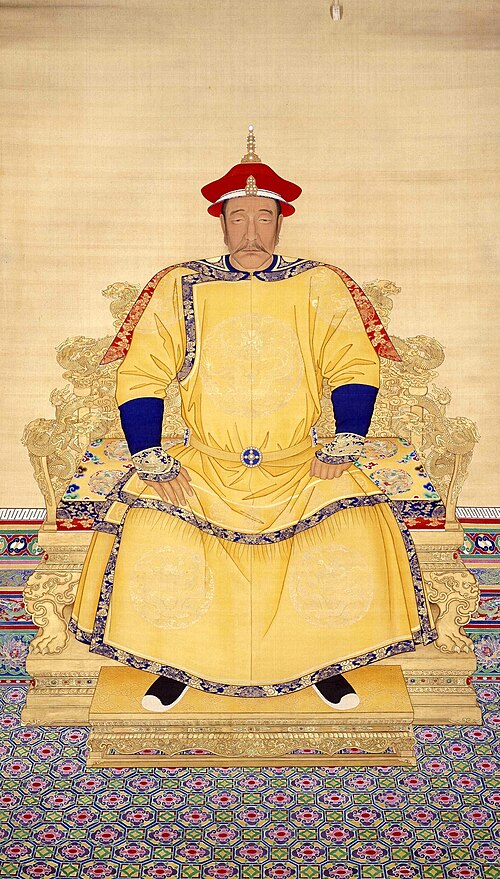
Start at the top for an easy introduction. Go further down for more detail and scholarship.
- Easy
- Intermediate
- Advanced
For young readers
About 450 years ago, north of the Yalu River that today separates North Korea and China, lived many groups of a people called the Jurchens. They hunted, farmed, raised horses and traded furs and ginseng with China, which was then ruled by the Ming dynasty.
In 1583 a young Jurchen man named Nurhaci lost his father and grandfather in a fight involving a Ming army. Later stories say he began his own war with only thirteen suits of armour.
Step by step he brought the Jurchen groups together. He had a new alphabet made for his people’s language and organised everyone into eight groups called banners, each with its own coloured flag.
In 1616 he called himself khan, a ruler like an emperor. In 1618 he went to war with Ming China, and in 1619 he defeated a huge Ming army, which had soldiers from Korea with it, at a place called Sarhu.
Nurhaci died in 1626. His son renamed the state Qing, and in 1644 the Qing took Beijing and went on to rule China until 1912.
At a glance
- Lived
- 1559 – 30 September 1626 (11th day of the 8th lunar month of Tianming 11). Born among the Jianzhou Jurchens; died at Aiji Fort (Aijiabao), about 40 li from Shenyang, aged 68 by East Asian reckoning
- Names and titles
- Nurhaci (努爾哈赤). Ming titles: commander-assistant (dudu qianshi, 1589) and Dragon-Tiger General (Longhu jiangjun, about 1595). Khan from 17 February 1616; Qing records date his reign as Tianming (“mandate of Heaven”), though whether Tianming served at the time as an era name is disputed; Manchu sources call him Genggiyen Han, the Bright Khan. Posthumously Qing Taizu. Joseon records call him Noeulgajeok (老乙可赤) or simply “the slave chief” (奴酋)
- Bases
- Fe Ala (from 1587), Hetu Ala (from 1603; enthroned there in 1616), Jaifiyan (1619), Sarhu (1620), Liaoyang (1621), Dongjing beside Liaoyang (1622) and Shenyang (Mukden, from April 1625)
- Main achievements
- Absorbed the Jianzhou Jurchens and the four Haixi (Hulun) states: Hada (1599/1601), Hoifa (1607), Ula (1613) and Yehe (1619); had the Manchu script created from Mongolian letters (1599); organised his people into companies (niru) and the Eight Banners (1615); founded the state of Jin, later called Later Jin (1616)
- Wars with the Ming
- Seven Grievances and the capture of Fushun (May 1618); Qinghe (September 1618); Battle of Sarhu, 14–18 April 1619; Kaiyuan, Tieling (1619); Shenyang and Liaoyang (May 1621); Guangning (March 1622); repulsed at Ningyuan (February 1626)
- Links with Korea
- In 1592 Jianzhou envoys proposed, through the Ming, that his troops fight the Japanese (Joseon declined); received the Joseon envoy Sin Chung-il at Fe Ala in January 1596; his troops fought Ula at Ogalam on the Joseon side of the Tumen in 1607; wrote to King Gwanghaegun in 1618; defeated the Joseon contingent under Gang Hong-rip at Bucha (Fuca) in April 1619, which surrendered
- Main sources
- Qing Veritable Records (Taizu Wu huangdi shilu of 1636, Manzhou shilu, later revisions) and the Manchu archives (Manwen laodang); Ming Veritable Records, the Ming History compiled under the Qing and Ming private histories; Korean annals (Seonjo sillok, Gwanghaegun ilgi), Sin Chung-il’s report and map of 1596 and Yi Min-hwan’s diary Chaekjung illok
- Debated
- How his grandfather and father died in 1583; what the thirteen suits of armour mean; whether his state was called Jin or Later Jin; how the battles of 1619 should be counted; whether Gwanghaegun secretly ordered the Joseon contingent to surrender; whether a cannon wound at Ningyuan caused his death
On the map
Meanwhile elsewhere in the world
Other subjects in this library from around the same years, in distant parts of the world.
- Benin Bronzesc. 1300–1897 · Benin City (Kingdom of Benin)
- Tokugawa Ieyasu1603–1616 · Edo (Tokugawa shogunate)
- William Shakespeare1589–1613 · London (England)
- Akbar1556–1605 · Fatehpur Sikri (Mughal Empire)
- Selimiye Mosque1568–1575 · Edirne (Ottoman Empire)
- Nzinga of Ndongo and Matamba1624–1663 · Ndongo and Matamba (Mbundu kingdoms, present-day Angola)
The war day by day
Easy
Who was Nurhaci?
Nurhaci was a chief of the Jianzhou Jurchens, a people living in the hills and valleys north of the Yalu River, in what is now Liaoning province in north-east China. Born in 1559, he spent forty years turning a quarrelsome world of small Jurchen chiefdoms into a single state with its own script, army organisation and khan, and in his last decade he took Liaodong from Ming China. His son Hong Taiji renamed the people Manchu (1635) and the state Qing (1636), and the Qing went on to rule China from 1644 to 1912.
Nurhaci matters for Korean history too. His homeland bordered Joseon along the Yalu and Tumen rivers. During the Imjin War Jianzhou envoys proposed, through the Ming, that his troops fight the Japanese. Nurhaci received a Joseon envoy in 1596, wrote to King Gwanghaegun in 1618, and in 1619 defeated a Joseon army that the Ming had summoned to fight him. The sections below follow his life from 1583 to 1626, including the Battle of Sarhu, and then ask how a chief with a few suits of armour came to shake the Ming.
Dates in this article are Gregorian, converted from the lunar calendars of the Ming, Qing and Joseon records, which in this period agreed on the months; lunar dates are marked as such.
Easy
Beyond the Yalu: the Jurchens and the Ming frontier
Ming writers divided the Jurchens into three groups: the Jianzhou Jurchens nearest Liaodong and Korea, the Haixi Jurchens further north (the four states of Hada, Hoifa, Ula and Yehe, called the Hulun in Qing sources) and the “Wild” Jurchens of the far north-east. The Ming ruled them indirectly: chiefs received titles and seals as heads of nominal “guards” (the Jianzhou Guard dates from 1403) and patents (chishu) that let them bring tribute and trade. Horse markets outside frontier towns such as Kaiyuan, Fushun and Qinghe bought Jurchen horses, furs and ginseng.
For more than twenty years the frontier was held by Li Chengliang, regional commander of Liaodong in 1570–1591 and 1601–1608, who played chiefs against one another. The Ming History says his family came from Korea; his son Li Rusong retook Pyongyang from the Japanese in 1593. A Ming private history says Nurhaci served Li with great deference and that Li handed him the tribes he had subdued; the official Ming History, compiled under the Qing, leaves Nurhaci out of Li’s biography altogether.
Even in 1596 the seal on Nurhaci’s letters read “Seal of the Jianzhou Left Guard”, a Ming office. His rise took place inside the Ming frontier system before it turned against it.
Easy
1583: Gure and the thirteen suits of armour
In the spring of 1583 Li Chengliang attacked the fort of Gure, held by the chief Atai, and Nurhaci’s grandfather Giocangga and father Taksi died in the attack. The Qing records, written after the dynasty was founded, say that a rival chief, Nikan Wailan, incited the Ming troops, that the two men had gone into the fort to bring out Giocangga’s granddaughter, and that the Ming admitted a mistaken killing and gave Nurhaci thirty patents and thirty horses. The Ming History reports only Li’s victory and some 2,300 heads taken; a Ming memorial of 1619 says Li had used the two men as guides and killed them along with Atai’s people.
The Qing’s first Veritable Record of the founder, completed in 1636, then says that Nurhaci, wishing to avenge his grandfather and father, “had only thirteen suits of armour left” and raised troops in the 5th lunar month of 1583 (from 20 June), at the age of 25. A later revision says the armour was his father’s. Qing records also say his first attack, on Nikan Wailan’s town of Turun, was made with fewer than a hundred men.
There is no independent contemporary witness to the thirteen suits of armour, and the figure does not mean thirteen horsemen. It is best read as the way the Qing chose to remember their beginning: a small, wronged family that grew by its own strength. Thirty-five years later, the first of Nurhaci’s Seven Grievances against the Ming would again be the killing of his father and grandfather.
Easy
Uniting the Jurchens: Fe Ala, Gure Mountain and the Hulun states
Over the next years Nurhaci brought the Jianzhou chiefs under his control. In 1587 he built the walled town of Fe Ala in the hills of the upper Suksuhu valley, and in 1589 the Ming made him a commander-assistant (dudu qianshi). The Haixi states watched his growth with alarm. According to the Qing records, in the autumn of 1593 (9th lunar month) a coalition of nine peoples led by Yehe, with Hada, Ula, Hoifa and the Khorchin Mongols, marched on him by three roads. The Qing records give their strength as 30,000; a Ming history, which dates the battle to 1594, says 70,000 to 80,000.
The battle was fought near Gure Mountain, where the valleys narrow. The Qing account says Nurhaci told his commanders that wounding one or two of the enemy leaders would make the rest flee; when the Yehe chief Bujai’s horse fell, Bujai was killed and the coalition broke. Bujantai of Ula was captured, or, as the Joseon envoy Sin Chung-il heard two years later, surrendered. After this, Sin was told, “near and distant tribes came over one after another”.
Nurhaci then took the Hulun states one by one: Hada fell on 25 October 1599 and was absorbed in 1601; Hoifa on 3 November 1607; Ula on 8 March 1613, when its chief Bujantai fled to Yehe; Yehe, protected by Ming troops, held out until September 1619. In 1603 he moved his seat a few kilometres north to Hetu Ala; a Joseon report of that year describes the new fortress, its stockade not yet finished.
Intermediate
What Joseon saw, 1589–1607
Korea heard of Nurhaci early. On 22 August 1589 the army commander of Pyeongan Province reported what Jurchen defectors said: “Noeulgajeok calls himself king (wang).” In the autumn of 1592, with the Japanese in Pyongyang, the Ming Ministry of War passed on a proposal from Jianzhou tribute envoys: Nurhaci had 30,000–40,000 horsemen and 40,000–50,000 foot soldiers, and the envoys expected him to agree to cross the frozen river in winter and attack the Japanese. The ministry itself doubted the Jurchens, and Joseon declined; minister Yun Du-su said that if it were true, “our country will perish”. Whether Nurhaci himself had authorised the proposal is not known, and no record has been found of an offer made to Joseon directly.
In the winter of 1595–96, after a Joseon official at Wiwon killed Jurchens who had crossed to dig ginseng, the court sent the officer Sin Chung-il to Fe Ala. He crossed the frozen Yalu at Manpo on 21 January 1596, passed the old Goguryeo capital at Ji’an and reached Nurhaci’s house on 27 January. His report and route map, the Geonju gijeong dogi, give the earliest eyewitness picture of Nurhaci: walls of stone and earth around a stockaded house, some 150 commanders, no one who could read. Nurhaci was “sturdy, with a straight, large nose and a long, firm face”; at the New Year feast he played the lute and said that “the two countries will be as one country”. King Seonjo, reading the report, said Joseon was caught between great enemies to the south and north.
In 1601 Nurhaci asked for a Joseon appointment and was told he already held a Ming title. In the spring of 1607 his brother Šurhaci and his sons, sent to bring over Jurchens on the lower Tumen, defeated an Ula army at Ogalam near Jongseong and rode past the walls of Gyeongwon. The revised Seonjo annals say they passed through Joseon’s frontier “as if through an empty land”; a historian’s comment in the Seonjo annals called Ula a vicious dog and Nurhaci a tiger hiding in the mountains.
Intermediate
1616: khan of Jin (“Later Jin”)
On 17 February 1616, the first day of the lunar year, Nurhaci was proclaimed khan at Hetu Ala, aged 58 by East Asian reckoning. The Qing records say his sons and officials, standing by banner, presented a memorial, that he was given a title meaning “bright emperor who nourishes the nations” and that the era was named Tianming, “mandate of Heaven”; Qing chronology counts his reign in Tianming years.
The state is usually called Later Jin (後金), after the Jurchen Jin dynasty of the twelfth century; the Manchu form is sometimes given as Amaga Aisin gurun. But the enthronement entries give no state name, and Nurhaci’s seal reads “seal of the khan of the Jin state, mandated by Heaven” (abkai fulingga aisin gurun han i doron). Other titles circulated too: a Ming record of 1618 quotes him as “khan of the state of Jianzhou”, and the Joseon annals render the heading of a letter received in 1619 as “Later Jin khan”, which need not reproduce the original Manchu wording. Surveying more than a hundred official uses, Lu Zhengheng and Huang Yi-long concluded that the state called itself simply Jin, and argued that Tianming was not a reign name in the Chinese sense; this article uses the familiar names.
Neither Joseon nor the Ming seems to have registered the enthronement at once. No entry announcing it has been found in the Joseon annals for 1616–17; in 1619 a Ming official cited a Joseon report that Nurhaci had “dared to found a state, change the era and call himself ‘We’”.
Intermediate
A Ming weakened from within
While Nurhaci built his state, the Ming government was faltering. From the late 1580s the Wanli Emperor largely abandoned regular court audiences, and vacancies in the ministries and censorate went unfilled for years. The Ming History says the war in Korea, “eight years from start to finish”, cost more than seven million taels of silver; other entries give 7.8 million. To raise money the emperor sent palace eunuchs to collect mining and commercial taxes; in Liaodong the eunuch Gao Huai’s exactions provoked mutinies in 1608.
The frontier was also changing. Li Chengliang was dismissed in 1591, and in his absence Liaodong’s commanders changed often. In 1606, back in command, he and the governors abandoned the six forts around Kuandian as too exposed and drove the settlers back inside the frontier: the Ming History gives over 64,000 households, the Dongyi kaolüe over 60,000 people; a Ming critic later called it “not abandoning land but presenting it”. Nurhaci’s people moved into the empty land.
Historians differ on how much the Imjin War itself weakened the Ming in Liaodong. But the chronology is clear: while Ming armies and silver were committed to Korea, from 1592 to 1598, Nurhaci defeated the coalition at Gure Mountain and drew neighbouring tribes to him, and the Ming did little to stop him; his conquest of the Hulun states began with Hada in 1599.
Intermediate
1618: the Seven Grievances, Fushun and Qinghe
On 7 May 1618 Nurhaci announced Seven Grievances against the Ming to Heaven and marched with 20,000 men. In the Qing records the Ming had killed his father and grandfather without cause, broken a sworn border agreement to protect Yehe, made him execute ten men over a border killing, let Yehe give his betrothed to the Mongols, driven his people from their fields at Chaihe, Sancha and Fu’an before harvest, insulted him on Yehe’s word and forced him to restore Hada. The wording survives only in later Qing texts, but a document of this kind existed in 1618: a Ming compilation records that in June (the intercalary 4th month) Nurhaci sent released Chinese captives with a letter in which he called himself “khan of the state of Jianzhou” and set out “seven grievances”, and a Joseon record of July summarises a letter with the same theme.
Fushun fell on 9 May. Ming records say Jurchens announced that they were coming to a great market and broke in when merchants came out to trade; the Qing records say a letter persuaded the Ming officer Li Yongfang to surrender as the walls were scaled. A relief army of about 10,000 under Zhang Chengyin, regional commander of Guangning, was destroyed on 15 May; the Ming History says some ten thousand died and that “the whole court was shocked”. In September the fort of Qinghe fell too.
Joseon was drawn in at once. On 4 June a dispatch from the Ming governor of Liaodong asking Joseon to join an attack reached the court, and on 9 August the new Ming military commissioner, Yang Hao, demanded 10,000 picked troops. Nurhaci also wrote: on 7 July twelve Jurchen horsemen appeared across the Yalu at Manpo with a letter addressed “to be opened by the King of Joseon”, saying that Joseon had no grievance against their master and should guard its own land and not raise troops.
Intermediate
Joseon between the Ming and Nurhaci
King Gwanghaegun, enthroned in 1608 and invested by the Ming in 1609 (the interpreter at the ceremony was Gang Hong-rip), had watched the north closely. In 1614 a frontier commander told him that Nurhaci’s men were “not to be compared with an ordinary tribe; their commands are strict and their weapons fine”. In 1618 the king spoke of loyalty to the Ming but argued against sending troops: the request came from the Liaodong governor, “not from the Son of Heaven” (16 June); Nurhaci was “truly a formidable enemy under heaven”, nothing like the Jianzhou chiefs Joseon had once defeated (22 June); and the troops should wait at Uiju on the Yalu.
His ministers agreed that Joseon’s soldiers were weak — the Left State Councillor Han Hyo-sun said they were all farmers and “not one is fit for use” — but argued that the debt of the Imjin War, when the Ming had saved Korea, made refusal impossible. After Yang Hao’s demand Joseon gave way. On 23 August 1618 it sent the Ming a roster of 10,000 men: 3,500 musketeers, 3,500 archers and 3,000 close-combat soldiers (salsu; the surviving text repeats “archers” here by a copying slip), under the civil official Gang Hong-rip as commander-in-chief and Kim Gyeong-seo as his deputy. On 7 September Gwanghaegun still refused to send more men deep into Jurchen land, calling it “a matter of the survival of the state”.
Gwanghaegun’s policy is often called “neutral diplomacy”, but the label is a modern interpretation and disputed: some historians praise his realism, others argue that neutrality was impossible within the Ming-centred order. By the end of 1618 Joseon was committed to a war it did not want.
Intermediate
The Battle of Sarhu, April 1619
Yang Hao planned to end the war in one stroke. Four columns were to converge on Hetu Ala: Du Song from Fushun in the west, Ma Lin from the Kaiyuan–Tieling area in the north with Yehe allies, Li Rubai from Qinghe in the south and Liu Ting from Kuandian in the east with the Joseon army. The Ming proclaimed 470,000 men; the Qing records say Yang Hao had 200,000; a Ming compilation of contemporary reports counts 88,550 officers and men, not counting the Koreans. Heavy snow delayed the start, and the columns left their passes days apart: Liu Ting on 9 April, Ma Lin on 12 April, Du Song on the afternoon of 13 April and Li Rubai on 14 April.
Nurhaci judged that the southern movements were a feint and that the main army was coming from Fushun, and concentrated against it. On 14 April Du Song crossed the Hun River, so deep and fast that his wagons and cannon were left behind, and divided his army: one camp on the hill of Sarhu, near where the Hun and Suksuhu meet, while he attacked the cliff of Jilin (Girin hada) at Jaifiyan, where Jurchen labourers guarded by 400 horsemen were building a fort. Late in the day Nurhaci arrived, threw the troops of six of his eight banners against the Sarhu camp and broke it, then turned on Du Song, who was killed. The Qing records say Ming weapons and bodies floated down the Hun “like ice breaking up”. The valley is now under the Dahuofang reservoir, built in the 1950s.
On 15 April the Jurchens turned north and routed Ma Lin at Shanggiyan Hada; Ma escaped, but his supervising official Pan Zongyan was killed. Li Rubai was ordered back by Yang Hao and withdrew almost without fighting, which later brought accusations against him. Nurhaci’s army moved on short interior lines while the Ming columns came separately over the mountains. The famous saying “however many roads you come by, I go by one” is not in the Qing records; it is found in later Ming writings.
The eastern column met the Jurchens last. On 17 April Liu Ting’s vanguard, strung out and plundering villages after scouts reported no enemy ahead, was attacked at Abdari ridge (Abudali gang): the Qing records say Hong Taiji struck from higher ground and Daišan from the flank, and the two rear Ming camps were overrun before they could form up. Liu Ting was killed. Some Ming sources, the Ming History and the later Draft History of Qing add that the Jurchens used Du Song’s banners and uniforms to deceive him; the early Manzhou shilu does not.
Intermediate
The Joseon army at Bucha and Gang Hong-rip’s surrender
About 13,000 Joseon soldiers crossed the Yalu around Changseong between 3 and 7 April 1619, according to the diary of Yi Min-hwan, a staff officer with Gang Hong-rip. Liu Ting’s camp had no heavy guns; he told Gang that Yang Hao “must want me dead” and that his own troops numbered no more than 10,000. The march over snowy passes went badly: on 12 April Gang reported that the ten days’ rations each man had carried were gone, and Ming officers accused the Koreans of dragging their feet.
On 17 April the Joseon army reached Bucha (Fuca), a plain among hills about 60 li from Hetu Ala. Gang ordered his divisions onto high ground, but Kim Eung-ha’s left division had already camped on the plain behind portable barriers. Jurchen cavalry enveloped it, and the right division came down to join it. Every account mentions wind: the Joseon annals say a north-west wind blew away the powder so that the guns could not be used; the Qing records say the gun smoke blew back on the Korean lines; Yi Min-hwan, watching from the centre, wrote that after one volley the horsemen were inside before the guns could be reloaded. Both divisions were destroyed in moments.
Kim Eung-ha died fighting. The Joseon annals say he leaned against a tree shooting with three bows and kept hold of his bow after a spear pierced his chest, and that the Jurchens called him “the general who leaned on the willow”; later writings added that he fought on with his sword and bare hands. Yi Min-hwan, who was there, wrote only that he “heard afterwards” that Kim had fought to the death.
The hungry centre division was left on its hill. Yi Min-hwan says the Jurchens called for an interpreter and said they had no quarrel with Korea; the deputy commander Kim Gyeong-seo went to their camp, and on 18 April Gang Hong-rip followed and the army laid down its arms. The Qing records say instead that Gang lowered his flags and sent word first that “this coming was not our wish”; who opened the talks cannot be settled. The Ming officer Qiao Yiqi, who had sheltered with the Koreans, threw himself from a cliff. Joseon losses are uncertain: the annals later speak of eight to nine thousand dead at Bucha, the Qing records of 5,000 who surrendered.
Advanced
Did Gwanghaegun order the surrender?
A long tradition holds that Gwanghaegun secretly told Gang Hong-rip to watch events and choose his side, and the Encyclopedia of Korean Culture’s entry on the battle reports it. The written instructions say less. On 17 March 1619 the king noted that although Joseon troops sent forward in January had returned without meeting the enemy, the Jurchens would bear a grudge, so the upper Yalu must be guarded; on 18 March, rebuking Gang for detaching 400 musketeers to the Ming camp, he told him “not simply to follow the Ming generals’ words, but to strive only to stand where he cannot be defeated”. Neither is an order to surrender.
After the battle Gang reported (15 May 1619) that on the march he had secretly told the Jurchens through an interpreter that Joseon would stay behind the Ming lines and avoid battle; the Border Defence Council condemned him. Gwanghaegun asked his ministers whether Joseon could resist this enemy at all and defended Gang’s secret reports from captivity. The explicit charge of a secret order comes from his enemies: the proclamation deposing him in April 1623 said he had “secretly instructed the commander to watch events and choose his side”, and the editors of his annals, working after the coup, added that the surrender had been planned.
Historians remain divided. Some, following Yi Byeong-do, see a deliberate policy of avoiding war with Nurhaci; Oh Hang-nyeong thinks that, judging from the circumstances, a secret order probably existed, but criticises Gwanghaegun’s policy as opportunism; Jang Jeong-su emphasises back-channel negotiations with the Later Jin involving the Border Defence Council and how their character changed, rather than a single royal order. Gang Hong-rip remained a captive until 1627, when he returned with the Later Jin army that invaded Joseon; he died that September.
Intermediate
Taking Liaodong, 1619–1625
Sarhu opened Liaodong. Kaiyuan fell on 26 July 1619 and Tieling on 3 September; on 29 September Yehe was destroyed and its chiefs Gintaisi and Buyanggū were put to death. Nurhaci moved west towards the Ming, to a new fort at Jaifiyan in 1619 and to Sarhu in 1620. In May 1621 he took Shenyang (4 May) and, after a two-day battle, Liaoyang, the Ming capital of Liaodong (11–12 May); the military commissioner Yuan Yingtai burned himself to death in a gate tower. Liaoyang became Nurhaci’s capital.
In March 1622 he crossed the Liao River, defeated a Ming army at Xiping and entered Guangning on 5 March as its officials fled to Shanhai Pass. That year he ordered a new walled city built a few kilometres east of Liaoyang, Dongjing, the “Eastern Capital”. On 10 April 1625 he moved again, to Shenyang, which he called a crossroads from which roads ran west to the Ming, north to the Mongols and south to Joseon.
Ruling Liaodong meant ruling a large Han Chinese population; after a revolt in 1623 Nurhaci turned from concessions to discrimination and killings. Ming resistance continued near Korea: in 1621 Mao Wenlong took Zhenjiang near the Yalu mouth, Nurhaci’s troops pursued him into Joseon territory in December, and he later based himself on Ka Island off Cheolsan, drawing Joseon deeper into the conflict.
Intermediate
Ningyuan and the death of Nurhaci, 1626
Early in 1626, hearing that the Ming had pulled back most of its forces behind Shanhai Pass, Nurhaci crossed the Liao River again. On 19 February he reached Ningyuan, held by Yuan Chonghuan, who refused to surrender. Attacks on 20 and 21 February failed against a garrison firing cannon and incendiaries from the walls, including large Western-style guns; on 22 February his troops destroyed the Ming grain depot on Juehua Island instead. He was back in Shenyang on 6 March. The Qing records say that “since the age of 25 he had won every battle and taken every city he attacked; only Ningyuan he could not take”, and that he returned unhappy.
A widespread story says he was wounded by cannon fire at Ningyuan and died of it. The evidence is thin: the Ming writer Zhang Dai says a shot hit the yellow tent and wounded a “subordinate prince”, which some historians take to mean Nurhaci, while others note that in late April 1626 he led a campaign against the Khalkha Mongols in person. The Qing records say only that he fell ill in September, went to the hot springs at Qinghe and died on 30 September 1626 at Aiji Fort, about 40 li from Shenyang, while returning by boat. The next day his widow Lady Abahai, mother of Dorgon, was made to follow him in death.
Nurhaci was buried in the Fuling tomb east of Shenyang. His eighth son Hong Taiji was chosen khan.
Advanced
How did a chief with thirteen suits of armour shake the Ming?
The answer begins inside the Ming system. Nurhaci rose as a Ming-titled chief who held trade patents and used the frontier markets, and, according to a Ming private history, served Li Chengliang; the patents and titles brought him wealth and standing over rivals. The Ming’s habit of managing the Jurchens by dividing them, and by backing one chief against another, let him absorb his neighbours one at a time, while Ming attention and silver were drawn to Korea in the 1590s and to troubles at court.
Second, he turned a confederation into a state. Joseon visitors in 1596 saw a chief with 150 commanders and no one who could write; twenty years later he had a script, written orders, a registered population organised in companies and banners, and a khan’s title. The banners turned scattered clans into a disciplined army that could move fast and concentrate, and the script and records gave the new state a memory and a law of its own.
Third, the Ming was weakening from within. An emperor who largely abandoned regular audiences, unfilled offices, the cost of the wars of the 1590s, eunuch tax collectors and mutinies in Liaodong, and the withdrawal from Kuandian in 1606 all reduced the frontier’s ability to respond. When Nurhaci struck in 1618, a Joseon frontier commander and Gwanghaegun had already judged him stronger than any Jurchen chief they knew.
Finally, he won the decisive battles: Fushun and Qinghe in 1618 showed that Ming forts could fall; at Sarhu in 1619 he beat a divided offensive column by column; in 1621 he took Shenyang and Liaoyang. The thirteen suits of armour are a Qing story, but the shaking of the Ming was real: within three years of declaring war he held Liaodong east of the Liao River, and Joseon was caught between its old protector and a new power on the Yalu.
Advanced
After Nurhaci: Later Jin, Qing and Korea
Hong Taiji continued his father’s war. In 1627 the Later Jin invaded Joseon (the Jeongmyo War), justifying it partly by Mao Wenlong’s presence on Ka Island, and imposed a “brotherly” relationship. In 1635 he renamed the Jurchens “Manchu”, and in 1636 he proclaimed the Great Qing; that winter the Qing invaded Joseon again and forced it to break with the Ming. In 1644 the Qing entered Beijing.
The Qing remembered Nurhaci as their founder, Taizu, in Veritable Records revised under later emperors; much of his story, from the thirteen suits of armour to the grievances, comes from them. In Korea he is remembered through Sin Chung-il’s visit, the defeat at Bucha and the long argument over Gwanghaegun’s choices.
Advanced
Sources and their problems
The Qing accounts of Nurhaci were written after he became a founder to be honoured. The first Veritable Record (1636) and the illustrated Manzhou shilu already contain the thirteen suits of armour, the Ming’s “mistaken” killing of his father and grandfather and the providential wind at Bucha; later revisions polished his words and changed names and numbers. The Manchu archives (Manwen laodang) are closer to events but were not consulted directly for this article.
Ming sources have their own interests. Commanders blamed one another after Sarhu, and the Ming History, compiled under the Qing, left Nurhaci out of Li Chengliang’s life, draws on Qing-derived narratives for the war and its imperial annals misdate Liu Ting’s death to the day corresponding to 20 April. Ming-side reports and later writings are the source of stories such as the market trick at Fushun, the disguise at Abdari ridge and the “one road” saying.
Korean sources include eyewitnesses: Sin Chung-il’s report of 1596 and Yi Min-hwan’s diary of the campaign and his captivity. But Sin wrote as a spy, Yi revised his diary after returning and had his conduct to defend, and the Gwanghaegun annals were compiled by the king’s opponents, whose comments must be separated from the documents they preserve. Numbers in all three traditions, from the 470,000 Ming soldiers to the Joseon dead, are claims rather than counts.
Key ideas
- Inside, then against, the Ming system
- Nurhaci began as a Ming-titled Jurchen chief with trade patents and a Ming seal. He used that position to defeat his rivals before declaring war on the Ming in 1618.
- Thirteen suits of armour
- The Qing records say he started his war in 1583 with only thirteen suits of armour. No independent source confirms it; it is the Qing’s chosen picture of a humble, wronged beginning.
- Script and banners
- A new script (1599) and the organisation of all his people into companies and eight banners (by 1615) turned a coalition of clans into a state with records, laws and a disciplined army.
- One road against four
- At Sarhu in 1619 the Ming divided its army into four columns that arrived at different times. Nurhaci, at the centre, defeated three of them one after another, and the fourth withdrew.
- Korea between two powers
- Joseon owed the Ming for its help against Japan but feared Nurhaci. Its army fought at Sarhu and surrendered, and whether King Gwanghaegun secretly planned this is still debated.
- From Later Jin to Qing
- The state Nurhaci founded in 1616 called itself Jin. His son renamed it Qing in 1636, and the Qing ruled China from 1644.
Records
- 1559 — Nurhaci is born among the Jianzhou Jurchens.
- 1583 — Spring: his grandfather and father die in Li Chengliang’s attack on Gure. Summer: the Qing records say he begins his war with thirteen suits of armour.
- 1587 — Builds the walled town of Fe Ala.
- 1589 — 22 August: a Joseon report says he “calls himself king”. The Ming makes him commander-assistant.
- 1592 — Autumn: Jianzhou envoys propose, through the Ming, that his troops fight the Japanese in Korea; Joseon declines.
- 1593 — Autumn: defeats the nine-people coalition led by Yehe at Gure Mountain.
- 1596 — 21–27 January: the Joseon envoy Sin Chung-il travels from Manpo to Fe Ala and later reports on Nurhaci.
- 1599 — The Manchu script is created from Mongolian letters. 25 October: Hada falls.
- 1603 — Moves his seat to Hetu Ala.
- 1607 — Spring: his troops defeat Ula at Ogalam on the Tumen near Jongseong. 3 November: Hoifa falls.
- 1613 — 8 March: Ula falls.
- 1615 — End of the year: the Qing records describe the Eight Banners.
- 1616 — 17 February: proclaimed khan at Hetu Ala; Qing records begin the Tianming years.
- 1618 — 7 May: the Seven Grievances. 9 May: Fushun falls. 7 July: his envoys bring a letter addressed to the King of Joseon to Manpo. September: Qinghe falls.
- 1619 — 14–18 April: Battle of Sarhu; Du Song, Ma Lin and Liu Ting are defeated and the Joseon army surrenders after Bucha. 29 September: Yehe is destroyed.
- 1621 — 4 May: Shenyang falls. 11–12 May: Liaoyang falls and becomes his capital.
- 1622 — 5 March: enters Guangning. Dongjing is built beside Liaoyang.
- 1625 — 10 April: moves his capital to Shenyang.
- 1626 — 19–22 February: fails to take Ningyuan. 30 September: dies near Shenyang; Hong Taiji succeeds him.
- 1627 — The Later Jin invades Joseon; Gang Hong-rip returns with the invading army.
- 1636 — Hong Taiji proclaims the Qing dynasty.
- 1644 — The Qing enters Beijing.
Glossary
- Jurchens
- The Tungusic-speaking peoples of Manchuria. Nurhaci’s Jianzhou Jurchens and the Haixi Jurchens were renamed Manchu in 1635.
- Jianzhou, Haixi and Wild Jurchens
- The three groups into which Ming writers divided the Jurchens, from nearest Liaodong and Korea to the far north-east.
- Hulun
- The Qing name for the four Haixi states of Hada, Hoifa, Ula and Yehe.
- Patent (chishu)
- A Ming document that allowed a Jurchen chief to bring tribute and trade. Controlling many patents meant wealth and power.
- Niru
- “Arrow”: a company of about 300 men and their households, the basic unit of Nurhaci’s organisation.
- Banner (gūsa)
- One of eight divisions, each with its own flag, into which Nurhaci organised his people for war, farming and administration.
- Khan
- The title of a supreme ruler among Mongol and Jurchen peoples, taken by Nurhaci in 1616.
- Seven Grievances
- Nurhaci’s list of wrongs done to him by the Ming, announced when he went to war in 1618.
- Military commissioner (jinglüe)
- A senior Ming official given overall command of a war zone, such as Yang Hao in Liaodong in 1618–19.
- Dowonsu
- Joseon commander-in-chief of an expeditionary army; in 1619 the civil official Gang Hong-rip.
Questions and answers
Did Nurhaci really start with thirteen suits of armour?
That is what the Qing records say, from the first version of 1636 onwards. No independent source confirms it, and it is best read as the Qing story of their beginning.
Did Nurhaci offer to help Korea against Japan?
In 1592 the Ming Ministry of War passed on a proposal by Jianzhou envoys that his troops fight Japan; whether Nurhaci had authorised it is unknown. Joseon declined, fearing his intentions. No direct offer to Joseon has been found.
Was his state called Later Jin?
That is the usual modern name, and the Joseon annals render the heading of a 1619 letter as “Later Jin khan”, though the original wording is not established. But his seal and most official uses say simply Jin (Aisin gurun).
Why did the Ming lose at Sarhu?
Its columns set out at different times over difficult country. A concentrated Jurchen army destroyed three of them in turn — Du Song’s, which had left its guns behind at the Hun River, then Ma Lin’s and Liu Ting’s — while Li Rubai withdrew largely intact.
How many Koreans fought at Sarhu?
About 13,000 crossed the Yalu, according to Yi Min-hwan and the Joseon annals. Numbers of dead and captured vary widely between sources.
Did Gwanghaegun order Gang Hong-rip to surrender?
No such order survives. He told Gang to avoid defeat and not simply obey the Ming generals, and Gang made contacts with the Jurchens, but the explicit charge of a secret order appears in the 1623 proclamation that deposed him, and the later annal commentary also alleged a prior arrangement. Historians still disagree.
Who was Kim Eung-ha?
The commander of Joseon’s left division, killed at Bucha on 17 April 1619. Joseon honoured him as a hero, and accounts of his death grew more dramatic over time.
Did Nurhaci die of a wound received at Ningyuan?
This is a popular story but not proven. He campaigned again two months after Ningyuan, and the Qing records say he fell ill in September 1626 and died on 30 September.
Where is Sarhu today?
East of Fushun in Liaoning, China, where the Hun and Suksuhu rivers meet; much of the battlefield valley now lies under the Dahuofang reservoir.
Sources and further reading
- 清實錄 · 太祖武皇帝實錄 (Veritable Record of Emperor Taizu Wu, 1636). Wikisource (Chinese)
- 清實錄 · 太祖高皇帝實錄 (revised edition), juan 1. Wikisource (Chinese)
- 清實錄 · 太祖高皇帝實錄 (revised edition), juan 4 (1612–1615, incl. the Eight Banners). Wikisource (Chinese)
- 清實錄 · 太祖高皇帝實錄 (revised edition), juan 5 (1616 enthronement). Wikisource (Chinese)
- 滿洲實錄 (Manzhou shilu), juan 2. Wikisource (Chinese)
- 滿洲實錄 (Manzhou shilu), juan 3. Wikisource (Chinese)
- 滿洲實錄 (Manzhou shilu), juan 4 (incl. the Seven Grievances and Fushun). Wikisource (Chinese)
- 滿洲實錄 (Manzhou shilu), juan 5 (the Sarhu campaign). Wikisource (Chinese)
- 滿洲實錄 (Manzhou shilu), juan 6 (1619–1621). Wikisource (Chinese)
- 滿洲實錄 (Manzhou shilu), juan 7 (1621–1624). Wikisource (Chinese)
- 滿洲實錄 (Manzhou shilu), juan 8 (1625–1626). Wikisource (Chinese)
- 明史 (Ming History), juan 21: annals of the Shenzong (Wanli) Emperor. Wikisource (Chinese)
- 明史 (Ming History), juan 90: Treatise on the Army 2. Wikisource (Chinese)
- 明史 (Ming History), juan 238: biography of Li Chengliang. Wikisource (Chinese)
- 明史 (Ming History), juan 239: biographies incl. Zhang Chengyin and Du Song. Wikisource (Chinese)
- 明史 (Ming History), juan 247: biography of Liu Ting. Wikisource (Chinese)
- 明史 (Ming History), juan 259: biography of Yang Hao. Wikisource (Chinese)
- 明史 (Ming History), juan 305: eunuchs (Chen Zeng, Gao Huai). Wikisource (Chinese)
- 明神宗實錄 (Ming Shenzong shilu), 11th day of the 3rd month of Wanli 47 (1619): memorial of the censor Chen Wangting on the columns’ departure. National Institute of Korean History, Ming–Qing Veritable Records database (sillok.history.go.kr/mc, entry msilok_011_5800_0010_0010_0110_0060)
- Zhuang Tinglong (莊廷鑨), 明史鈔略 (Mingshi chaolüe), biography of Li Chengliang. Wikisource (Chinese)
- Mao Ruizheng (茅瑞徵), 東夷考略 (Dongyi kaolüe). Wikisource (Chinese)
- Wang Zaijin (王在晉), 三朝遼事實錄 (Sanchao Liaoshi shilu), general summary. Wikisource (Chinese)
- Wang Zaijin (王在晉), 三朝遼事實錄 (Sanchao Liaoshi shilu), juan 1 (incl. the Joseon king’s memorial of 1619). Wikisource (Chinese)
- Xia Yunyi (夏允彝), 幸存錄 (Xingcun lu), juan 1. Wikisource (Chinese)
- 선조실록 (Seonjo sillok), 12th day of the 7th month of 1589: the Pyeongan army commander reports on Jianzhou. Institute for the Translation of Korean Classics (Korean Classics DB)
- 선조실록 (Seonjo sillok), 14th day of the 9th month of 1592 (Yun Du-su on Nurhaci’s offer). Institute for the Translation of Korean Classics (Korean Classics DB)
- 선조실록 (Seonjo sillok), 17th day of the 9th month of 1592: correspondence with the Ming Ministry of War on the Jurchen offer. Institute for the Translation of Korean Classics (Korean Classics DB)
- 선조실록 (Seonjo sillok), 30th day of the 1st month of 1596: report of Sin Chung-il. Institute for the Translation of Korean Classics (Korean Classics DB)
- 선조실록 (Seonjo sillok), 30th day of the 1st month of 1596: the king’s instruction on Sin Chung-il’s report. Institute for the Translation of Korean Classics (Korean Classics DB)
- 선조실록 (Seonjo sillok), 23rd day of the 10th month of 1601: Nurhaci asks for a Joseon appointment. Institute for the Translation of Korean Classics (Korean Classics DB)
- 선조실록 (Seonjo sillok), 8th day of the 8th month of 1603: report on Nurhaci’s new fortress. Institute for the Translation of Korean Classics (Korean Classics DB)
- 선조수정실록 (Seonjo sujeong sillok), 2nd month of 1607: the battle at Ogalam. Institute for the Translation of Korean Classics (Korean Classics DB)
- 선조실록 (Seonjo sillok), 2nd day of the 4th month of 1607, with the historian’s comment. Institute for the Translation of Korean Classics (Korean Classics DB)
- 광해군일기 (Gwanghaegun ilgi), 2nd day of the 6th month of 1609: the Ming investiture. Institute for the Translation of Korean Classics (Korean Classics DB)
- 광해군일기 (Gwanghaegun ilgi), 25th day of the 6th month of 1614: audience with Yi Si-eon. Institute for the Translation of Korean Classics (Korean Classics DB)
- 광해군일기 (Gwanghaegun ilgi), 12th day of the intercalary 4th month of 1618: dispatch of the Liaodong governor. Institute for the Translation of Korean Classics (Korean Classics DB)
- 광해군일기 (Gwanghaegun ilgi), 23rd day of the intercalary 4th month of 1618: opinion of Han Hyo-sun. Institute for the Translation of Korean Classics (Korean Classics DB)
- 광해군일기 (Gwanghaegun ilgi), 24th day of the intercalary 4th month of 1618: “not the command of the Son of Heaven”. Institute for the Translation of Korean Classics (Korean Classics DB)
- 광해군일기 (Gwanghaegun ilgi), 1st day of the 5th month of 1618: “truly a formidable enemy under heaven”. Institute for the Translation of Korean Classics (Korean Classics DB)
- 광해군일기 (Gwanghaegun ilgi), 29th day of the 5th month of 1618: the Jurchen letter at Manpo. Institute for the Translation of Korean Classics (Korean Classics DB)
- 광해군일기 (Gwanghaegun ilgi), 19th day of the 6th month of 1618: dispatch of Yang Hao. Institute for the Translation of Korean Classics (Korean Classics DB)
- 광해군일기 (Gwanghaegun ilgi), 4th day of the 7th month of 1618: Joseon’s dispatch with the roster of the expeditionary army. Institute for the Translation of Korean Classics (Korean Classics DB)
- 광해군일기 (Gwanghaegun ilgi), 19th day of the 7th month of 1618. Institute for the Translation of Korean Classics (Korean Classics DB)
- 광해군일기 (Gwanghaegun ilgi), 2nd day of the 2nd month of 1619: instruction to Gang Hong-rip on the northern defences. Institute for the Translation of Korean Classics (Korean Classics DB)
- 광해군일기 (Gwanghaegun ilgi), 3rd day of the 2nd month of 1619: instruction to Gang Hong-rip. Institute for the Translation of Korean Classics (Korean Classics DB)
- 광해군일기 (Gwanghaegun ilgi), 26th day of the 2nd month of 1619: Gang Hong-rip’s report on Liu Ting. Institute for the Translation of Korean Classics (Korean Classics DB)
- 광해군일기 (Gwanghaegun ilgi), 12th day of the 3rd month of 1619: the Pyeongan governor reports the defeat. Institute for the Translation of Korean Classics (Korean Classics DB)
- 광해군일기 (Gwanghaegun ilgi), 15th day of the 3rd month of 1619: a Joseon musketeer on Du Song’s defeat. Institute for the Translation of Korean Classics (Korean Classics DB)
- 광해군일기 (Gwanghaegun ilgi), 27th day of the 5th month of 1619: Ming condolence grants and the Joseon dead. Institute for the Translation of Korean Classics (Korean Classics DB)
- 광해군일기 (Gwanghaegun ilgi), 2nd day of the 4th month of 1619: Nurhaci’s letter and Gang Hong-rip’s report. Institute for the Translation of Korean Classics (Korean Classics DB)
- 광해군일기 (Gwanghaegun ilgi), 8th day of the 4th month of 1619: the Border Defence Council and the king on Gang Hong-rip. Institute for the Translation of Korean Classics (Korean Classics DB)
- 광해군일기 (Gwanghaegun ilgi), 9th day of the 4th month of 1619: on the reply to Nurhaci. Institute for the Translation of Korean Classics (Korean Classics DB)
- 인조실록 (Injo sillok), 14th day of the 3rd month of 1623: the queen dowager’s proclamation deposing Gwanghaegun. Institute for the Translation of Korean Classics (Korean Classics DB)
- 인조실록 (Injo sillok), 27th day of the 7th month of 1627: obituary of Gang Hong-rip. Institute for the Translation of Korean Classics (Korean Classics DB)
- Yi Min-hwan (李民寏), 柵中日錄 (Chaekjung illok), in 紫巖集 (Jaam jip), juan 5. Institute for the Translation of Korean Classics (Korean Classics DB)
- 박정자 (Park Jeong-ja), 건주기정도기 (建州紀程圖記, Geonju gijeong dogi). Encyclopedia of Korean Culture (Academy of Korean Studies)
- 계승범 (Kye Seung-beom), 광해군 (Gwanghaegun). Encyclopedia of Korean Culture (Academy of Korean Studies)
- 이장희 (Yi Jang-hui), 부차전투 (富車戰鬪, Battle of Bucha). Encyclopedia of Korean Culture (Academy of Korean Studies)
- 이장희 (Yi Jang-hui), 강홍립 (姜弘立, Gang Hong-rip). Encyclopedia of Korean Culture (Academy of Korean Studies)
- 이영춘 (Yi Yeong-chun), 책중일록 (柵中日錄, Chaekjung illok). Encyclopedia of Korean Culture (Academy of Korean Studies)
- 숭명정책과 중립 양단외교 (Pro-Ming policy and Gwanghaegun’s ‘neutral’ diplomacy), in 신편 한국사 (New History of Korea) 29. National Institute of Korean History (Uri Yeoksa Net)
- 오항녕 (Oh Hang-nyeong), <최종병기 활>이 놓쳤던 광해군의 앞잡이! (Gwanghaegun’s agent, missed by the film War of the Arrows). Pressian
- 장정수 (Jang Jeong-su), 심하전역 당시 광해군의 ‘밀지’와 대후금 배후교섭의 변질 (Gwanghaegun’s ‘secret order’ in the Simha campaign and back-channel negotiations with the Later Jin). 사총 (Sachong) 104, 2021
- 박현규 (Park Hyeon-gyu), 姜弘立 조선군의 深河전투 참전지리 고찰 (The geography of the Joseon army’s Simha campaign). 한중인문학연구 (Korean-Chinese Humanities Studies) 63, 2019
- Jungmin Park, Recovery of the Travel Route between Joseon Korea and the Jianzhou Jurchens during the Imjin War: Drawing on the 建州紀程圖記 (Illustrated Account of a Trip to the Jianzhou). Journal of Northeast Asian History 17-1, 2020
- Lu Zhengheng (盧正恒) and Huang Yi-long (黃一農), 先清時期國號新考 (A new study of the state name before the Qing, 1616–1636), abstract. 文史哲 (Literature, History and Philosophy) 2014-1, 2014
- Nurhaci. Wikipedia
- Later Jin (1616–1636). Wikipedia
- Jianzhou Jurchens. Wikipedia
- Manchu alphabet. Wikipedia
- Battle of Sarhū. Wikipedia
- 寧遠之戰 (Battle of Ningyuan). Wikipedia (Chinese)
- 七大恨 (Seven Grievances). Wikipedia (Chinese)
- Pamela Kyle Crossley, The Manchus. Blackwell, 1997
- Mark C. Elliott, The Manchu Way: The Eight Banners and Ethnic Identity in Late Imperial China. Stanford University Press, 2001
- Frederic Wakeman Jr., The Great Enterprise: The Manchu Reconstruction of Imperial Order in Seventeenth-Century China. University of California Press, 1985
- Kenneth M. Swope, The Military Collapse of China’s Ming Dynasty, 1618–44. Routledge, 2014
- 음양력 변환 계산 (Lunar–solar calendar conversion). Korea Astronomy and Space Science Institute
Related
- Li RusongMing general from Liaodong who led the Ming army that retook Pyongyang from the Japanese in 1593 and was then defeated near Byeokjegwan.
- King Seonjo of JoseonFourteenth king of Joseon (r. 1567–1608), whose reign saw the court split into rival factions and the Japanese invasions of 1592–1598.
Written with AI assistance from the published sources listed above, and revised as new research appears.