Start at the top for an easy introduction. Go further down for more detail and scholarship.
- Easy
- Intermediate
- Advanced
For young readers
In 1592 a small Korean army inside the walled town of Jinju beat a much bigger Japanese army. The Japanese leader, Toyotomi Hideyoshi, was furious. The next year, even while his officials were talking peace with China, he ordered his generals to go back and take Jinju.
This time the Japanese army was enormous. Many Korean and Chinese commanders said the town could not be saved and that the people should leave. But a few leaders, Kim Cheon-il, Hwang Jin and Choe Gyeong-hoe, decided to stay. They said Jinju was the gate to Jeolla, the rice-growing province to the west, and they did not trust the Japanese promise to go away afterwards.
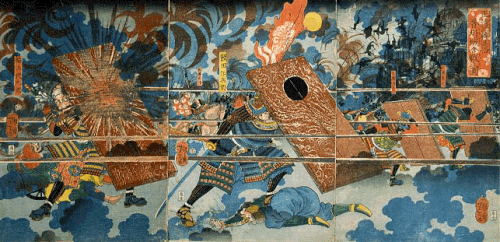
For nine days in the middle of summer the defenders fought from the walls. The Japanese built hills of earth so they could shoot down into the town, and pushed covered wagons up to the walls to dig at the stones. Townspeople, men and women, carried earth and stones to help. Then heavy rain soaked the walls. Hwang Jin, the bravest of the commanders, was killed, and on the ninth day part of the wall fell down.
The Japanese rushed in. Kim Cheon-il and Choe Gyeong-hoe jumped into the Nam River rather than be captured. Then the soldiers killed a huge number of people in the town, soldiers and ordinary people alike. Korean records say that about 60,000 people died in all during the siege and its end, including many who drowned in the river. It was one of the saddest days of the whole war.
People in Jinju still remember a young woman named Nongae. The story says she held a Japanese officer tightly and jumped with him into the river. The story was first written down about 30 years later, so we cannot be sure of every detail, but it became one of the most famous memories of the war.
At a glance
- What
- A Japanese siege and capture of Jinju fortress during a lull in the Imjin War, ordered to avenge the Japanese defeat there in 1592
- When
- Lunar 1593, 6th month, days 21–29, in the Joseon calendar; 19–27 July 1593 in the Gregorian calendar (full fighting from 20 July; English Wikipedia gives 20–27 July)
- Where
- Jinju fortress beside the Nam River, the leading town of Gyeongsang Right Province; today Jinju, South Gyeongsang
- Defenders
- Kim Cheon-il (changuisa, commissioner of the righteous armies), Choe Gyeong-hoe (army commander of Gyeongsang Right), Hwang Jin (army commander of Chungcheong), Go Jong-hu, Jang Yun, Yi Jong-in, Kim Jun-min and the Jinju magistrate Seo Ye-won
- Attackers
- Japanese commanders named in Japanese and modern accounts include Ukita Hideie, Katō Kiyomasa, Kuroda Nagamasa and Shimazu Yoshihiro in the siege corps, with Mōri Hidemoto, Kobayakawa Takakage and Konishi Yukinaga’s forces in supporting roles
- Numbers
- Japanese: about 90,000–100,000 mobilized for the operation; by one reconstruction about 40,000 (Encyclopedia of Korean Culture) or 42,491 (a Shimazu list cited by Japanese Wikipedia) actually surrounded the fortress, though some accounts place the whole army at Jinju. Defenders: “a few thousand” fighting men; 60,000–70,000 people inside counting refugees
- Result
- Jinju fell on 27 July; almost all the commanders died and the town was sacked. Korean records give about 60,000 dead or more; Japanese records count heads. The Japanese raided towards Gurye but did not occupy Jeolla
- Remembered
- Changnyeolsa shrine (royal plaque 1607); the Uiam rock and Uigisa shrine for Nongae; the dead of 1593 are commemorated in Jinju fortress beside the victory of 1592
On the map
Meanwhile elsewhere in the world
Other subjects in this library from around the same years, in distant parts of the world.
- Benin Bronzesc. 1300–1897 · Benin City (Kingdom of Benin)
- William Shakespeare1589–1613 · London (England)
- Akbar1556–1605 · Fatehpur Sikri (Mughal Empire)
- Selimiye Mosque1568–1575 · Edirne (Ottoman Empire)
- Florentine Codexc. 1545–1577 · Tlatelolco, Mexico City (New Spain)
- Hội An Ancient Townc. 1500–1900 · Hội An (Đàng Trong, Nguyễn lords)
Easy
What was the second siege of Jinju?
The second siege of Jinju was fought in the summer of 1593, in the second year of the Imjin War, at the same walled town on the Nam River whose defenders had driven off a Japanese army the autumn before. By then the war had changed. A Ming and Joseon army had retaken Pyongyang in February, the Japanese had left Hanseong (Seoul) in May and pulled back to fortified camps along the south coast, and Ming and Japanese envoys were negotiating peace. Yet in the middle of these talks the Japanese gathered most of their army in Korea and marched on Jinju.
From the twenty-first to the twenty-ninth day of the sixth lunar month (19–27 July 1593), a Japanese army many times larger than the garrison surrounded the town. Inside were a few thousand soldiers and volunteers under commanders such as Kim Cheon-il, Choe Gyeong-hoe and Hwang Jin, together with tens of thousands of townspeople and refugees. After nine days of fighting, with heavy rain hampering the defence in its later stages, the Japanese broke in on the twenty-ninth (27 July).
The fall was followed by one of the worst massacres of the war. Korean records put the total dead at about 60,000 or more, soldiers and civilians together, including those who drowned. Most of the commanders died, several of them by throwing themselves into the Nam River. Yet the Japanese did not go on to occupy Jeolla Province: after raids to the west they returned to the coast. The siege is remembered in Korea as a tragedy and a symbol of loyalty, and it still raises a hard question: should the town have been defended at all?
Easy
Why Jinju again? Revenge in the middle of peace talks
The first siege of Jinju, in the tenth lunar month of 1592, had been one of the worst Japanese defeats on land. According to the Revised Annals of King Seonjo, when Shen Weijing, the Ming negotiator, and the two Ming envoys who had met Hideyoshi at his headquarters at Nagoya in Kyushu came back, they reported that Hideyoshi was determined “to avenge the defeat of the previous year” by combining his forces to destroy Jinju before taking his army home. Shen also wrote to Joseon’s commander-in-chief that Hideyoshi had told his generals: “You too attack Jinju, break its walls and moats, and wipe out the old grudge.” Shen listed other Japanese grievances as well: the many men killed at Jinju, the ships lost at sea, and Korean troops repeatedly killing Japanese foragers.
Revenge was not the only motive. The Encyclopedia of Korean Culture says the Japanese also wanted to win an advantageous position in the peace talks, and Korean Wikipedia describes the attack as a show of force for the negotiations. At about this time Hideyoshi was setting out peace conditions for the Ming envoys that included the cession of Korea’s four southern provinces to Japan; Japanese Wikipedia suggests, without citing a source, that the Japanese aimed to turn their hold on the south into a fact on the ground. Jinju was also the main stronghold of western Gyeongsang and lay on the road to Jeolla, the province whose capital Jeonju and main grain-producing areas the Japanese had failed to secure in 1592.
The attack therefore came while the war was officially winding down. The Japanese had left Hanseong on the eighteenth day of the fourth lunar month (18 May) under an agreement with the Ming, and the Encyclopedia of Korean Culture notes that the Ming were avoiding battle on the grounds of the talks. Joseon, which wanted to fight on until the invaders were driven out, was largely shut out of the negotiations. Diplomacy had not stopped the fighting.
Easy
Stay or leave? The decision to defend Jinju
The allied forces in the south were scattered. According to the Annals of King Seonjo, the Ming general Liu Ting was at Daegu, Luo Shangzhi at Namwon and Wang Bidi at Sangju, while Shen Weijing was in Konishi Yukinaga’s camp negotiating. Joseon’s commander-in-chief Kim Myeong-won and the Jeolla governor Gwon Yul reached Uiryeong on royal orders, but, in the words of the Encyclopedia of Korean Culture, fell back before the enemy’s strength.
Warnings came from both sides. Shen Weijing passed on a message from Konishi Yukinaga, who led the Japanese side of the talks: the army marching on Jinju was huge (Konishi called it 300,000), so the people of Jinju should get out of its way; if the Japanese found the town empty, they would withdraw east. Shen himself told the Korean commanders that the only course was to empty the fortress and take refuge for a while. Choe Gyeong-hoe, the army commander of Gyeongsang Right Province, forwarded this warning to the court in his own report. An interpreter who travelled with Shen said Konishi claimed to have tried hard to stop Katō Kiyomasa, who had pressed Hideyoshi for the attack.
Several Korean commanders concluded that the fortress could not be held. The Jeolla army commander Seon Geo-i and Hong Gye-nam argued that the enemy were many and the defenders few and that it was better to fall back and hold the interior; they left and camped at Unbong. Gwak Jae-u, the most famous righteous-army leader of Gyeongsang, refused an order to go in. “How can one hold a lone fortress only three li around against such a force?” he asked, according to the Revised Annals. “I would rather help from outside than enter the fortress.” He added that he could not bear to throw away his veteran soldiers.
Others chose to stay. Kim Cheon-il, a former official from Naju in Jeolla who held the title changuisa (commissioner of the righteous armies), entered Jinju with about 300 volunteers on the fourteenth day of the sixth lunar month (12 July), according to the Encyclopedia of Korean Culture, and argued down the proposals to withdraw. Hwang Jin, army commander of Chungcheong, came with 700 men, Choe Gyeong-hoe with 500, Go Jong-hu, whose father Go Gyeong-myeong had been killed in 1592, with 400 “avenging” volunteers, and others joined the magistrate Seo Ye-won and the officers Yi Jong-in and Kim Jun-min. In Korean accounts their reasoning was that Jinju was the gateway to Jeolla and that the Japanese promise to leave after taking it could not be trusted. When Hwang Jin was told that Jinju was not his responsibility and that he could fight from outside, he replied that he had made a pledge with Kim Cheon-il and could not break it. Kim and Choe became joint commanders, Kim of the volunteers and Choe of the government troops, and Hwang Jin was put in charge of patrolling the walls. Finding the town’s granaries full, they judged that they could hold out.
Easy
Nine days in July 1593
Japanese horsemen appeared on the hills north-east of the town on the twenty-first (19 July). On the twenty-second (20 July) the main army arrived and deployed in two bodies, and in the first clash the defenders shot about thirty Japanese and drove them back. The attackers came again at nightfall and through the night. The defenders had expected an attack only from the east, because the Nam River and the cliff of Chokseok protected the south and a moat filled with water guarded the west and north; but the Japanese drained the moat and filled it with earth to make a road. They also posted troops in the surrounding districts to block any relief force, and a Korean officer who escaped later reported that the besiegers’ lines stretched for about five li around the town.
Day after day the Korean records describe repeated assaults, often three by day and four by night. On the twenty-fifth (23 July) the Japanese raised an earthen mound outside the east gate with a shelter on top from which to fire into the town. Hwang Jin took off his battle coat and hat and carried stones and earth himself, and the townspeople, men and women, built a counter-mound in a single night, from which a heavy hyeonja gun smashed the enemy’s position. On the twenty-sixth the attackers came forward under wooden boxes covered with raw hides to dig at the wall, and shot fire arrows from a wooden tower that set the thatched houses inside alight. Heavy rain loosened the glue of the defenders’ bows and wore the men out, while the Japanese, with far greater numbers, could rotate fresh troops.
On the twenty-seventh the Japanese built five mounds outside the east and west gates and fired down from bamboo platforms, killing some 300 people inside according to the Annals of King Seonjo. They pushed large wooden chests on four-wheeled carts up to the wall, sheltering men in iron armour who tried to break it with iron bars. Yi Jong-in, the strongest fighter in the garrison, killed five of them, and the defenders burned the carts with oil-soaked torches. On the twenty-eighth (26 July), as Hwang Jin looked down at the dead before the walls and remarked that a thousand of the enemy must have fallen that day, a bullet fired from below glanced off a wooden shield and struck him in the forehead, killing him. His death shook the garrison.
On the twenty-ninth (27 July) the magistrate Seo Ye-won, appointed in Hwang Jin’s place, panicked and was replaced by Jang Yun, who was soon shot dead too. In the early afternoon a section of the east wall weakened by rain collapsed. The Japanese advanced behind covered wagons: Japanese accounts call them “tortoise-shell wagons” (kikkōsha), and the Encyclopedia of Korean Culture describes them as covered with several layers of ox hide. Yi Jong-in and his men put down their bows and drove back the first wave with spears and swords, but the attackers then broke in on the north-west side, held by Kim Cheon-il’s volunteers, and the defence collapsed.
Intermediate
The fall of the fortress and the massacre
As the Japanese poured in, many defenders fell back to the Chokseongnu pavilion above the river. According to the Encyclopedia of Korean Culture, Kim Cheon-il, Go Jong-hu and Choe Gyeong-hoe bowed towards the north, the direction of the king, and threw themselves into the Nam River. The Revised Annals add that Kim died together with his son Kim Sang-geon, that Yang San-suk, who had raised volunteers with him in Naju, died with them, and that Yi Jong-in, after fighting his way to the river, seized two Japanese soldiers under his arms and leapt in, shouting “Here dies Yi Jong-in, magistrate of Gimhae!” Kim Jun-min was last seen fighting alone on horseback in the streets; no one knew where he died. The magistrate Seo Ye-won was also killed.
Then came the killing. The Revised Annals say that once the town fell the Japanese “slaughtered on a great scale”, that men and women of the town rushed to the river to drown themselves until “the floating corpses filled the river”, and that the Japanese pulled down the walls and burned the houses. An inspection ordered later by the governor of Gyeongsang found more than a thousand bodies inside the walls, corpses heaped up from the pavilion to the north bank of the Nam River, and bodies floating far downstream. Korean records put the total dead, in the fighting, the massacre and the river, at about 60,000 or more. The exact number can never be known, but there is no doubt that the civilians in the town were massacred on a vast scale after the defenders collapsed.
The Japanese also paid a high price. The Revised Annals say that more than a hundred engagements, large and small, were fought by day and night in nine days, and that the enemy’s dead were also numerous. English Wikipedia, citing the historian Kenneth Swope, gives more than 13,000 Japanese casualties, but there is no reliable count. The Encyclopedia of Korean Culture judges that the Japanese losses were so heavy that they could not advance further and withdrew.
News travelled slowly and help never came. Li Rusong, the Ming commander, had ordered his generals in the south to advance to the rescue, but according to the Revised Annals they feared the enemy’s strength and did not dare. On the fifteenth day of the seventh lunar month (11 August), more than two weeks after the fall, King Seonjo was still urging that new appeals for relief be sent to the Ming commanders; the report of the fall reached the court the next day. Seonjo then blamed the Ming negotiator Shen Weijing for the loss. The Revised Annals also accuse Li Rusong of reporting to Beijing that he had gone south to relieve Jinju while concealing its fall, and the Ming military commissioner Song Yingchang, who was pursuing peace, of blocking Joseon’s urgent reports.
Intermediate
How large were the armies? Mobilized troops and besiegers
Figures for the Japanese army differ widely because they count different things. The whole force mobilized for the operation is usually given as about 90,000 to 100,000 men. English Wikipedia, following the historian Stephen Turnbull, gives 90,000 and calls it the largest Japanese mobilization for a single operation in the whole war; Korean Wikipedia lists five divisions totalling 90,000; the Encyclopedia of Korean Culture’s entry on Kim Cheon-il speaks of “nearly 100,000” and its entry on the Changnyeolsa shrine of “over 100,000”.
Several sources suggest that not all of these troops surrounded the fortress. The Encyclopedia of Korean Culture’s entry on Jinju fortress says that about 40,000 Japanese attacked. Japanese Wikipedia, citing a list preserved in the papers of the Shimazu family, gives 42,491 men for the siege corps: the first division, under Kuroda Nagamasa, Katō Kiyomasa, Shimazu Yoshihiro, Nabeshima Naoshige and others, and the third, under Ukita Hideie and Ishida Mitsunari. The forces of Mōri Hidemoto and of Kobayakawa Takakage and Tachibana Muneshige were assigned to building forts, and those of Konishi Yukinaga, Hosokawa Tadaoki and Sō Yoshitoshi to transport from Busan and garrison duty. Japanese Wikipedia’s figures for all these units add up to about 91,000. On this reconstruction, about 91,000 men were assigned to the operation and some 42,500 surrounded the fortress. Not every account agrees: English Wikipedia, following Turnbull, has the whole 90,000 arrive at Jinju and places Konishi with 26,000 men on its western side. The figure of about 40,000–43,000 besiegers is therefore an estimate, though one supported by both the Encyclopedia and the Shimazu list.
Koreans at the time heard even larger numbers. The Annals of King Seonjo record that Katō Kiyomasa claimed the combined army was 300,000 strong, the same figure Konishi gave Shen Weijing, while others put it at 70,000 or 80,000. Such claims were themselves part of the pressure on the defenders.
The defenders were far fewer. The Revised Annals list the contingents that entered the town (300 with Kim Cheon-il, 700 with Hwang Jin, 500 with Choe Gyeong-hoe, 400 with Go Jong-hu, 300 with Jang Yun, and smaller bands) and say the fighting men numbered only “a few thousand”. Modern figures range from 4,000–6,000 soldiers (Turnbull, as cited by English Wikipedia) to 6,000 soldiers and 2,800 volunteers (Korean Wikipedia) or about 7,000 (Japanese Wikipedia). Counting refugees, 60,000 to 70,000 people were inside the walls, according to the Encyclopedia of Korean Culture. A survivor told Korean officers that some twenty Ming soldiers who had come to observe left the town when they saw the size of the enemy.
Intermediate
After the fall: raids towards Jeolla and the return to the coast
Japanese columns did move west after the fall. On the fourth day of the seventh lunar month (31 July), Wang Gyeong-jo, an ambush commander guarding Seokju on the border of Gurye in Jeolla, reported that “over 20,000 horsemen” had come from Jinju straight to the Agyang granary, burned it, and were approaching his position; his men fled at the news. The Jeolla governor Yi Jeong-am forwarded the report to the court, warning that the province might collapse “by morning or evening” and asking for picked troops. In the same dispatch he reported that 700–800 Japanese ships had gathered at Ungcheon and moved towards Geoje, and that the fleets of three provinces had resolved to block them at Hansan Island and Gyeonnaeryang: the threat to Jeolla seemed to come by land and sea at once.
According to the Annals of King Seonjo, the Japanese split into several columns after the fall. One went by way of Danseong and Sanum (today’s Sancheong) into the Jiri mountains; another went west to join it and spread into Gurye, Gwangyang, Namwon and Suncheon, plundering villages; others burned houses around Sacheon and Goseong and around Samga and Uiryeong before camping at Haman and Changwon; and one returned to Gimhae with captives and loot. The Revised Annals note that these were districts that had escaped the enemy the year before. The Ming general Luo Shangzhi fortified Namwon and sent 300 musketeers forward, and the Korean commander Hong Gye-nam fought the Japanese vanguard over a long distance down to Gurye and Gwangyang until they withdrew.
Japanese Wikipedia says that Japanese troops reached Gurye on the fifth and Gokseong on the seventh day of the seventh month, but turned back towards Jinju on the ninth on finding Namwon strongly held. The Japanese did not press a deep offensive into Jeolla, and their main forces returned to the camps along the south coast, where the units of Mōri, Kobayakawa and others had already begun building permanent castles (wajō). Why they stopped (heavy losses at Jinju, the defences of Namwon, the logic of the peace talks, or a plan that had never aimed at more than a demonstration) is discussed below.
Intermediate
Nongae: tradition and record
The best-known story of the second siege is that of Nongae. According to tradition, after the fall, while Japanese commanders were celebrating at the Chokseongnu pavilion, Nongae, a gisaeng (a female entertainer attached to the local government) of Jinju, lured a Japanese officer onto a rock in the river below, embraced him and plunged with him into the Nam River. The rock is now called Uiam, “the rock of righteousness”.
How much of this is record? The Encyclopedia of Korean Culture describes Nongae as an official gisaeng of Jinju and says that her deed first spread by word of mouth and began to be written down only around 1620, when Yu Mong-in included it in his collection of anecdotes, Eou yadam, about a generation after the siege. At about the same time, the people of Jinju carved the characters 義巖 (Uiam) on the rock. The Encyclopedia adds that her deed was left out of the official illustrated record of the loyal subjects, filial children and virtuous women of the war, the Dongguk sinsok samgang haengsildo, because some editors objected to honouring a government gisaeng.
Official recognition came only in the eighteenth century. In 1721, at the request of the people of Jinju, the army commander of Gyeongsang Right, Choe Jin-han, asked the court to honour her; a memorial stele, the Uiam sajeokbi, was set up, and her descendants were granted an exemption from labour service. In 1739 the shrine Uigisa (“shrine of the righteous gisaeng”) was built near the rock, and from 1868 a three-day memorial rite, the Uiam byeolje, was held each year with some 300 female entertainers, until it was discontinued because of Japanese interference.
Many details now told about Nongae are later additions. Since the nineteenth century, writers have claimed that she was born in Jangsu in Jeolla, that her surname was Ju, that she came from a yangban family, and that she was the beloved of Choe Gyeong-hoe or of Hwang Jin. The Encyclopedia of Korean Culture warns that documentary evidence is lacking and that over-embellishing her origins calls for caution. Later accounts also name the Japanese officer as Keyamura Rokusuke, an identification the sources used here do not allow us to check. What can be said is that the story of a woman of Jinju who killed an enemy officer at the cost of her own life was in writing within about thirty years of the siege, and that it became one of the most powerful memories of the war.
Intermediate
Meanwhile, July–August 1593
The siege took place as the peace talks reached a turning point in Japan. Ming envoys, sent by the Ming command in Korea, met Hideyoshi at Nagoya in Kyushu in the fifth month. According to Japanese Wikipedia, Hideyoshi presented them with seven conditions, among them a Ming princess as consort for the Japanese emperor, the revival of licensed trade, and the cession of the four southern provinces of Korea to Japan, and its chronology dates his presentation of the conditions to the twenty-eighth day of the sixth month, the day before Jinju fell. Konishi Yukinaga’s retainer Naitō Joan was then sent towards Beijing as Japan’s envoy, but he reached the Ming capital only in the twelfth month of 1594 by the Japanese calendar.
Hideyoshi’s own life also changed that summer. On 28 August 1593 his concubine Yodo-dono gave birth to his son Hideyori. The birth created a succession problem that ended, in 1595, with the forced suicide of his nephew and designated heir, Hidetsugu.
Far away, and with no connection to Korea, King Henry IV of France formally renounced Protestantism and became a Catholic on 25 July 1593, two days before Jinju fell, securing his hold on the French crown. The saying “Paris is well worth a Mass” is attributed to him, though the attribution is doubtful.
Intermediate
How the siege is remembered
The dead of 1593 were honoured soon after the war. Officials and townspeople together built a shrine in Jinju, which received a royal name plaque as Changnyeolsa in 1607 and survived the closure of shrines and academies in 1871. According to the Encyclopedia of Korean Culture, its main hall honours seven men, with Kim Si-min, the defender of 1592, at their head, followed by Kim Cheon-il, Hwang Jin, Choe Gyeong-hoe, Jang Yun, Go Jong-hu and Yu Bok-rip, while more than twenty others, among them Yi Jong-in, Kim Sang-geon, Yang San-suk and Kim Jun-min, are honoured in the side rows. Kim Cheon-il is also honoured at shrines in Naju and elsewhere, and Choe Gyeong-hoe at Neungju (today’s Hwasun).
Other monuments stand beside the Chokseongnu pavilion. Korean Wikipedia records that a stele honouring the loyal dead, the Chokseok jeongchungdan bi, was set up in 1686, and that in 1987 an altar to the victory of 1592 and to the righteous dead of 1593 was built opposite the pavilion. The Uiam rock and the Uigisa shrine keep the memory of Nongae. Jinju fortress, restored in the 1970s, is today a historic site where the victory of 1592 and the loss of 1593 are remembered side by side.
How the siege has been remembered also tells us about later values. The commanders who drowned themselves were honoured as models of loyalty to the king; the tens of thousands of ordinary people who died appear in the records mostly as a single estimated number; and the most famous individual story is of a woman whose deed was first written down a generation later and officially recognized only in the eighteenth century.
Advanced
Death tolls and other numbers: what the records count
The death toll shows how figures from this war measure different things. The earliest detailed Korean account, entered in the Annals of King Seonjo on the sixteenth day of the seventh lunar month of 1593 (12 August), says that “over 60,000 people died in the fortress” and adds in a note that some said 80,000 and others 30,000. The Revised Annals, compiled decades later, give “about 60,000 or 70,000”, the same as the number of townspeople and refugees said to have been inside, and claim that only two or three fighting men escaped. These are estimates of everyone who died, soldiers and civilians, including those who drowned in the river.
The same entry records an attempt to count. Yi Jeong, a post-station official sent by the Gyeongsang governor Kim Neuk, found more than a thousand bodies inside the walls, corpses piled from the pavilion to the north bank of the river, and bodies floating far downstream. Such evidence shows the scale of the killing but could not produce a total.
Japanese figures are of another kind. English Wikipedia, citing Turnbull, says that according to Japanese accounts 20,000 heads were sent back to Japan after the victory: a count of trophies taken as proof of service, not a census of the dead. Korean Wikipedia cites a later Japanese war chronicle, the Intoku taiheiki, for 30,000 dead. These figures cannot be reconciled with one another, but all of them describe killing on an enormous scale. Japanese losses are just as uncertain: the more than 13,000 casualties given by English Wikipedia (citing Swope) and much higher modern estimates cited by Japanese Wikipedia rest on different methods.
Other details also differ. The Annals of King Seonjo say that Hwang Jin was killed by a bullet on the twenty-eighth, though they note a report that he survived until the town fell; English Wikipedia, following Turnbull, has him surviving two shots in the chest and fighting on to the end. English accounts also describe Japanese siege towers and a threat to behead captured peasants that do not appear in this form in the Korean records. Accounts of who took part differ as well: the interpreter who travelled with Shen Weijing said that Ukita Hideie and Konishi did not join the march, while Japanese sources make Ukita the overall commander. Dates need conversion, too: English Wikipedia gives 20–27 July, counting from the first full day of fighting, while this article follows the Korean lunar dates (the twenty-first to twenty-ninth of the sixth month) converted with the Korea Astronomy and Space Science Institute table, 19–27 July.
Finally, the Korean accounts are not neutral. The reports came from officials and soldiers writing for the court, and the Revised Annals, compiled in the mid-seventeenth century, praise Kim Cheon-il at length and condemn the magistrate Seo Ye-won harshly, noting that Seo’s elder brother had tried to clear his name. Their judgements of individuals should be read with the same caution as other praise and blame in that source.
Advanced
Debates: a needless sacrifice, a trap, or a stand that mattered?
Should Jinju have been defended? Contemporaries disagreed. Gwak Jae-u, Seon Geo-i and Hong Gye-nam judged the fortress indefensible and stayed out, and Shen Weijing urged evacuation. After the war, Korean Wikipedia notes, Yu Seong-ryong criticized Kim Cheon-il as high-minded but lacking ability, while An Bang-jun defended him, and the dispute had a factional colouring, since Kim and An belonged to the Westerners and Yu led the Southerners. The Revised Annals record that “the world blames Kim Cheon-il” for overruling the proposal to leave, but defend him: without Kim and his officers, they argue, the timid Seo Ye-won could not have held out for even a day or two, and the 60,000–70,000 people inside would have died anyway while the town’s grain and weapons fell to the enemy.
Was the advice to abandon Jinju sincere? The compilers of the Revised Annals suspected a trap. Konishi, they argued, pretended to be at odds with Katō and urged evacuation knowing that Joseon would never give up Jinju, so that the court would send its best commanders into the town to die together; they cite Japanese remarks, one of them reported by Kang Hang, a Korean scholar later held captive in Japan, that “Joseon’s warriors all died at Jinju, so no one will trouble us any more.” This is a later Korean interpretation, not proof of Japanese intentions. A simpler reading, which is this article’s and not the Annals’, is that Konishi, who was steering the peace talks, had reason to fear that a bloody siege would damage them.
Did the siege matter militarily? Korean Wikipedia notes that the Jeolla righteous armies lost their leaders at a stroke. On the other hand, the Japanese did not take Jeolla: after raids towards Gurye and Namwon they returned to the coast. The Encyclopedia of Korean Culture attributes this to their heavy losses; Turnbull, as cited by English Wikipedia, judges that Jinju was taken only for symbolic reasons and that losing so many men for such a purpose was wasteful; Japanese Wikipedia presents the attack as part of an effort to secure southern Korea before a settlement. None of these readings treats the siege as the start of a new march on the capital.
The siege also exposed tensions inside the alliance. No Ming army came to Jinju’s aid, and King Seonjo blamed Shen Weijing’s diplomacy for its fall. For Joseon, Jinju became a symbol of being sacrificed to a peace process in which it had no voice; for the Ming command, which faced its own supply problems, avoiding battle protected talks it hoped would end an expensive war. That contrast is this article’s summary of the positions the sources describe, not a verdict on who was right.
Key ideas
- War during peace talks
- The siege was ordered while Ming and Japanese envoys were negotiating; Joseon, excluded from the talks, bore the cost of a battle fought partly to gain leverage in them.
- Revenge for 1592
- Korean records report that Hideyoshi wanted to avenge the Japanese defeat at Jinju in 1592; the Encyclopedia of Korean Culture also mentions the aim of strengthening Japan’s hand in the talks.
- Mobilized versus besieging troops
- About 90,000–100,000 Japanese were mobilized for the operation; according to the Encyclopedia of Korean Culture and a Shimazu list cited by Japanese Wikipedia, only about 40,000–43,000 of them surrounded the fortress while the rest built forts and guarded supply lines, though some accounts place the whole army at Jinju.
- Gateway to Jeolla
- The defenders stayed because they saw Jinju as the gateway to Jeolla and did not trust the Japanese promise to leave after taking it.
- Different kinds of death tolls
- Korean estimates of everyone who died (about 60,000 or more), Japanese counts of heads taken (20,000) and a later chronicle’s figure (30,000) measure different things and cannot simply be compared.
- Tradition and record
- The story of Nongae was first written down about a generation after the siege and officially recognized only in the eighteenth century; many details about her life are later additions.
- Fall without breakthrough
- Taking Jinju did not open Jeolla: the Japanese raided towards Gurye and Namwon and then returned to their camps on the south coast.
Records
- 1592 — Lunar 10th month, 5th–10th days (8–13 November): first siege of Jinju; the Japanese withdraw. The defender Kim Si-min is wounded during the siege and later dies of the wound.
- 1593 — February: a Ming and Joseon army retakes Pyongyang. Lunar 4th month, 18th day (18 May): the Japanese leave Hanseong and withdraw to the south coast while peace talks go on.
- 1593 — Lunar 5th month: Ming envoys meet Hideyoshi at Nagoya; Korean records report his wish to avenge the defeat at Jinju.
- 1593 — Lunar 6th month, 14th day (12 July): Kim Cheon-il enters Jinju with about 300 volunteers; Hwang Jin, Choe Gyeong-hoe and others join him, while Gwak Jae-u and others stay outside.
- 1593 — Lunar 6th month, 21st–22nd days (19–20 July): the Japanese surround Jinju; full-scale fighting begins.
- 1593 — Lunar 6th month, 28th day (26 July): Hwang Jin is killed by a bullet.
- 1593 — Lunar 6th month, 29th day (27 July): the rain-soaked east wall collapses and the fortress falls; Kim Cheon-il and Choe Gyeong-hoe throw themselves into the Nam River, and soldiers and civilians in the town are massacred.
- 1593 — Lunar 7th month, 4th day (31 July): a dispatch from Wang Gyeong-jo reports that Japanese troops from Jinju have already burned the Agyang granary and are approaching Gurye in Jeolla; they later return to the coast.
- 1593 — Lunar 7th month, 16th day (12 August): the report of Jinju’s fall reaches King Seonjo’s court.
- 1607 — The shrine for the dead of Jinju receives a royal name plaque as Changnyeolsa.
- c. 1620 — Yu Mong-in records the story of Nongae in Eou yadam; the characters Uiam are carved on the rock.
- 1721 — At the request of Jinju’s people, the court is asked to honour Nongae; a memorial stele is set up and her descendants are granted an exemption.
- 1739 — The Uigisa shrine to Nongae is built in Jinju.
Glossary
- Changuisa
- “Commissioner of the righteous armies”, a title given by the court to Kim Cheon-il in 1592 as leader of volunteer forces.
- Byeongsa
- Army commander of a province, such as Choe Gyeong-hoe for Gyeongsang Right and Hwang Jin for Chungcheong.
- Righteous army (uibyeong)
- Volunteer forces raised by local scholars, former officials, monks and commoners to fight the invaders, outside the regular army.
- Gyeongsang Right Province (Gyeongsang-udo)
- The western half of Gyeongsang Province, as seen from the capital, with Jinju as its leading town.
- Jeolla Province (Honam)
- The south-western province of Korea, rich in rice and largely out of Japanese control in 1592–93.
- Tortoise-shell wagon (kikkōsha)
- A covered siege cart protected with hides, used by the Japanese to approach and undermine Jinju’s walls in 1593.
- Wajō
- Japanese-style castles built along Korea’s south coast from 1593, where the Japanese army waited during the peace talks.
- Gisaeng
- A female entertainer registered with a government office in Joseon; Nongae is described as an official gisaeng of Jinju.
- Uiam
- “Rock of righteousness”, the rock in the Nam River below Chokseongnu from which Nongae is said to have leapt.
- Annals of King Seonjo
- The official chronicle of Seonjo’s reign within the Veritable Records of the Joseon Dynasty; a revised version was completed in 1657.
- Lunisolar calendar
- The calendar used in Joseon and Japan, with months following the moon; its dates must be converted to the Gregorian calendar.
Questions and answers
Why did the Japanese attack Jinju again in 1593?
Korean records report that Hideyoshi wanted revenge for the Japanese defeat there in 1592. The attack also came while peace talks were under way, and the Encyclopedia of Korean Culture says the Japanese wanted to strengthen their position in them.
How many Japanese soldiers attacked?
About 90,000–100,000 were mobilized for the operation. According to the Encyclopedia of Korean Culture and a Japanese list of the siege corps, only about 40,000–43,000 of them actually surrounded the fortress, while the rest built forts or guarded supply lines; some accounts, however, place the whole army at Jinju. At the time the Japanese claimed 300,000.
Why did the defenders stay when others left?
Kim Cheon-il, Hwang Jin, Choe Gyeong-hoe and others saw Jinju as the gateway to Jeolla and did not trust the Japanese promise to withdraw after taking it. Gwak Jae-u and some other commanders judged the fortress indefensible and stayed outside.
How many people died?
No one knows exactly. Korean records say about 60,000 or more, soldiers and civilians together; Japanese accounts mention 20,000 heads sent to Japan; a later Japanese chronicle gives 30,000. They count different things, but all show a massacre on a vast scale.
Is the story of Nongae true?
It was first written down around 1620, about a generation after the siege, and the people of Jinju carved Uiam on the rock at about that time. Many details told today, such as her birthplace and family, were added later and lack documentary support.
Did taking Jinju let the Japanese conquer Jeolla?
No. Japanese troops raided as far as Gurye and the area around Namwon, but they did not press on, and their main forces returned to their camps on the south coast.
How is this different from the first siege of Jinju?
In 1592 a garrison of a few thousand under Kim Si-min, helped by forces outside, drove off the Japanese. In 1593 a much larger Japanese army returned, no relief came, and the fortress fell.
Sources and further reading
- Revised Annals of King Seonjo (Seonjo sujeong sillok), vol. 27, Seonjo 26 (1593), 6th month, 1st day, entry 1: Katō returns the two princes; Hideyoshi resolves to destroy Jinju. National Institute of Korean History, Veritable Records of the Joseon Dynasty
- Revised Annals of King Seonjo, vol. 27, Seonjo 26 (1593), 6th month, 1st day, entry 3: the Japanese attack Jinju; government troops and volunteers are ordered to defend it. National Institute of Korean History, Veritable Records of the Joseon Dynasty
- Revised Annals of King Seonjo, vol. 27, Seonjo 26 (1593), 6th month, 1st day, entry 5: the Japanese take Jinju; Kim Cheon-il, Choe Gyeong-hoe and others die. National Institute of Korean History, Veritable Records of the Joseon Dynasty
- Revised Annals of King Seonjo, vol. 27, Seonjo 26 (1593), 6th month, 1st day, entry 7: obituary of Hwang Jin. National Institute of Korean History, Veritable Records of the Joseon Dynasty
- Revised Annals of King Seonjo, vol. 27, Seonjo 26 (1593), 6th month, 1st day, entry 17: Japanese troops from Jinju plunder Gonyang, Hadong, Sanum and other districts. National Institute of Korean History, Veritable Records of the Joseon Dynasty
- Annals of King Seonjo (Seonjo sillok), vol. 40, Seonjo 26 (1593), 7th month, 10th day, entry 8: report of Choe Gyeong-hoe, forwarding Shen Weijing’s warning. National Institute of Korean History, Veritable Records of the Joseon Dynasty
- Annals of King Seonjo, vol. 40, Seonjo 26 (1593), 7th month, 15th day, entry 13: the king orders further appeals for the relief of Jinju. National Institute of Korean History, Veritable Records of the Joseon Dynasty
- Annals of King Seonjo, vol. 40, Seonjo 26 (1593), 7th month, 16th day, entry 4: report of Yi Si-eon, with the testimony of a survivor of Jinju. National Institute of Korean History, Veritable Records of the Joseon Dynasty
- Annals of King Seonjo, vol. 40, Seonjo 26 (1593), 7th month, 16th day, entry 5: detailed account of the fall of Jinju. National Institute of Korean History, Veritable Records of the Joseon Dynasty
- Annals of King Seonjo, vol. 40, Seonjo 26 (1593), 7th month, 18th day, entry 5: the king blames Shen Weijing for the fall of Jinju. National Institute of Korean History, Veritable Records of the Joseon Dynasty
- Annals of King Seonjo, vol. 40, Seonjo 26 (1593), 7th month, 20th day, entry 9: Jeolla governor Yi Jeong-am reports the Japanese advance from Jinju towards Gurye. National Institute of Korean History, Veritable Records of the Joseon Dynasty
- Kim Seok-hui, 진주전투 (Battles of Jinju). Encyclopedia of Korean Culture (Academy of Korean Studies)
- 진주성 (Jinju fortress). Encyclopedia of Korean Culture (Academy of Korean Studies)
- Yi Jang-hui, 임진왜란 (Imjin War). Encyclopedia of Korean Culture (Academy of Korean Studies)
- 김천일 (Kim Cheon-il). Encyclopedia of Korean Culture (Academy of Korean Studies)
- 최경회 (Choe Gyeong-hoe). Encyclopedia of Korean Culture (Academy of Korean Studies)
- 논개 (Nongae). Encyclopedia of Korean Culture (Academy of Korean Studies)
- 창렬사 (Changnyeolsa shrine). Encyclopedia of Korean Culture (Academy of Korean Studies)
- Siege of Jinju (1593). Wikipedia
- 제2차 진주성 전투 (Second siege of Jinju). Korean Wikipedia
- 晋州城攻防戦 (Sieges of Jinju). Japanese Wikipedia
- 文禄・慶長の役 (Bunroku and Keichō campaigns). Japanese Wikipedia
- Nongae. Wikipedia
- 선조실록 (Annals of King Seonjo, including the Revised Annals). Korean Wikipedia
- Toyotomi Hideyori. Wikipedia
- Henry IV of France. Wikipedia
- Lunar–solar calendar conversion (음양력 변환 계산). Korea Astronomy and Space Science Institute (KASI)
Related
- Kim Cheon-ilScholar-official from Naju who raised one of the first righteous armies in Jeolla in 1592 and died when Jinju fell in 1593.
- Konishi YukinagaChristian daimyō from a Sakai merchant family who led the First Division in the 1592 invasion of Korea and conducted Japan’s peace talks with the Ming envoy Shen Weijing.
- Yi Sun-sinJoseon naval commander who defeated Japanese fleets during the invasions of 1592–1598 and kept the war diary Nanjung ilgi.
Written with AI assistance from the published sources listed above, and revised as new research appears.