Start at the top for an easy introduction. Go further down for more detail and scholarship.
- Easy
- Intermediate
- Advanced
For young readers
More than 400 years ago, in 1592, a huge Japanese army invaded Korea, which was then the kingdom of Joseon. The Japanese took the capital, Hanseong (today’s Seoul), very quickly. Then China, which was called Ming, sent an army to help Korea, and early in 1593 the Japanese were pushed back south to Hanseong.
A Korean general named Gwon Yul brought his soldiers from the south-west of Korea to help win back the capital. He camped on a low hill called Haengju, beside the wide Han River, not far from the city. There his men put up two rings of strong wooden fences and dug in behind them.
Early one morning in March 1593, a very large Japanese army came out of the city to attack. Group after group of Japanese soldiers climbed the hill all day long. The Korean soldiers, together with Buddhist monks who had become soldiers, fought back with bows and arrows, cannons, special weapon carts called hwacha that carried many guns, and even stones.
At one point the attackers broke through the outer fence, and the defenders were running out of arrows. Then boats came up the river carrying more arrows. Several Japanese commanders had been hurt, and in the end the Japanese gave up and went back to the city.
People often say that the women of Haengju carried stones in their aprons, and that this is why a kitchen apron is called a haengju-chima in Korean. It is a nice story, but the word is older than the battle, so the name cannot come from it. The victory itself is real, and Koreans remember it as one of the three great victories of the war.
At a glance
- Date
- 12th day of the 2nd lunar month of 1593 (Joseon and Japanese calendars) = 14 March 1593 (Gregorian, converted with the Korea Astronomy and Space Science Institute table); the fighting lasted from about dawn into the late afternoon or evening
- Place
- Haengju fortress (Haengjusanseong) on Deogyangsan, a low hill on the north bank of the Han River in today’s Goyang, Gyeonggi Province, about 14 km west of Hanseong
- War
- First Japanese invasion of the Imjin War (1592–1598), during the Ming–Joseon counter-offensive of early 1593
- Commanders
- Joseon: Gwon Yul (governor and inspector of Jeolla), with his staff officer Jo Gyeong and the monk commander Cheoyeong / Japan: overall commander Ukita Hideie, with Konishi Yukinaga, Ishida Mitsunari, Kuroda Nagamasa, Kikkawa Hiroie, Kobayakawa Takakage and others
- Forces
- Joseon: 2,300 picked men according to the Veritable Records of King Seonjo and the 1602 victory stele (followed by Hawley); other accounts give 2,800, 3,400, 3,800, 4,000 or “under 10,000” / Japan: “no more than 30,000” according to the officer who reported the victory to the king; modern Korean accounts give over 30,000 in seven divisions
- Losses
- Japan: 130 heads taken by the defenders and more than 200 bodies left on the field, besides those the Japanese burned; estimates in later works range far higher / Joseon: not recorded in the sources used here
- Result
- Joseon victory: the Japanese withdrew to Hanseong. Gwon Yul then moved to a stronger position at Paju; the Japanese left Hanseong on 18 May 1593 after peace talks
- Main sources
- Veritable Records of King Seonjo (report of Shin Gyeong-hui and a compiled account, 24th day of the 2nd month), Revised Annals of King Seonjo, Yu Seong-ryong’s Jingbirok, the 1602 victory stele; later compilations followed by modern encyclopedias
On the map
Meanwhile elsewhere in the world
Other subjects in this library from around the same years, in distant parts of the world.
- Benin Bronzesc. 1300–1897 · Benin City (Kingdom of Benin)
- William Shakespeare1589–1613 · London (England)
- Akbar1556–1605 · Fatehpur Sikri (Mughal Empire)
- Selimiye Mosque1568–1575 · Edirne (Ottoman Empire)
- Florentine Codexc. 1545–1577 · Tlatelolco, Mexico City (New Spain)
- Hội An Ancient Townc. 1500–1900 · Hội An (Đàng Trong, Nguyễn lords)
Easy
What happened at Haengju?
The Battle of Haengju was fought during the Imjin War, the Japanese invasion of Korea that began in 1592. It took place on the 12th day of the 2nd lunar month of 1593. Converted with the table of the Korea Astronomy and Space Science Institute (KASI), that day is 14 March 1593. Japanese accounts also give the 12th day of the 2nd month.
The battlefield was Haengju, a low hill on the north bank of the Han River, west of Hanseong, the Joseon capital, which the Japanese had held since June 1592. Gwon Yul, governor of Jeolla Province, had camped there with a small army of picked soldiers and Buddhist warrior monks, intending to help the Ming Chinese army retake the capital. The Japanese commanders in Hanseong decided to destroy this force before it could become a danger to them.
From about dawn the Japanese, under their overall commander Ukita Hideie, attacked the hill in successive waves. The defenders fought from behind palisades with bows, cannon, other gunpowder weapons and stones. Late in the day, after several Japanese commanders, including Ukita himself, had been wounded, the Japanese gave up and withdrew to Hanseong, burning many of their dead on the way.
In Korea the battle is counted, with the battle of Hansan Island and the first siege of Jinju in 1592, among the “three great victories” of the war. It was a defensive victory: it did not drive the Japanese out of the capital, and Gwon Yul himself soon left Haengju for a stronger position. But it showed that a Korean army could stand its ground close to the capital, at a moment when the Ming advance had stalled. The later sections of this page look at what the sources actually say, and where they disagree.
Easy
Gwon Yul’s road from Ichi to the Han River
Gwon Yul (1537–1599) was a civil official, not a professional soldier. He passed the state examination late, in 1582, and when the war broke out in 1592 he was appointed magistrate of Gwangju in Jeolla Province. In the summer of 1592 he served in the Jeolla army’s march on the capital, which ended in defeat near Yongin; he had argued against the attack that led to it. He then won fame in the 7th lunar month of 1592 by holding the Ichi pass, on the road from Geumsan to Jeonju, together with Hwang Jin. That defence helped keep Jeonju and most of Jeolla, Joseon’s richest rice-growing province, out of Japanese hands, and Gwon was made governor of Jeolla.
Around January 1593 (the 12th lunar month of 1592), Gwon led about 10,000 men north to help retake the capital. Remembering the defeat near Yongin, he did not march straight on Hanseong but occupied Dokseong (Doksan) fortress near Suwon. According to the Encyclopedia of Korean Culture, Ukita Hideie, worried about this army in his rear, sent troops from the capital to try to draw Gwon out; when Gwon kept to his fortress and raided their camps, they withdrew to the capital.
To get closer to the capital and join the Ming advance on it, Gwon sent his officer Jo Gyeong to find a position west of it. Jo chose Haengju, across the Han River from Yangcheon. According to the encyclopedia, Jo built the palisade in two days, and Gwon moved his troops there secretly, leaving a few men at Dokseong to make it look as if his army were still in place. He detached a large part of his force under Seon Geo-i, commander of the Jeolla army, to a separate camp south of the river to threaten the Japanese in the capital.
Meanwhile the war in the north had changed. A Ming army under Li Rusong, with Korean troops, retook Pyongyang on 8 February 1593. Li then pushed on toward Hanseong, but on 27 February he was defeated by Japanese forces near the Byeokjegwan relay station, north of the capital, and fell back first to Kaesong and then to Pyongyang. Jingbirok records that when Li withdrew, Gwon was already at Haengju. With the Ming army gone, his small force was left isolated close to the capital.
Easy
One day of assaults: 14 March 1593
Haengju is a small hill, Deogyangsan, about 125 metres high. The Han River runs along its south side, so the defenders had the river at their backs and nowhere to run. Shin Gyeong-hui, the officer who later reported the battle to the king, described the place as “river on one side, hills on the other three”. The defenders set up abatis, rows of sharpened branches, and then raised a wall of earth and stone. The Encyclopedia of Korean Culture adds that the palisade was doubled, an outer and an inner ring, and that earth banks were piled up to protect the men from musket fire.
Early on the morning of the 12th, scouts reported Japanese troops coming from the direction of Hongjewon, north-west of the capital, in two wings with red and white flags. About a hundred horsemen came first, and then, in the words of the compiled account in the Veritable Records, “more than ten thousand horsemen” covered the plain, surrounded the hill and attacked at once. The Japanese came up in turns, unit after unit; the defenders shot arrows, threw stones and fired cannon and other gunpowder weapons into them.
Modern Korean accounts, including the Encyclopedia of Korean Culture, describe seven Japanese divisions. According to the Encyclopedia of Korean Culture, Konishi Yukinaga led the first assault, Ishida Mitsunari the second and Kuroda Nagamasa the third, which tried to shoot into the fortress from raised platforms. Ukita Hideie then led the fourth division himself; his men broke through the outer palisade and reached the inner one before Ukita was wounded and had to be helped back by his men. Ishida was also wounded. The fifth division, under Kikkawa Hiroie, tried to set the palisade on fire, but the defenders put the flames out with water they had ready, and Kikkawa too was wounded.
The most dangerous moment came at the north-west, where warrior monks guarded an outwork. When the Japanese broke down a section of the palisade there, the monks gave ground and the attackers pushed in. Gwon Yul drew his sword, cut down several men who were retreating and rallied the defenders, and the palisade was set up again. As arrows ran short, boats arrived with fresh supplies: the Revised Annals and the encyclopedia say that the naval commander Yi Bin brought tens of thousands of arrows by boat up the Han River. By late afternoon or evening the Japanese broke off. They gathered their dead into four heaps and burned them, and, by Yu Seong-ryong’s account in Jingbirok, returned to the capital at dusk.
Intermediate
Who held the hill, and with what
The garrison was made up of different kinds of fighters. At its core were government troops from Jeolla, whom the Revised Annals call “the strong men of Honam”, all good archers. With them were militia volunteers and a force of Buddhist warrior monks under Cheoyeong, a disciple of the great monk Hyujeong (Seosan Daesa), who had called on Korea’s monks to take up arms. Cheoyeong had fought alongside Gwon since 1592; the Encyclopedia of Korean Culture puts his monks at 1,000 in its article on the battle and 700 in its article on Cheoyeong himself. The court records place the monks at the north-west outwork, where the line nearly broke.
The defenders’ main weapon was the bow. The Revised Annals stress that because the Japanese had to shoot uphill their bullets flew wide, while the Korean archers rarely missed. The compiled account in the Veritable Records lists the gunpowder weapons as well: seungja chongtong guns, large and small, the jincheolloe, an exploding shell, and other gunpowder devices. Shin Gyeong-hui told the king that stones were the best weapon of all, and that because there were many stones on the hill, every soldier joined in throwing them.
Modern accounts also give an important place to the hwacha. Hwacha were weapon carts of several designs: earlier ones launched dozens of arrows or rockets at once, while the version Byeon I-jung made in 1592, according to the Encyclopedia of Korean Culture, carried 40 seungja guns whose fuses were linked so that they fired one after another. The encyclopedia says that Byeon’s hwacha were used at Haengju, together with a stone-throwing device made on Gwon’s orders; English Wikipedia’s article on the hwacha speaks of forty of them. The court records of 1593 used here do not name the hwacha, so their number and importance cannot be checked against those records. Byeon’s carts had a mixed record: the Revised Annals note, in the same month, that his ox-drawn war carts were burned and his troops routed when he attacked a Japanese camp at Juksan, and Shin complained to the king that Byeon was forcing people to hand over their oxen for his carts.
Gwon’s army also depended on help from outside. Seon Geo-i’s detachment south of the river and other Korean units in the area were placed to threaten the Japanese in the capital, and the arrows that arrived by boat came at the critical moment. Not every commander helped: Shin reported that Korean commanders across the river at Yangcheon and elsewhere did not come to the rescue, although they could have crossed by boat, and the king ordered an investigation of the commanders south of the Han River.
Intermediate
After the battle: Paju, praise and the Japanese departure from Hanseong
Gwon did not stay at Haengju. According to Jingbirok, he heard that the Japanese were preparing to attack again and take revenge, took down his palisade and moved to join the commander-in-chief Kim Myeong-won near the Imjin River. Yu Seong-ryong then had him hold a hill fortress at Paju, on the main road north, which Yu judged steep enough to defend. Jingbirok records that a Japanese force later came within a few li of the Paju fortress but turned back without attacking.
The victory was quickly recognised. The court raised Gwon to the rank of jaheon daebu (senior second rank) and rewarded Jo Gyeong and other officers. The Revised Annals report that the Ming general Zha Dashou visited the battlefield the next day and said, “There is a true general in a foreign country,” and that Li Rusong, on hearing the news, regretted having pulled back so hastily. In the 3rd lunar month the Ming commander Song Yingchang sent Joseon a letter praising Gwon as a loyal subject and a great general, with gifts of red silk and fifty taels of silver. Later in 1593 Gwon was made dowonsu, commander-in-chief of the Korean forces.
For nearly two months after Haengju, the two sides faced each other between Kaesong and Hanseong. The Revised Annals describe Korean troops in Gyeonggi Province, led by Gwon’s army, raiding the Japanese so that they could not go far to gather firewood, while Korean ships moved up to the mouth of the Han. The Japanese in Hanseong, reported at about 50,000 around the time of Byeokjegwan, suffered from food shortages and disease, and there are accounts of a Ming raiding party burning Japanese granaries at Yongsan.
In the end the Japanese were not driven out of Hanseong by an assault; they withdrew under an agreement reached in negotiations. The Ming envoy Shen Weijing negotiated with Konishi Yukinaga, and on 18 May 1593 (the 18th day of the 4th lunar month) the Japanese evacuated the capital and moved to fortresses on the south coast. Haengju was one of several pressures behind this decision, together with the loss of Pyongyang, the supply crisis and the negotiations; the sources used here do not allow its share to be measured.
Intermediate
Meanwhile in the world, 1593
In Europe, 1593 was a year of new wars and turning points. On 22 June 1593 a Habsburg army defeated an Ottoman force besieging Sisak in Croatia; it was followed by the Long Turkish War between the Habsburgs and the Ottomans, which lasted until 1606. In France, King Henry IV, a Protestant who had been fighting the Catholic League for years, converted to Catholicism on 25 July 1593 to secure his hold on the crown.
In England, the playwright Christopher Marlowe was killed on 30 May 1593 by England’s Julian calendar (9 June in the Gregorian calendar), and William Shakespeare published his narrative poem Venus and Adonis, probably his first work to appear in print, written while the London theatres were closed by plague. In Japan, Toyotomi Hideyoshi’s son Hideyori was born in August 1593; the birth of an heir would shape Japanese politics in the years that followed.
None of these events was connected with the fighting at Haengju. Setting them side by side shows only that the year of Haengju was also a year of religious and political change in Europe and of new literature in England.
Intermediate
The women, the stones and the haengju-chima
The best-known story about Haengju is that the women of the fortress cut their long skirts short and carried stones in them to the defenders, and that this is why a kitchen apron is called a haengju-chima in Korean. The story is repeated widely. The Encyclopedia of Korean Culture’s article on the battle tells of the women cutting their skirts and carrying stones as part of its narrative, but adds the claim that this gave rise to the name haengju-chima with the qualifier “it is said”.
The linguist Jo Hang-beom, writing in 2006 in Saegugeo saenghwal, the journal of the National Institute of Korean Language, showed why the word cannot come from the battle. An earlier form of haengju-chima is already recorded in the sixteenth-century dictionary Saseong tonghae, decades before 1593. Its first part is an old word for a cloth used for wiping, the ancestor of today’s haengju, “dishcloth”, which happens to sound the same as the place name Haengju (幸州). Once the old meaning of the word was forgotten, the apron was linked to the famous battle.
This does not mean that no one but soldiers fought at Haengju. The court records of 1593 describe the soldiers themselves throwing stones, and modern accounts, such as English Wikipedia’s article on Gwon Yul, mention civilians in the fortress. But those court records do not mention women carrying stones, and the apron story is best treated as a later legend that grew around the battle, not as evidence about it.
Intermediate
Remembering Haengju
The battle was commemorated almost at once. In 1602 Gwon Yul’s former officers and soldiers set up a victory stele at Haengju. Its text was composed by the writer Choe Rip and written out by the famous calligrapher Han Ho (Han Seok-bong), and the inscription on the back was composed by Gwon’s son-in-law Yi Hang-bok. The stele speaks of Gwon leading 2,300 picked men; it is now so worn that only a few dozen characters can be read in places.
Gwon died in 1599. In 1604 he was named a first-class Seonmu meritorious subject for his service in the war, and in 1712 (12th lunar month) his posthumous name was changed to Chungjang (忠莊). In the nineteenth century a shrine to him, Gigongsa, was built at Haengju (1841, according to the Encyclopedia of Korean Culture), and in 1845 a second victory stele was erected.
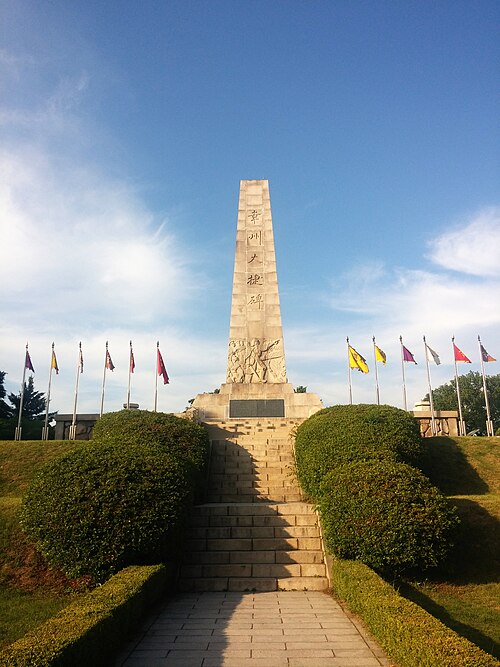
In the Republic of Korea the site became a national symbol. Haengju fortress was designated a Historic Site in 1963, the year a new monument was set up on the summit, and in 1970 the site was restored, with a shrine to Gwon Yul, Chungjangsa, and other buildings. Excavations since 2017 have shown that the hill had been fortified long before 1593: the first stone wall dates to the seventh century, and the earthen walls were built in the Goryeo period.
Haengju also has a place in international memory. The Revised Annals report that the Wanli Emperor sent an official with words of praise, saying that Gwon’s many kills showed that the Korean people could yet be roused. In English Wikipedia the battle appears above all as the hwacha’s most prominent success.
Advanced
Counting soldiers and dead: what the sources say
No figure for the defenders is certain. The compiled account in the Veritable Records says that Gwon split his 4,000 men in half, leaving one part under Seon Geo-i on the bank of the river at Yangcheon and taking 2,300 picked men to Haengju; the victory stele of 1602 also speaks of 2,300, and Samuel Hawley’s history follows this figure. The Revised Annals, compiled decades later, say that Gwon took 4,000 picked men across the river and sent Seon Geo-i with the rest of the army to Geumcheon. The Encyclopedia of Korean Culture says that Gwon detached 4,000 men under Seon and that the force at Haengju was “under 10,000”; its article on Cheoyeong gives 3,800. Wikipedia articles give still other figures: 2,800 (English, on Gwon Yul), 3,400 (English, on the hwacha) and about 9,000, including 6,000 militia (Korean, on the battle). Some figures count different groups, such as the detached force, monks, militia or civilians, but the records also disagree about the picked troops themselves, and the sources used here do not allow the totals to be reconciled.
For the attackers, Shin Gyeong-hui answered the king’s question with “no more than 30,000”, and the Revised Annals say “several tens of thousands”. Modern Korean accounts give over 30,000. Japanese Wikipedia lists the units by their mobilisation quotas and by a muster taken in Hanseong a few weeks later, and cites the Japanese historian Watanabe Tosui as estimating that no more than 10,000 actually attacked. The size of the hill limited how many could fight at once, so the number present and the number engaged may differ greatly.
Japanese losses are just as uncertain. The court records say that the defenders took 130 heads; the compiled account notes dozens of Japanese dead and over a hundred wounded in the course of three assaults; the Encyclopedia of Korean Culture adds that more than 200 bodies were left on the field besides those burned, and that Kikkawa’s division alone lost 160 dead. Japanese Wikipedia cites a report that a Japanese envoy later admitted about 400 dead. Later works give much larger totals: the Encyclopedia of Korean Culture’s article on Cheoyeong speaks of 24,000 casualties, and English Wikipedia’s article on Gwon Yul of over 10,000. The records give counts or estimates in the hundreds, but these do not establish the total number killed, because many bodies were burned or carried away; the much larger later estimates cannot be verified from the sources used here, and the number of wounded is unknown. Korean losses are not given in the sources used here; Shin told the king only that the dead had been buried, and that those with no one to bury them had been marked with wooden posts.
Even the shape of the battle varies. Modern accounts describe seven divisions, but the sources used here do not establish where this detail first comes from; Shin told the king that the Japanese advanced and fell back eight or nine times, the compiled account speaks of three advances and three retreats, and Jingbirok of three formations attacking in turn. The fighting lasted from mao (about 5–7 a.m.) to shen (3–5 p.m.) by Shin’s account, and to you (5–7 p.m.) in the other records.
Advanced
Sources and their problems
The earliest account is Shin Gyeong-hui’s oral report to King Seonjo, recorded in the Veritable Records under the 24th day of the 2nd month, twelve days after the battle. It is close to the events but brief and personal: Shin answers the king’s questions, praises Gwon’s leadership and uses the audience to complain about other officials. The same day’s entries include a longer compiled account of the battle (it quotes a letter from the 3rd month, so it was put together somewhat later), with the 2,300 men, the order of the Japanese advance, the weapons and the burning of the dead, and the king’s order to investigate the commanders who did not help.
The records do not agree on every detail. The Revised Annals and the Encyclopedia of Korean Culture credit the naval commander Yi Bin with bringing arrows; Shin told the king that the arrows were brought by Jeong Geol, whom he called the Chungcheong army commander (other records make him the Chungcheong naval commander), and that more than forty grain ships from Jeolla appeared off Yangcheon as the Japanese withdrew, which he saw as timely support. Yi Bin’s name is itself written with two different characters in the records (李蘋 and 李薲), and Jingbirok uses the second for a different officer, the border commander Yi Bin, who was then at Paju. Shin also said that many defenders were hit by Korean-style short arrows (pyeonjeon), and concluded that Koreans must have been fighting on the Japanese side.
Yu Seong-ryong’s Jingbirok, written after the war, gives a short and unheroic version: the soldiers were frightened and wanted to scatter, but with the river behind them they had to fight; the Japanese attacked in three formations and were beaten each time; and Gwon had the Japanese dead cut apart and hung in the trees to vent their anger. Many vivid details of modern accounts, such as the seven named divisions, the musketeers on platforms, the ash bags and the women with stones, are not in the court records or Jingbirok used here. They appear in modern accounts such as the Encyclopedia of Korean Culture, whose references include Nanjung japrok, a private record kept by a contemporary, and Yeollyeosil gisul, a much later compilation. The sources used here do not show where each detail comes from or whether it rests on eyewitness testimony, so these details are best read with caution. Even the lists of Japanese divisions differ between Korean and Japanese accounts.
Japanese sources are thinner. Japanese Wikipedia cites war diaries such as that of the Yoshimi family, which speaks of more than 30,000 men, and the army general staff’s history of the invasion, which says Japanese casualties were very heavy. These can be set beside the Korean records, but the sources used here do not allow their reliability to be judged in detail.
Advanced
How much did Haengju matter?
Korean tradition ranks Haengju with Hansan Island and Jinju as one of the three great victories of the war. The reasons are clear: a small Korean army, without Ming help, beat off the main Japanese force in the capital, led by its commander-in-chief, wounded several of Japan’s leading generals and did so a few weeks after the Ming defeat at Byeokjegwan had stalled the allied advance. The Ming commanders’ praise, recorded in the Revised Annals, shows that contemporaries saw it as a significant success, and the Encyclopedia of Korean Culture judges that the victory contributed greatly to Gwon’s appointment as commander-in-chief.
Contemporaries were also aware of how close it had been. At the audience with Shin Gyeong-hui, the minister Sim Hui-su called the victory “heaven’s luck”: the army had come close to destruction, the neighbouring commanders had not helped, and the Japanese did not come back the next day because, with Korean forces posted all around, they could not tell that the Ming army had already withdrawn. Gwon himself judged Haengju too exposed to hold and soon moved away.
Historians also differ on how much the battle contributed to the Japanese withdrawal from Hanseong two months later. Korean accounts see it, together with raids on Japanese foragers, as one of the pressures that made the capital untenable. Others put more weight on the Ming side: Kenneth Swope’s study of the war argues that the Ming intervention on land, above all the recapture of Pyongyang, turned the war. The decision to leave Hanseong itself was reached through the Ming–Japanese talks. Food shortages, disease and the burning of granaries also weighed on the Japanese, and the sources used here do not allow the effect of one battle to be separated from these.
What the sources agree on is narrower. On one day in March 1593, a Korean force of disputed size on a fortified hill, with the river behind it, held off repeated assaults by a much larger Japanese army, inflicted losses that the Japanese could not ignore and kept a Korean army in being close to the capital. Combined with the Ming presence in the north, the supply crisis and the negotiations, it was one of the conditions under which the Japanese gave up Hanseong in May 1593.
Key ideas
- Fighting with the river behind
- Haengju had the Han River at its back. The court records and Jingbirok say that with no way to run, the defenders had to fight to the end.
- Height and fortification
- A small army behind abatis, palisades and earth banks on a hill could hold off a much larger force: attackers had to come uphill in turns, and their musket fire was less effective.
- Many kinds of fighters
- Government troops from Jeolla, militia volunteers and Buddhist warrior monks fought together; the monks held one of the most dangerous sectors.
- Arrows, stones and gunpowder
- The records stress archery and stones as much as cannon and exploding shells; the hwacha is prominent in modern accounts but is not named in the court records used here.
- Supply by river
- Arrows brought by boat at the critical moment show how the Han River could help the defenders as well as trap them.
- A defensive victory
- Haengju stopped an attack but did not retake the capital; the Japanese left Hanseong two months later through negotiation, under pressure from many directions.
- Legend and record
- Popular stories, such as the women’s aprons, grew around the battle. Comparing early court records with later compilations shows which details are documented.
Records
- 1592 — 7th lunar month (August): Gwon Yul and Hwang Jin hold the Ichi pass on the road to Jeonju; Gwon becomes governor of Jeolla.
- 1593 — Around January (12th lunar month of 1592): Gwon leads about 10,000 men north and occupies Dokseong fortress near Suwon.
- 1593 — 8 February: the Ming and Joseon allies retake Pyongyang.
- 1593 — 27 February: the Ming army under Li Rusong is defeated near Byeokjegwan and falls back.
- 1593 — 14 March (12th day of the 2nd lunar month): Battle of Haengju.
- 1593 — 26 March (24th day of the 2nd lunar month): Shin Gyeong-hui reports the victory to King Seonjo.
- 1593 — 18 May (18th day of the 4th lunar month): the Japanese leave Hanseong after negotiations.
- 1593 — Gwon Yul becomes dowonsu, commander-in-chief of the Korean forces.
- 1599 — Gwon Yul dies.
- 1602 — Gwon’s officers and soldiers set up the Haengju victory stele, text by Choe Rip, calligraphy by Han Ho.
- 1963 — Haengju fortress is designated a Historic Site, and a new monument is set up on the summit.
- 1970 — The site is restored and the shrine Chungjangsa is built.
- 2006 — The linguist Jo Hang-beom shows that the word haengju-chima is older than the battle.
Glossary
- Haengjusanseong
- “Haengju mountain fortress”, the hill fort on Deogyangsan beside the Han River in today’s Goyang, where the battle was fought.
- Palisade and abatis
- A palisade (mokchaek) is a fence of stakes; abatis (nokgak, “deer antlers”) are rows of sharpened branches. Both slowed attackers so that defenders could shoot them.
- Hwacha
- A Joseon weapon cart carrying many guns or launchers for arrows or rockets, depending on the design; the version Byeon I-jung made in 1592 carried 40 seungja guns fired one after another.
- Jincheolloe
- A Joseon exploding shell, fired from a mortar or thrown, that burst after landing.
- Warrior monks (uiseunggun)
- Buddhist monks who took up arms during the Imjin War, many in answer to the call of Hyujeong; Cheoyeong led those at Haengju.
- Susa
- A provincial naval commander of Joseon, such as the Gyeonggi naval commander Yi Bin.
- Dowonsu
- Commander-in-chief of the Joseon army in wartime, the post Gwon Yul received after Haengju.
- Haengju-chima
- Korean for a kitchen apron. Popularly linked to the battle, but the word is older; its first part is an old word for a wiping cloth.
- Three great victories
- Hansan Island (1592), the first siege of Jinju (1592) and Haengju (1593), traditionally counted as the greatest Korean victories of the Imjin War.
- Lunisolar calendar
- The calendar Joseon used: months follow the moon, with an extra month added from time to time to keep in step with the solar year. Its dates must be converted to the Western (Gregorian) calendar.
Questions and answers
Did the women of Haengju win the battle with their aprons?
The story is popular, but the word haengju-chima is older than the battle, so the apron was not named after it. The court records of 1593 say the soldiers threw stones; they do not mention women carrying them.
How many soldiers fought?
Nobody knows exactly. The court records and the 1602 stele give Gwon 2,300 picked men at Haengju; other accounts give 3,800, 4,000 or “under 10,000”. The Japanese were reported at up to 30,000, though one Japanese historian thought no more than 10,000 actually attacked.
Why did the Japanese attack Haengju?
Gwon’s army was close to the Japanese-held capital and could threaten it, especially if the Ming army returned. The Japanese commanders wanted to destroy it with one blow while the Ming were away.
Why did Gwon Yul leave Haengju after winning?
He expected a new and stronger attack and judged the small hill fort too exposed. He moved north to a steeper fortress at Paju, which the Japanese later approached but did not attack.
Is the date 12 February or 14 March?
Both refer to the same day. The records give the 12th day of the 2nd month by the lunar calendar; converted to the Western calendar it is 14 March 1593. “12 February” mixes the lunar month with the Western calendar.
Did Haengju drive the Japanese out of Seoul?
Not by itself. The Japanese stayed in Hanseong for two more months and left in May 1593 after negotiations, under pressure from food shortages, disease, Korean raids and the Ming army. Haengju was one of those pressures.
Who were the monk soldiers?
Buddhist monks who took up arms when the master Hyujeong called on them. At Haengju they were led by his disciple Cheoyeong and guarded the north-west outwork, where the line almost broke.
Sources and further reading
- 이장희, 행주대첩 (幸州大捷). Encyclopedia of Korean Culture (Academy of Korean Studies)
- 권율 (權慄). Encyclopedia of Korean Culture (Academy of Korean Studies)
- 이종익, 처영 (處英). Encyclopedia of Korean Culture (Academy of Korean Studies)
- 고양 행주산성 (高陽 幸州山城). Encyclopedia of Korean Culture (Academy of Korean Studies)
- 행주대첩비 <구비> (幸州大捷碑 <舊碑>). Encyclopedia of Korean Culture (Academy of Korean Studies)
- 화차 (火車). Encyclopedia of Korean Culture (Academy of Korean Studies)
- 벽제관 전투 (碧蹄館戰鬪). Encyclopedia of Korean Culture (Academy of Korean Studies)
- 이장희, 임진왜란 (壬辰倭亂). Encyclopedia of Korean Culture (Academy of Korean Studies)
- Veritable Records of King Seonjo (선조실록), vol. 35, 24th day of the 2nd month of the 26th year of Seonjo (1593), entry 1: Shin Gyeong-hui reports Gwon Yul’s victory at Haengju and is questioned by the king. Annals of the Joseon Dynasty database, National Institute of Korean History
- Veritable Records of King Seonjo (선조실록), vol. 35, 24th day of the 2nd month of 1593, entry 2: order to investigate the commanders who did not relieve Gwon Yul. Annals of the Joseon Dynasty database, National Institute of Korean History
- Veritable Records of King Seonjo (선조실록), vol. 35, 24th day of the 2nd month of 1593, entry 6: account of the commanders’ advance after the recapture of Pyongyang and of the great victory at Haengju. Annals of the Joseon Dynasty database, National Institute of Korean History
- Revised Annals of King Seonjo (선조수정실록), vol. 27, 1st day of the 2nd month of the 26th year of Seonjo (1593), entry 8: Jeolla inspector Gwon Yul defeats the enemy at Haengju. Annals of the Joseon Dynasty database, National Institute of Korean History
- Revised Annals of King Seonjo (선조수정실록), vol. 27, 1st day of the 2nd month of 1593, entry 9: Gwon Yul raised to jaheon rank; Jo Gyeong and others rewarded. Annals of the Joseon Dynasty database, National Institute of Korean History
- Revised Annals of King Seonjo (선조수정실록), vol. 27, 1st day of the 2nd month of 1593, entry 10: Korean forces harass the weakened enemy, but the Ming commander declines to attack. Annals of the Joseon Dynasty database, National Institute of Korean History
- Revised Annals of King Seonjo (선조수정실록), vol. 27, 1st day of the 2nd month of 1593, entry 12: recruiting commissioner Byeon I-jung is defeated attacking the enemy camp at Juksan. Annals of the Joseon Dynasty database, National Institute of Korean History
- Veritable Records of King Sukjong (숙종실록), vol. 52, 25th day of the 12th month of the 38th year of Sukjong (1712), entry 1: appointments; Gwon Yul’s posthumous name changed to Chungjang. Annals of the Joseon Dynasty database, National Institute of Korean History
- Yu Seong-ryong (柳成龍), 懲毖錄 (Jingbirok), vol. 2 (classical Chinese text). Wikisource
- 조항범 (Jo Hang-beom), 잘못 알고 있는 어원 몇 가지(7) (Some mistaken etymologies, 7), Saegugeo saenghwal 16(3). National Institute of Korean Language, 2006
- Battle of Haengju. Wikipedia
- 행주대첩. Wikipedia (Korean)
- 幸州山城の戦い. Wikipedia (Japanese)
- Kwŏn Yul (general). Wikipedia
- 권율. Wikipedia (Korean)
- 고양 행주산성. Wikipedia (Korean)
- Hwacha. Wikipedia
- Battle of Byeokjegwan. Wikipedia
- Samuel Hawley, The Imjin War: Japan’s Sixteenth-Century Invasion of Korea and Attempt to Conquer China. Royal Asiatic Society, Korea Branch; Institute of East Asian Studies, University of California, Berkeley, 2005
- Kenneth M. Swope, A Dragon’s Head and a Serpent’s Tail: Ming China and the First Great East Asian War, 1592–1598. University of Oklahoma Press, 2009
- 음양력 변환 계산 (Lunar–solar calendar conversion). Korea Astronomy and Space Science Institute
- Battle of Sisak. Wikipedia
- Henry IV of France. Wikipedia
- Christopher Marlowe. Wikipedia
- Venus and Adonis (Shakespeare poem). Wikipedia
- Toyotomi Hideyori. Wikipedia
Related
Written with AI assistance from the published sources listed above, and revised as new research appears.